How Therapies Support Child Growth at Dr. Habib’s Foster CDC
Therapies
That Nurture Growth: A Detailed Guide to Child Development & Early
Intervention at Dr. Habib’s Foster CDC
Every child is born with their own strengths,
talents, and unique way of exploring the world. While many children reach
developmental milestones on time, some need additional guidance and support to
learn skills such as speaking, walking, interacting socially, focusing, or
coping with emotions.
This is not a problem it simply means they
need specialized care to help them reach their fullest potential.
This is where Dr. Habib’s Foster CDC – ChildDevelopment Centre in Hyderabad makes a life-changing difference. With
expert-led therapies and child-centered intervention programs, this centre
helps children:
- Communicate with clarity
- Learn and understand better
- Improve motor skills
- Manage emotions and behavior
- Become independent in everyday tasks
- Develop confidence and social skills
This comprehensive guide
explains each therapy in detail and helps parents understand how early
support can shape a child’s development in the most positive ways.
Why Early Intervention Matters So
Much
The early years of life are a period of
extraordinary brain growth. During this time, the brain creates millions of
neural connections every second. Any delays or difficulties appearing during
this phase—whether related to speech, behavior, learning, or motor skills—must
be addressed quickly.
Early intervention ensures that children receive
support at a time when their brain is most adaptable and ready to learn. With
the right guidance, children experience faster improvement and stronger
long-term development.
Benefits of Early Intervention:
The early years of a child’s life are the most
crucial for growth and development. During this period, the brain is rapidly
forming connections, absorbing information, and learning new skills faster than
at any other stage of life. Because of this, challenges in areas such as
speech, movement, social interaction, or behavior must be addressed early. When
therapy begins during these early stages, children have a much higher chance of
improving quickly and effectively. Below is a detailed explanation of why early
intervention is so important.
Improved
Communication Skills
Early therapy helps children express
their needs, feelings, and ideas clearly. They learn how to understand
language, respond correctly, and use appropriate gestures. This prevents
frustration and builds social confidence.
Stronger
Thinking & Learning Abilities
Children begin to develop better
memory, attention, reasoning, and problem-solving skills. A strong cognitive
foundation makes classroom learning smoother and more enjoyable later.
Better
Motor Skills (Fine & Gross)
Whether it is writing, buttoning
clothes, jumping, balancing, or running—motor skills are vital for everyday
life. Early therapy strengthens muscles, coordination, and body awareness,
making children more independent and active.
Reduced
Behavioral and Emotional Challenges
Early intervention teaches children
how to understand feelings, cope with frustration, reduce tantrums, and follow
routines. It helps them feel calmer, happier, and more secure emotionally.
Improved
Social Interaction
Children learn vital social skills
like sharing, eye contact, turn-taking, and responding appropriately. This
makes it easier for them to form friendships and participate in group
activities.
Better
School Readiness
With improved attention, communication,
behavior, and motor skills, children enter school with confidence. They adapt
easily to classroom routines and learning expectations.
Empowered
Parents & Stronger Family Support
Parents learn strategies to support
their child at home. They gain clarity, confidence, and practical guidance,
making parenting easier and more joyful.
Timely
Detection of Delays
Spotting developmental challenges
early prevents them from turning into bigger problems later. Early detection
leads to early correction.
1. Speech Therapy – Helping Children
Express Themselves Clearly
Speech therapy focuses on improving a child’s
ability to talk, understand language, express thoughts, and communicate
socially.
When Does a Child Need Speech
Therapy?
A child may need help if they:
- Are not speaking age-appropriate words
- Speak unclearly or form unclear sounds
- Cannot form sentences
- Stutter or repeat sounds
- Have difficulty understanding instructions
- Have limited vocabulary
- Struggle with social communication (eye
contact, interaction)
- Have feeding or swallowing difficulty
How Speech Therapy Helps Your Child
At Foster CDC, trained speech-language pathologists
use engaging activities such as:
- Picture-based communication
- Games and stories
- Repetition exercises
- Vocabulary-building techniques
- Social communication tasks
- Speech sound correction exercises
Through these sessions, children learn:
- To produce clear speech sounds
- To form grammatically correct sentences
- To use words confidently
- To follow and understand instructions
- To engage in conversations
- To improve eye contact and social response
For children facing feeding challenges, therapists
also work on strengthening oral muscles.
Overall, speech therapy helps
children express themselves confidently and communicate better at home and
school.
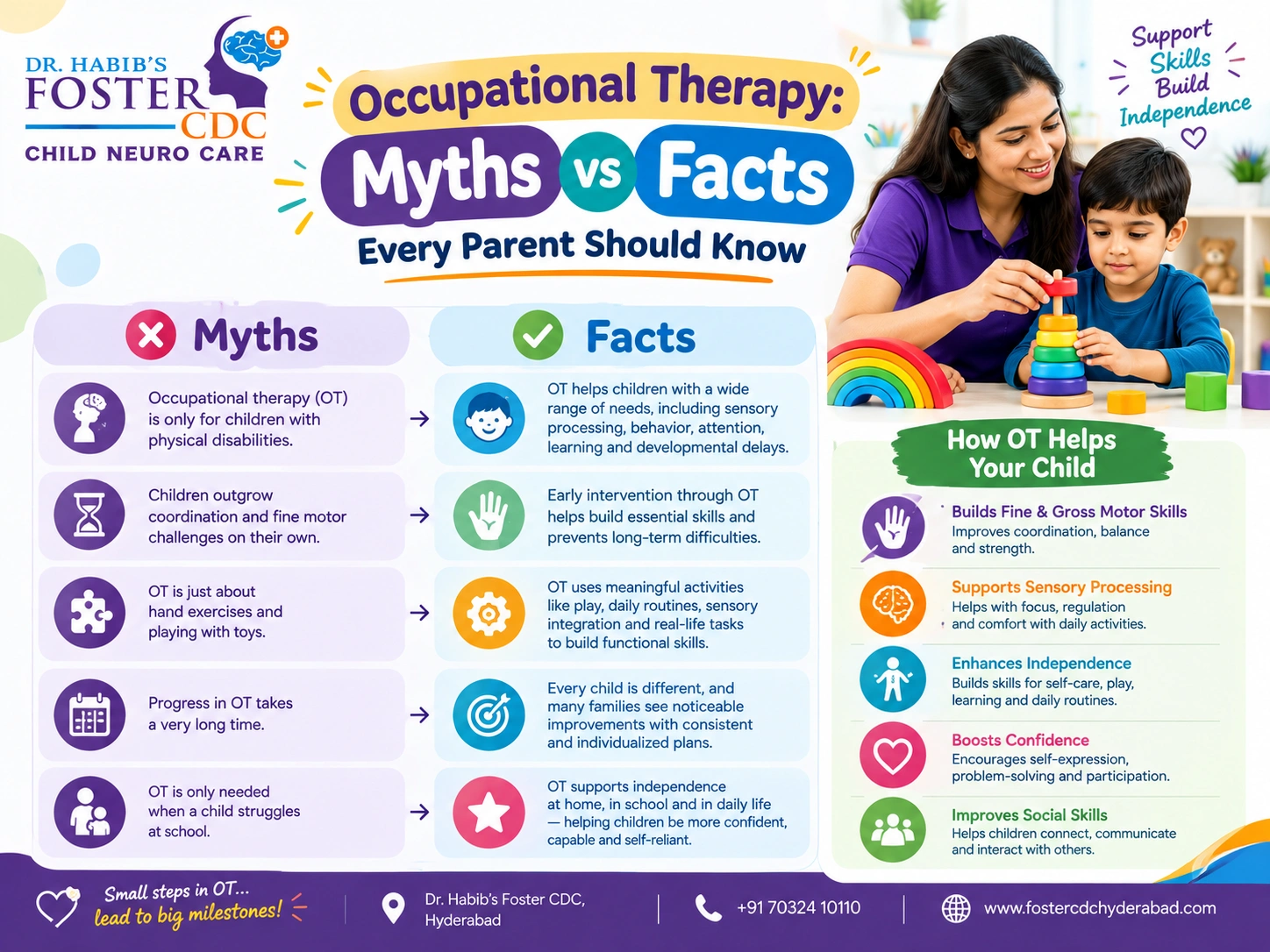
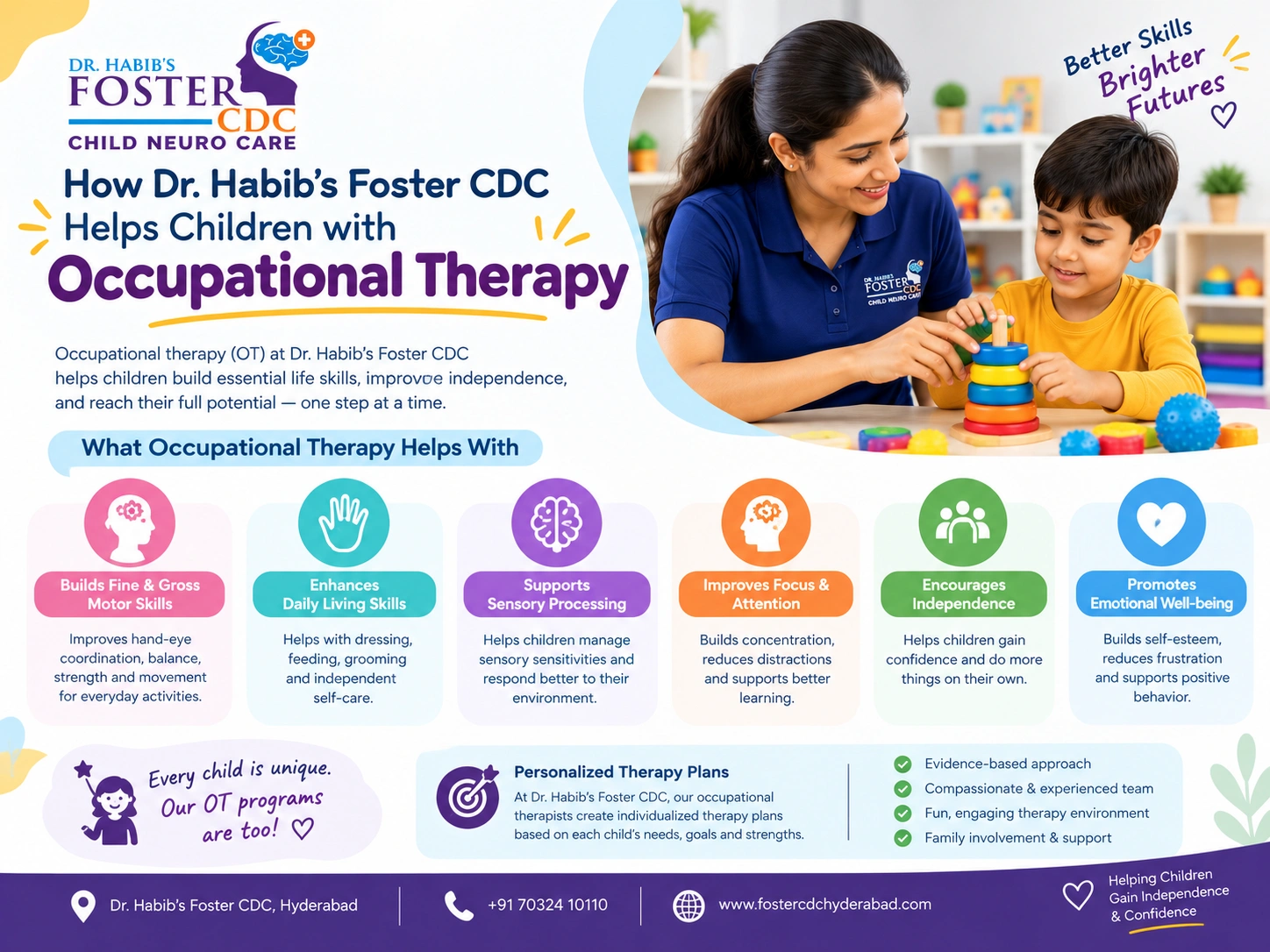
2. Occupational Therapy – Building
Independence Through Everyday Skills
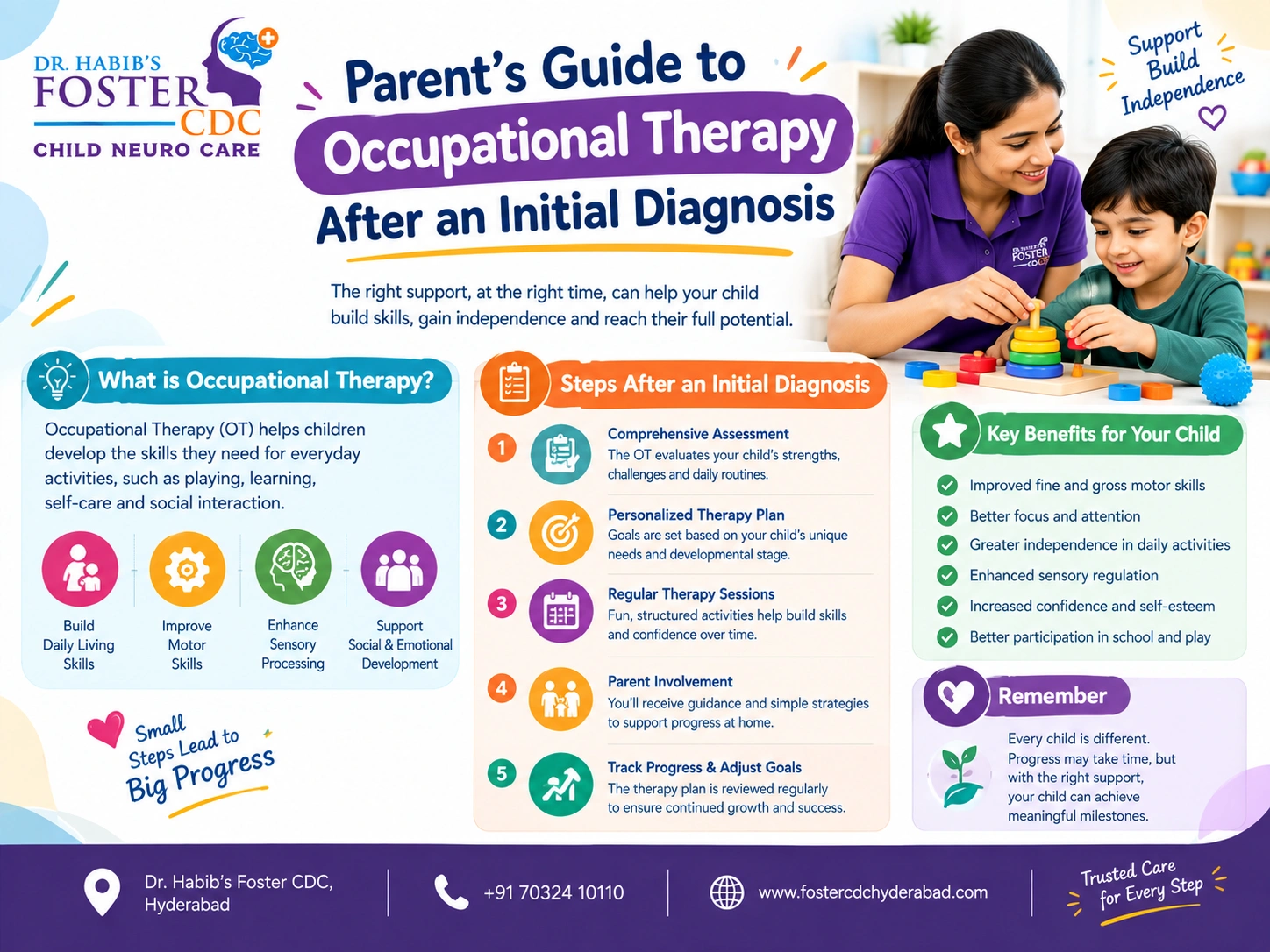
Occupational therapy (OT) helps children gain the
skills they need for daily living, learning, and playing.
Who Needs Occupational Therapy?
Children may benefit from OT if they have:
- Delayed fine motor skills (buttoning, writing,
cutting)
- Difficulty holding a pencil properly
- Sensory issues (too sensitive or
under-sensitive to touch, sound, textures)
- Poor coordination and balance
- Trouble with dressing, eating, or self-care
- Difficulty sitting still or paying attention
- Autism-related sensory and motor challenges
How Occupational Therapy Helps
Occupational therapists at Foster CDC use play-based,
sensory-rich activities to improve:
- Fine motor skills – Writing, drawing, picking up small objects
- Gross motor skills – Jumping, balancing, climbing
- Coordination & planning – Completing step-by-step tasks
- Sensory processing – Managing textures, sounds, lights
- Attention, focus & classroom readiness
- Self-help skills – Eating, dressing, brushing
Children learn in a fun way by using:
- Sensory tools (swings, balance boards,
textures)
- Hand exercises
- Motor skill games
- Task-based activities
- Writing and pre-writing programs
OT helps children become more independent,
confident, and capable in their everyday routines.
3. Behavioral Therapy – Guiding
Emotional & Social Development
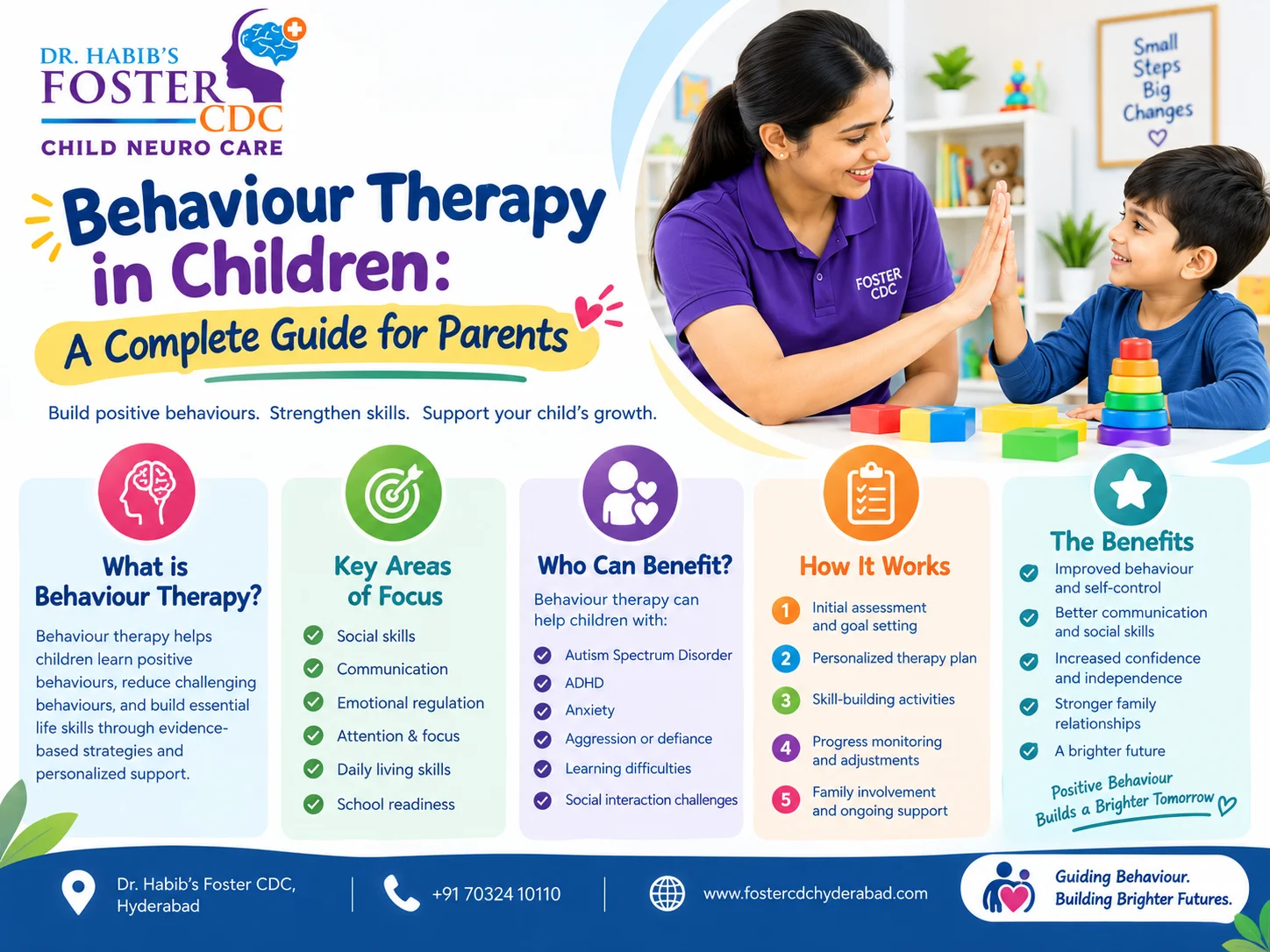
Behavioral therapy addresses emotional, social, and
behavioral challenges that affect a child’s daily life.
Signs Your Child May Need Behavioral
Therapy
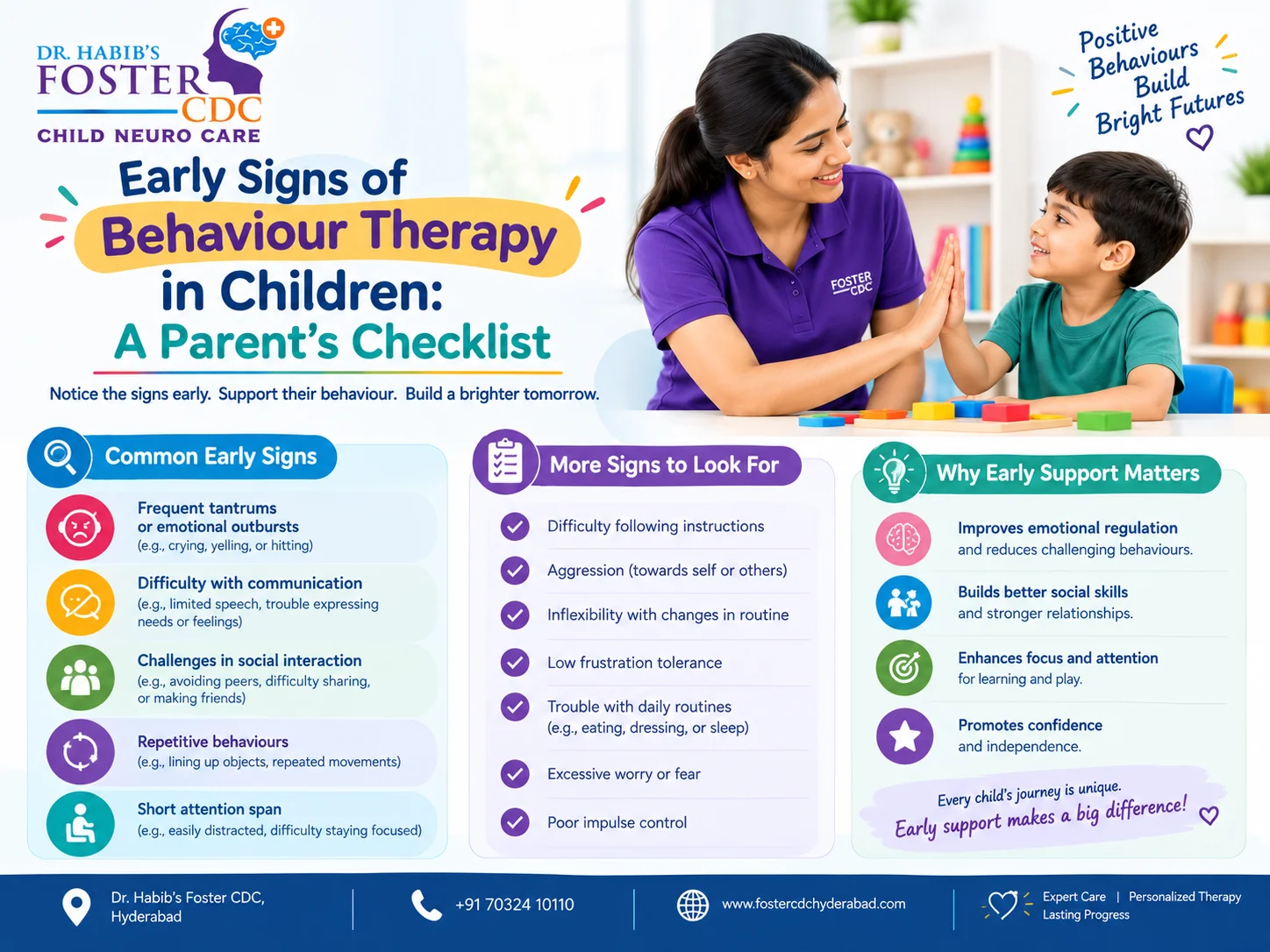
A child may benefit from behavioral therapy if
they:
- Have frequent tantrums
- Find it hard to follow instructions
- Are hyperactive or impulsive
- Have difficulty adjusting to changes
- Struggle to socialize or play with other
children
- Show anxiety, fear, or withdrawal
- Experience difficulty focusing on tasks
How Behavioral Therapy Helps
Foster CDC uses structured, evidence-based
approaches such as:
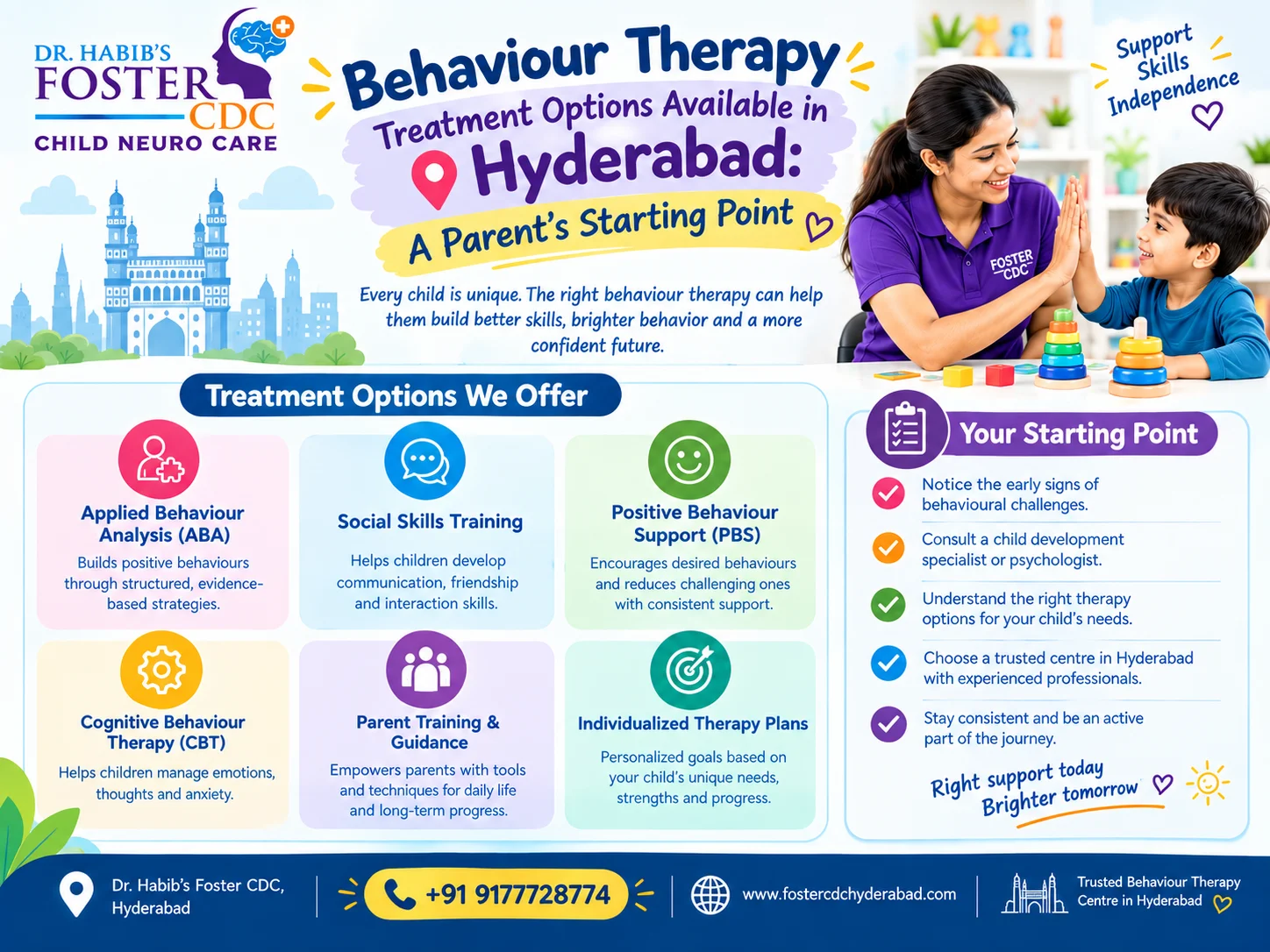
- Applied Behavior Analysis (ABA)
- Positive reinforcement
- Social skills training
- Emotion-regulation techniques
- Routine building and behavior-modification
plans
Children learn:
- To stay calm and manage emotions
- To follow rules and daily routines
- To reduce unwanted or harmful behaviors
- To develop patience and attention
- To communicate needs instead of crying or
shouting
- To build healthy relationships with others
Parents are also guided on how to apply the same
strategies at home so that progress continues consistently.
4. Early Intervention Programs –
Building the Foundation for Life
Early intervention is designed for children
between 0–6 years who show early signs of developmental
delays.
Why Early Intervention Is Essential
- Early brain development is extremely flexible
- Children learn faster during early childhood
- Many issues can be corrected or reduced if
addressed early
- Helps children catch up with developmental
milestones
- Supports smoother schooling later
What Early Intervention Includes at
Foster CDC
- Developmental assessments
- Sensory integration activities
- Early speech and language development
- Motor skill strengthening
- Play-based learning
- Building early social skills
- Parent training and home-based programs
This program creates a strong foundation in communication,
movement, learning, behavior, and social interaction.
5. Special Education – Helping
Children Learn at Their Own Pace
Special education helps children who struggle
academically due to developmental, neurological, or behavioral differences.
Who Needs Special Education?
Children diagnosed with:
- Learning disabilities (dyslexia, dyscalculia,
dysgraphia)
- ADHD
- Autism spectrum disorder
- Developmental delay
Other Blogs
Services
- Behavioural Therapy
- Speech Therapy
- Special Education
- Parent Training
- Psychotherapy & Counselling
- Yoga Therapy
- Postural & Mobility Therapy
- Early Intervention Services
- Cognitive Behavioural Therapy
- Occupational Therapy
- Group Teaching
- Teachers' Training
- Certified Courses
- Developmental Therapy
- Autism Therapy