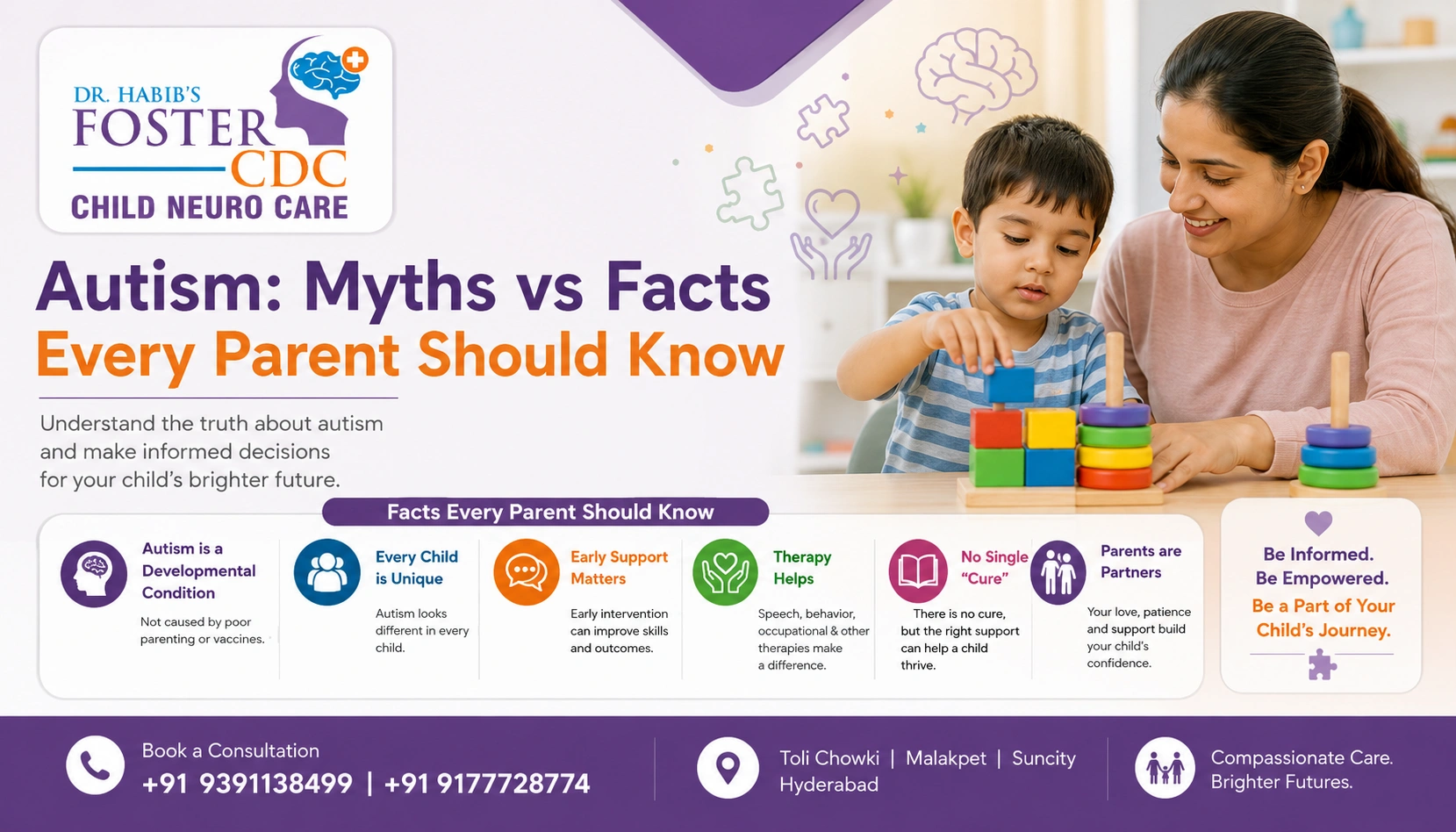
Autism: Myths vs Facts Every Parent Should Know
If you've already spent time researching autism symptoms in children, spoken with a pediatrician, or started therapy, you've probably also run into a lot of conflicting information — well-meaning relatives, social media posts, and outdated articles that don't reflect what's actually known about autism today. This guide separates the myths from the facts, so you can make decisions based on evidence, not noise. At Dr. Habib's Foster CDC, guided by Dr. Habib G Pathan, Developmental Pediatrician, we hear these myths from parents almost every week — often from families who are already partway through their child's therapy journey. This guide reflects that clinical experience, but it isn't a substitute for a professional evaluation.
Is autism caused by bad parenting?
No. This myth has been thoroughly disproven. Autism is a neurodevelopmental condition linked to genetic and biological factors — not parenting style, discipline, or emotional neglect.
Do vaccines cause autism?
No. Extensive research across large populations has found no link between vaccines and autism. This claim originated from a study that was later retracted and discredited.
Can autistic children live independent lives?
Many autistic individuals live independently, hold jobs, and build meaningful relationships, especially with early support. Independence levels vary widely across the spectrum.
Is autism the same as intellectual disability?
No. While some autistic children also have intellectual disabilities, many have average or above-average intelligence. Autism affects communication and social processing, not intelligence itself.
Does every autistic child need the same amount of therapy?
No. Therapy needs vary significantly based on each child's specific profile — some need intensive, daily support, while others need lighter, targeted sessions.
Can a child "grow out of" autism?
No, autism is lifelong. However, with therapy, many children develop stronger communication, social, and coping skills over time, and support needs can change significantly.
Why Myths About Autism Persist
Misinformation about autism spreads for a few common reasons: outdated media coverage, anecdotal stories shared without context, and a general lack of public understanding about neurodevelopmental conditions. For parents already managing an autism diagnosis in Hyderabad, these myths can create unnecessary guilt, delay appropriate care, or lead families toward unproven treatments instead of evidence-based ones.
Myths vs Facts: Causes and Diagnosis
Myths vs Facts: Symptoms and Presentation
Myths vs Facts: Treatment and Therapy
Myths vs Facts: Social and Everyday Life
Common Mistakes Parents Make When Believing Myths
Delaying professional evaluation due to fear of a "label"
Trying unproven remedies instead of evidence-based therapy
Feeling guilt over parenting choices that have no connection to autism's cause
Assuming therapy progress should be linear and constant
Comparing their child's journey to another child's, rather than tracking individual progress
Expert Tips for Navigating Misinformation
Rely on developmental pediatricians and licensed therapists over social media claims
Ask your therapy team to explain the evidence behind recommended approaches
Revisit outdated assumptions periodically — autism research and best practices continue to evolve
Connect with other parents at your child's therapy centre for grounded, real-world perspective
When in doubt, ask directly rather than assuming a myth is true
Key Takeaways
Many long-standing beliefs about autism — including its causes, symptoms, and treatment — are myths not supported by evidence.
Vaccines and parenting style do not cause autism; genetic and neurological factors are the primary known contributors.
Autism is lifelong, but therapy can meaningfully improve communication, social skills, and independence.
Recognizing autism symptoms in children early and seeking a proper autism diagnosis in Hyderabad leads to better-targeted support.
If you're comparing options, our guide on challenges in autism treatment and best way to manage autism can help you plan next steps.
Frequently Asked Questions
1. Do vaccines cause autism? No. Multiple large-scale studies across different countries have found no link between vaccines and autism. The original claim came from a study that was later retracted due to serious methodological flaws.
2. Is autism caused by parenting style? No. Autism is a neurodevelopmental condition linked to genetic and biological factors. Parenting style, discipline approach, or emotional bonding do not cause autism.
3. Can autistic children go to regular schools? Many autistic children attend mainstream schools, sometimes with additional support like individualized education plans, while others benefit from specialized educational settings depending on their needs.
4. Is it true that autistic people lack empathy? No. Autistic individuals often feel empathy deeply but may express or process it differently than neurotypical individuals, which can be misinterpreted as a lack of empathy.
5. Can autism be detected through a blood test? No single blood test can diagnose autism. Diagnosis relies on developmental screening, behavioral observation, and standardized clinical assessment tools.
6. Do all autistic children need medication? Not necessarily. Medication isn't a standard part of every autism treatment plan; it's typically considered only for specific co-occurring conditions like anxiety or sleep difficulties, under medical guidance.
7. Is autism becoming more common, or are we just diagnosing it more? Both improved awareness and broader diagnostic criteria have contributed to increased identification, though researchers continue studying the full picture behind rising diagnosis rates.
8. Can adults be diagnosed with autism for the first time? Yes. Some individuals aren't diagnosed until adulthood, particularly if their symptoms were subtle or masked during childhood.
9. Does autism affect intelligence? Not inherently. Autism affects communication and social processing; intelligence levels among autistic individuals vary just as widely as in the general population.
10. Is it too late to seek therapy if my child is already school-age? No. While early intervention shows strong results, therapy can still meaningfully help school-age children and even teens build communication, social, and coping skills.
Conclusion
Misinformation about autism can shape decisions in ways that aren't always in a child's best interest — from delaying evaluation to pursuing unproven remedies instead of effective therapy. Understanding what's actually supported by evidence, versus what's simply repeated often, helps parents make clearer, more confident choices for their child's care.
If you're navigating an autism diagnosis in Hyderabad or reassessing your child's current treatment plan, book an assessment with Dr. Habib's Foster CDC and get guidance grounded in clinical evidence, not myths.
This article is for informational purposes only and is not a substitute for professional medical evaluation. Please consult a qualified developmental pediatrician for concerns about your child's development. For further reading, see resources from the World Health Organization (WHO), the American Academy of Pediatrics (AAP), and the American Speech-Language-Hearing Association (ASHA).
Other Blogs


Services
- Behavioural Therapy
- Speech Therapy
- Special Education
- Parent Training
- Psychotherapy & Counselling
- Yoga Therapy
- Postural & Mobility Therapy
- Early Intervention Services
- Cognitive Behavioural Therapy
- Occupational Therapy
- Group Teaching
- Teachers' Training
- Certified Courses
- Developmental Therapy
- Autism Therapy