
Early Signs a Child Needs Early Intervention: A Parent's Checklist for Deciding When to Start
Last updated: November 2026
Start early intervention as soon as you notice a lost skill, a hearing or vision concern, seizures, or a pattern of delay across more than one area. You do not need a diagnosis first. For a single late skill, write it down, recheck in a few weeks, and ask for developmental screening at the next check-up.
Most parents do not wake up one morning sure that their child needs early intervention. It arrives as a string of small moments: a name that gets no response, a word that used to be there and is not, a cousin who is already running while your child still crawls.
The hard part is not finding a list of signs. It is knowing what to do with them: start now, book an assessment, or wait and watch. This checklist is built around that decision. If you want an area-by-area milestone list, use our early signs of developmental delay checklist. If your child already has a diagnosis, jump to the section written for you.
What Does "Early" Mean?
Early intervention is support for young children who are delayed or at risk of delay. On our site, it is described for children from birth to 6 years, and India's national RBSK program sets up District Early Intervention Centres at district hospitals for the same age range.
It starts when a concern appears, not when a label arrives. The Indian Academy of Pediatrics (IAP) guideline on developmental delay advises starting multidisciplinary intervention soon after a delay is recognised, instead of waiting for a formal diagnosis. The American Speech-Language-Hearing Association (ASHA) notes that the earlier a possible delay or disorder is addressed, the better.
The Checklist: Three Decisions
Decision 1: Act Now (This Week)
See a doctor or book an assessment promptly if you notice any of these. Do not wait for the next routine visit.
- Loss of a skill your child previously had, such as words, babbling or social engagement
- No response to sounds, or any concern about hearing or vision
- Seizures, repeated staring spells or sudden jerks
- A sudden change in alertness, feeding or sleep
- A strong, lasting feeling that something is wrong. The American Academy of Pediatrics (AAP) treats a parent's concern as part of developmental surveillance, so it is a valid reason to ask
Decision 2: Book an Assessment This Month
These are patterns, not single moments. Any one of them is reason enough to ask for an assessment.
- Behind in more than one area, such as talking and playing, or moving and learning
- A gap that widens over two to three months, or a skill that stalls after steady progress
- Little back-and-forth with people, such as limited eye contact, pointing, showing things or sharing enjoyment. Our early signs of autism checklist covers these in detail
- Ongoing difficulty with feeding, sleeping or calming that affects the family's routines
- The same concern raised independently by a teacher, doctor, therapist or grandparent
- A start that was early or complicated, such as premature birth, and your child now seems behind
Decision 3: Watch, Log and Recheck
Some situations are reasonable to watch for a short, defined time:
- One late skill, with progress in other areas
- A child who is slow to talk but understands, points and plays well
- A skill that is slow but steadily improving
Watching only works if it has an end date. So:
- Write down what you see, with dates
- Set a recheck date about four to six weeks away
- Ask your pediatrician to do structured developmental screening at the next visit. The AAP recommends standardized developmental screening at 9, 18 and 30 months, and autism-specific screening at 18 and 24 months
- Move up to Decision 2 if the recheck shows no progress or a new concern
Histories Worth Mentioning to Your Doctor
Some histories are recognised causes of developmental delay. Mention them at every visit, and ask whether closer developmental follow-up makes sense:
- Premature birth or low birth weight
- Complications around birth
- Infections affecting the brain, or seizures
- A known genetic condition
- Known hearing or vision problems
The IAP guideline lists causes like these and also recommends hearing and vision screening in every child with suspected delay, because untreated problems can look like delay or make it worse.
If Your Child Already Has a Diagnosis
A diagnosis answers what. Early intervention answers what now. The same principle applies: begin soon after the delay is recognised, and do not hold off for further tests or a final label.
- Ask for a baseline and written goals. They show where you are starting and how progress will be measured.
- Ask which therapies fit the areas that are delayed.
- Ask when the first review will be.
For what to do in the weeks after a diagnosis, see our guide to developmental delay after diagnosis. If autism is part of the picture, read our parent's guide to autism after an initial diagnosis. The IAP guideline also recommends autism screening at 18 to 24 months, repeated at 3 years if the first screen is negative.
What to Do This Week
- Write it down. What you saw, where, how often and since when. Short, dated notes help any professional.
- Check hearing and vision. Both are quick, and both are easy to overlook.
- Book an assessment. You do not need a referral or a diagnosis to ask.
- Start simple routines at home. Talk through the day, play on the floor and take turns. The World Health Organization's 2020 guideline on early childhood development recommends supporting responsive caregiving and early learning.
Choosing an Early Intervention Centre in Hyderabad
Families in Hyderabad commonly use more than one route: government early intervention services, hospital clinics for medical work-up, and child development centres for regular therapy. Our guide to developmental delay treatment in Hyderabad explains each route.
Whichever you consider, check three things:
- Who assesses and leads. Is a doctor with developmental training involved?
- How goals are written and reviewed. Are they specific, and is there a review date?
- How parents are trained. Will you be shown what to practise at home?
For what the therapies and the process look like, read our post on early intervention therapy in Hyderabad.
How Foster CDC Can Help
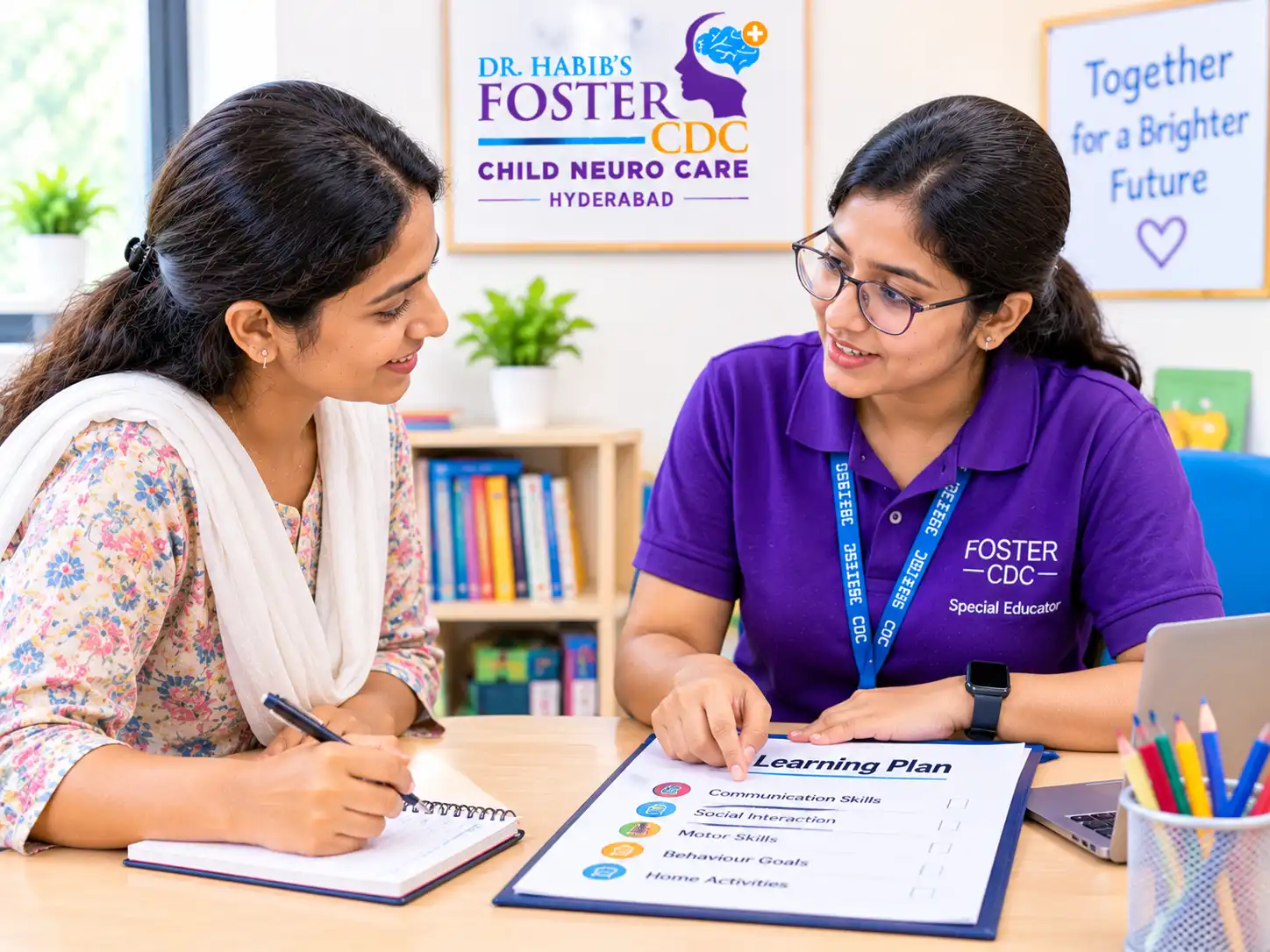
According to our special education page, early intervention programs at Foster CDC help babies and toddlers with skills such as walking, talking and play, and the team trains caregivers and families to support their child and to manage challenging behaviour. Our developmental therapy page says developmental therapy can begin in infancy, and that the assessment uses a standardized tool across social, personal, adaptive, communication, motor and cognitive skills to set a baseline for measuring progress. See our early intervention services page for what is offered, and our article on how Foster CDC helps children with developmental delay for how the process works.
We have centres at Toli Chowki, Malakpet and Suncity in Hyderabad. Our centres page has the details.
If you would like an individual assessment, book an appointment with Dr. Habib's Foster CDC. You can also call +91 9391138499.
Final Thoughts
You do not have to be certain to ask for help. A worry that has an end date, a written note and a recheck is a plan. A worry that just sits is not. Whatever you decide, decide it in a way that has a next step.
Frequently Asked Questions
When should a child start early intervention?
As soon as a concern appears. Start now if there is a lost skill, a hearing or vision concern, seizures, or a pattern of delay across more than one area. For one late skill, recheck in a few weeks.
Do I need a diagnosis before starting?
No. The IAP guideline advises starting intervention soon after a delay is recognised, without waiting for a formal diagnosis.
Is early intervention only for autism?
No. It supports children with delays in speech, movement, learning, social skills and behaviour, with or without autism.
What ages does early intervention cover?
On our site it is described for children from birth to 6 years, and India's RBSK program uses the same age range for District Early Intervention Centres. Support remains useful after that age too.
What if my doctor says to wait and see?
Ask for a specific recheck date and for structured developmental screening. If you remain worried, you can ask for an assessment at a child development centre.
Can I start while I wait for an appointment?
Yes. Talk, play and take turns every day, and check hearing and vision. These are safe, useful steps while you wait.
Which doctor should I see first?
Your pediatrician is a good starting point. A developmental pediatrician can assess the whole picture and coordinate speech, occupational and behaviour therapy.
Where can I get an early intervention assessment in Hyderabad?
Options include government early intervention services, hospital clinics, and child development centres. Dr. Habib's Foster CDC offers assessment at its centres in Toli Chowki, Malakpet and Suncity.
Other Blogs









Services
- Behavioural Therapy
- Speech Therapy
- Special Education
- Parent Training
- Psychotherapy & Counselling
- Yoga Therapy
- Postural & Mobility Therapy
- Early Intervention Services
- Cognitive Behavioural Therapy
- Occupational Therapy
- Group Teaching
- Teachers' Training
- Certified Courses
- Developmental Therapy
- Autism Therapy