How Dr. Habib's Foster CDC Helps Children with Developmental Delay: What to Expect, Step by Step
By Dr. Habib G Pathan, Developmental Pediatrician, Dr. Habib's Foster CDC, Hyderabad Last updated: October 2026
Quick answer: Dr. Habib's Foster CDC is a child development centre in Hyderabad where developmental care involves a developmental pediatrician working with speech, occupational, behavioural and other therapists. Each child is assessed with a standardized tool to set a baseline, goals are agreed with the family, and progress is reviewed against that starting point.
If you are comparing centres for a child with developmental delay, you have probably noticed that most websites sound alike. Everyone says "individualised", "holistic" and "expert." What you actually need is a way to picture what will happen to your child at the first visit, in the first month, and when the first review comes around.
So this page works a little differently. It explains how we work at Dr. Habib's Foster CDC, then gives you the questions to ask any centre, including us. If our answers don't satisfy you, that is useful information too.
First, a Quick Definition
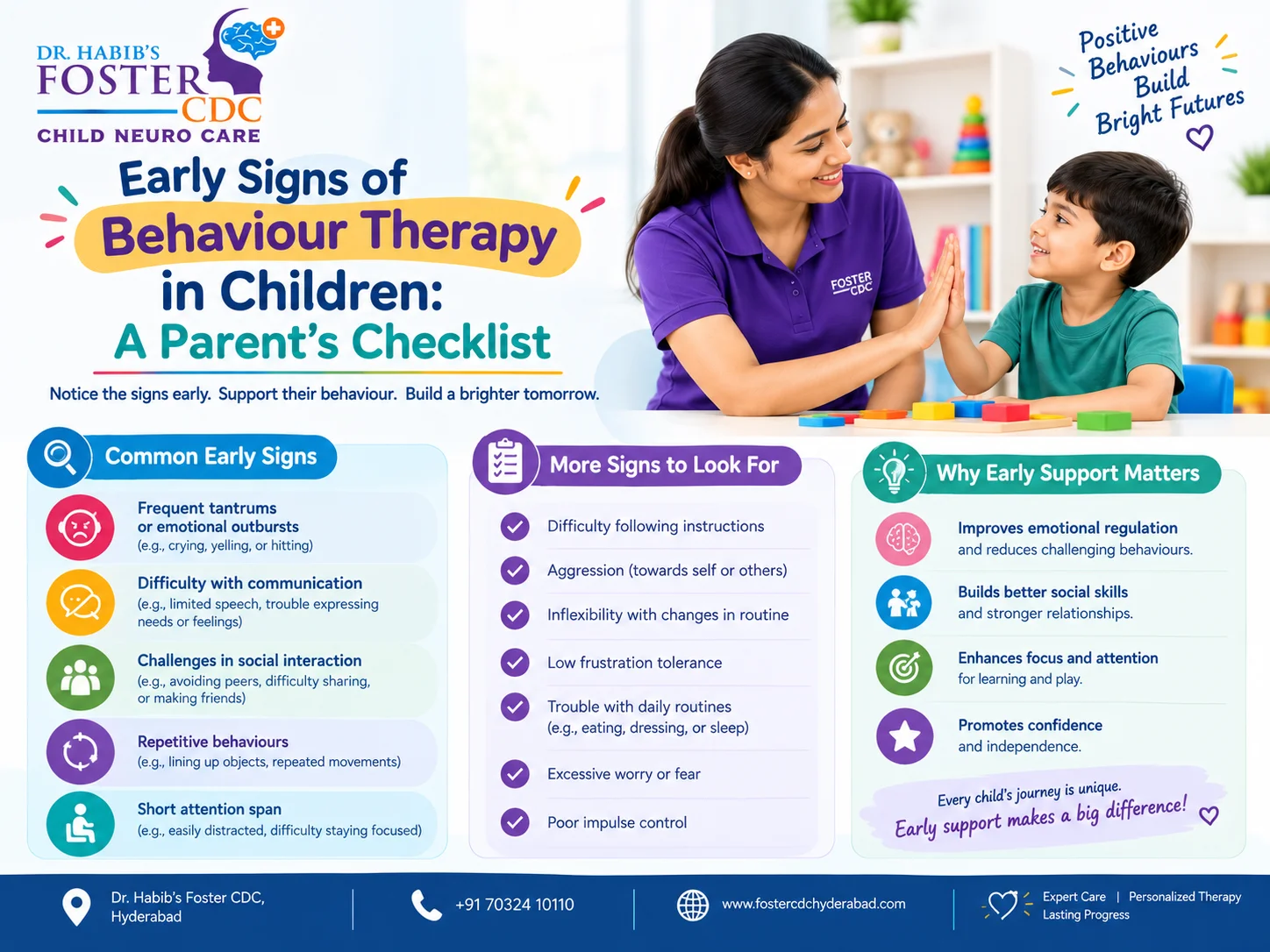
Developmental delay means a child is reaching milestones such as sitting, walking, talking or playing later than most children of the same age, in one area or several. If you want the full picture of signs, causes and tests, read our guide to developmental delay in children. If you are still wondering whether your child's pattern is worth checking, our early signs checklist is a calmer place to start. The American Speech-Language-Hearing Association (ASHA) makes a helpful point here: milestone checklists support monitoring, but they are not tools for diagnosing a child or planning care. That is the job of an assessment.
You do not have to wait for a diagnosis before asking for an assessment. The Indian Academy of Pediatrics (IAP) advises that early intervention begin soon after a delay is recognised, instead of waiting for a formal label, and the American Academy of Pediatrics (AAP) says a developmental concern at a check-up should lead to screening or a direct referral to early intervention.
What Happens at Foster CDC: From First Call to First Review
1. Booking the visit
You can book through our appointment page or by calling the number on our site. Bring any records you have: birth or discharge summaries, earlier assessments, blood or scan reports, and notes from a nursery or school. If your child is nervous about new places, our guide to preparing your child for the first therapy session helps.
2. The assessment
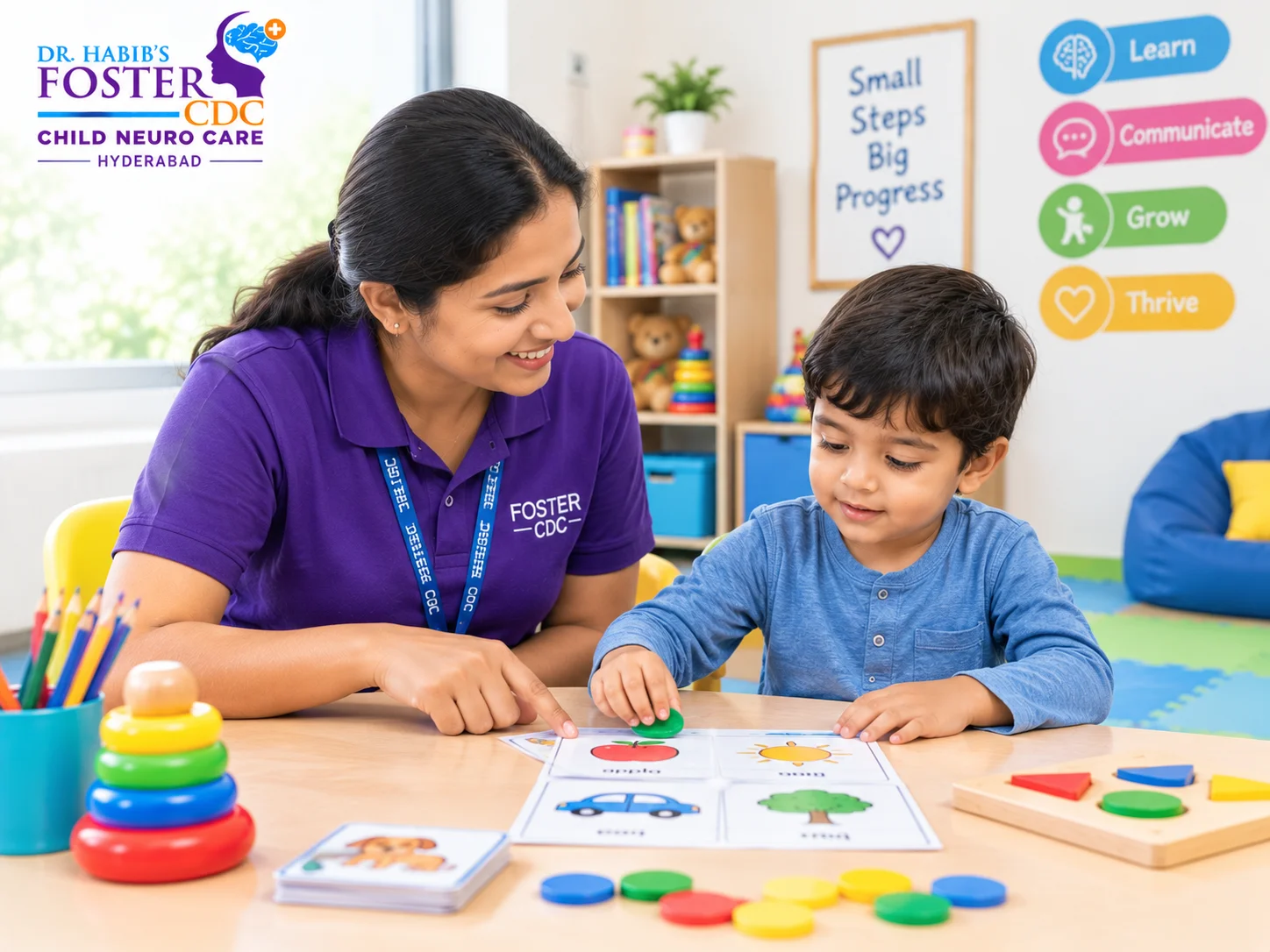
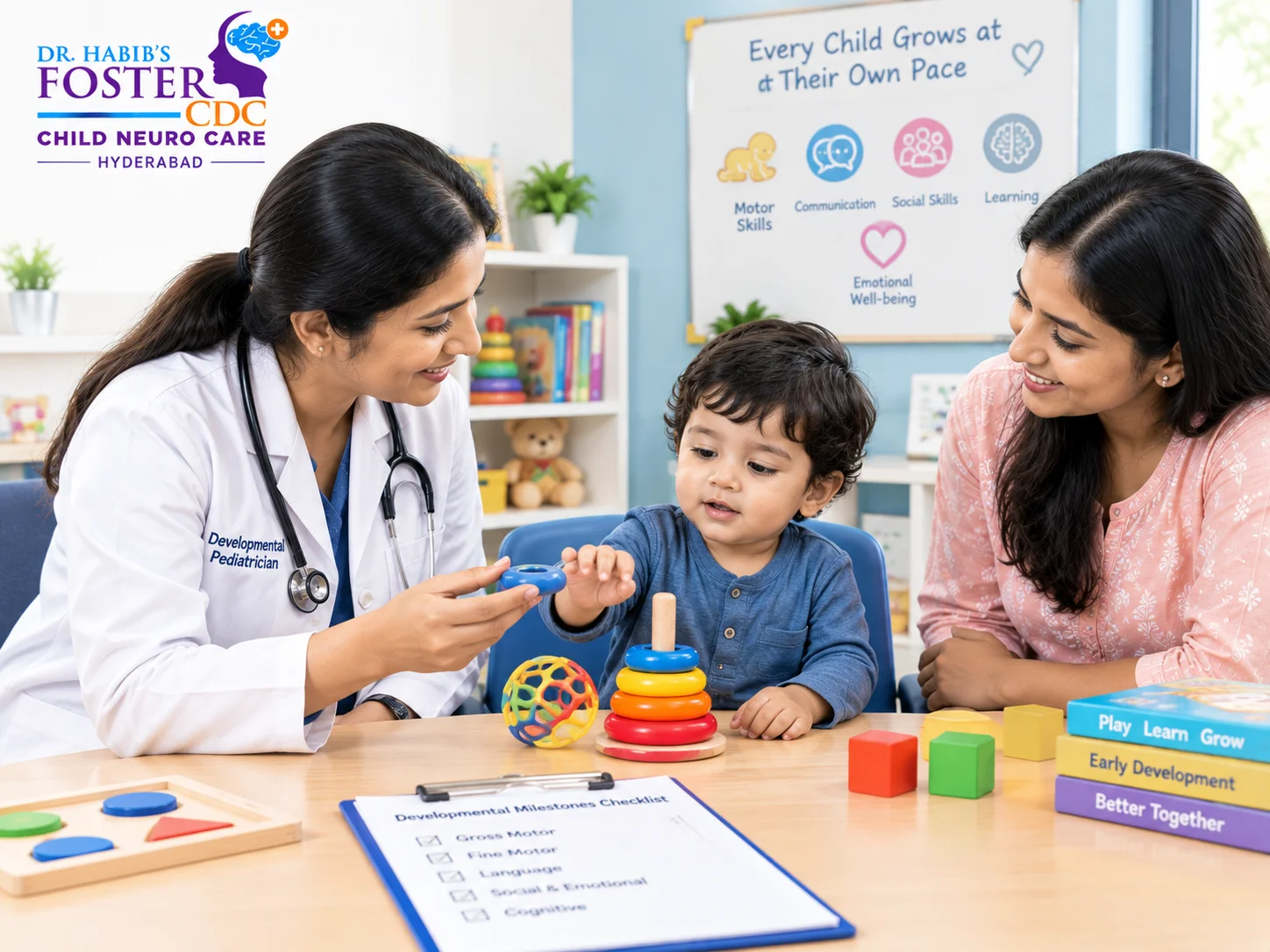
A comprehensive assessment looks at the whole child, not one skill. It can include your child's developmental and medical history, a conversation with you, and observation during play. It looks at communication, movement, social interaction, behaviour, learning and daily living skills.
Our developmental therapy page explains that the assessment uses a standardized tool to identify areas of concern across social, personal, adaptive, communication, motor and cognitive skills, and that the results set the baseline for measuring progress. That baseline is what lets anyone, including you, say later whether your child has moved forward.
3. Setting goals with your family
After the assessment, the therapist and family agree on specific, achievable goals. They are short-term and longer-term, and they reflect what matters at home: perhaps using words to ask for things, holding a spoon, or coping with a noisy classroom. Our article on personalized therapy plans explains how goals are chosen and why they differ between two children with the same label.
4. Therapy matched to the plan
Depending on what the assessment shows, a plan may include one therapy or several. A child whose delay is mainly in speech and play will not need the same mix as a child with motor, learning and behaviour needs. Because the services sit in one centre, the therapists can compare notes rather than leaving you to relay messages between unconnected providers.
5. Parents as part of the team
Parents spend the most time with their child, so the plan is built to continue at home. Expect progress updates, home activities tied to your child's goals, and the chance to ask questions. If you want structured coaching, see our parent training service. The World Health Organization's 2020 guideline on early childhood development points in the same direction: it recommends supporting responsive caregiving and early learning, which happen mostly in everyday family life.
6. Reviews against the baseline
Goals are reviewed regularly and updated as skills develop, so the plan changes with the child. How often reviews happen, how long sessions last and what they cost are things to confirm in writing at booking, because they depend on your child's plan. We have not put a single figure here on purpose.
Comparing Centres: Seven Questions to Ask
Use this table with any centre you are considering. The right-hand column shows what our own pages say about how we work, and where our site does not publish an answer, we say so.
| Question | Why it matters | What Foster CDC says about its approach |
|---|---|---|
| Who leads the care? | A delay can have medical causes. The IAP guideline describes a team led by a developmental pediatrician or pediatric neurologist | A developmental pediatrician is involved alongside other specialists |
| How do you set a starting point? | Without a baseline, progress is hard to measure | A standardized tool across social, personal, adaptive, communication, motor and cognitive skills sets the baseline |
| Who decides the goals? | Family priorities decide which skills matter day to day | Goals are agreed with the family, short-term and longer-term |
| Which therapies are under one roof? | Delays often cross several areas, and coordination saves time | Speech, occupational, behavioural, postural and mobility, early intervention, special education and parent training |
| How are parents involved? | Home practice carries therapy into daily life | Parents are part of the therapy team, with progress updates and home activities |
| How is progress reviewed? | Plans should change as the child changes | Goals are reviewed regularly and updated as skills develop |
| How often, and at what cost? | You need to plan your week and your budget | Not published on our pages. Please ask the team when you book |
When Another Route May Suit You Better
We are one option among several, and some situations call for a different first step:
- Seizures, repeated staring spells, or loss of skills. These need prompt medical evaluation, often at a hospital neurology or developmental clinic. Therapy can follow.
- A public-sector option. Under India's RBSK program, District Early Intervention Centres at district hospitals serve children from birth to six years. Ask your pediatrician or district health office what is available near you.
- A complex medical work-up, such as genetic or metabolic testing, usually happens at hospital-based specialist clinics.
The IAP guideline describes care in these levels, and many families combine them. A child can also move between levels as needs change.
Which Children We See
According to our developmental therapy page, children who may benefit include those with autism, cerebral palsy, Down syndrome and ADHD, as well as children with delays in speech, movement, social interaction or learning. If autism is part of your child's picture, see our autism therapy service.
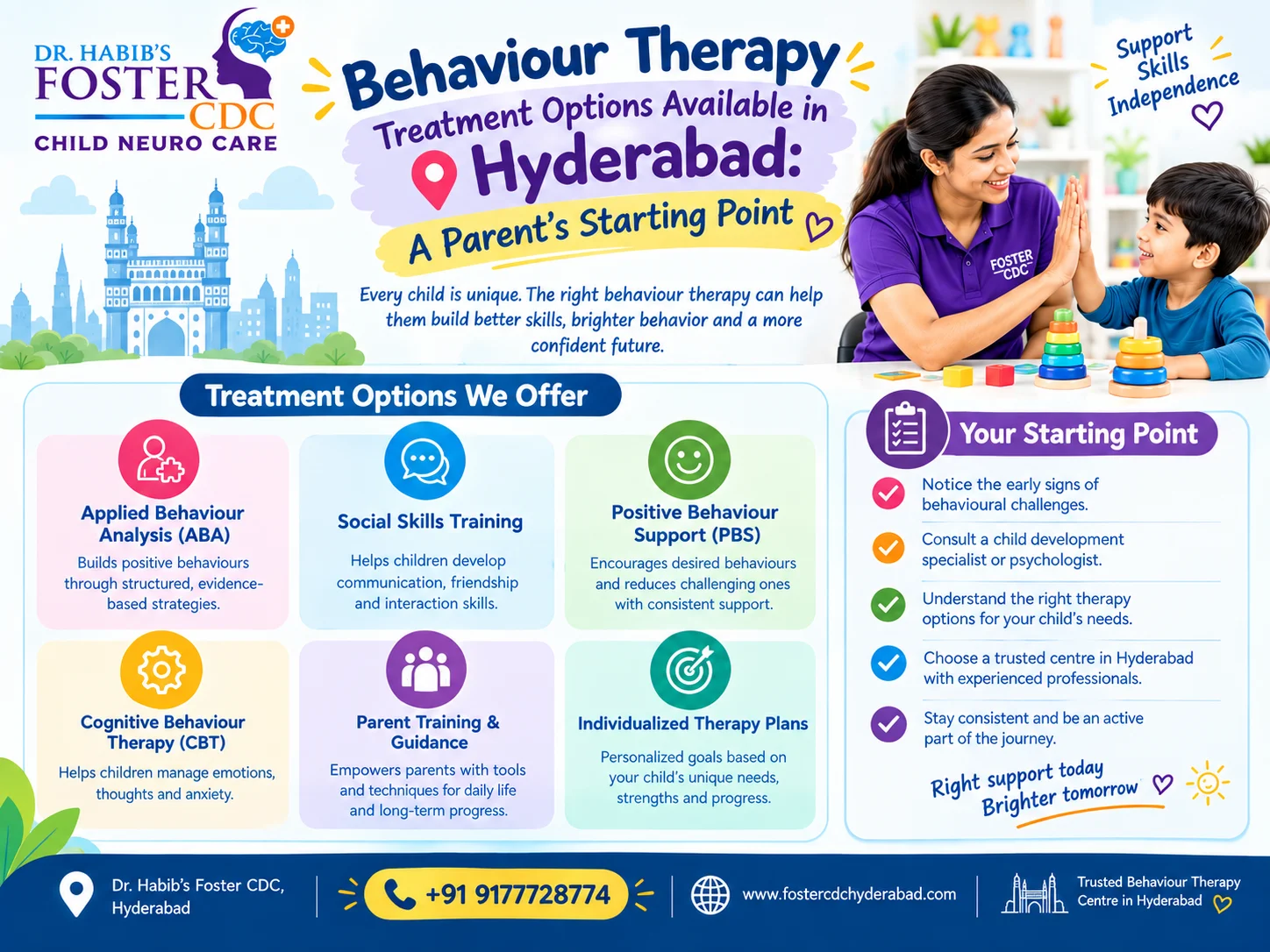
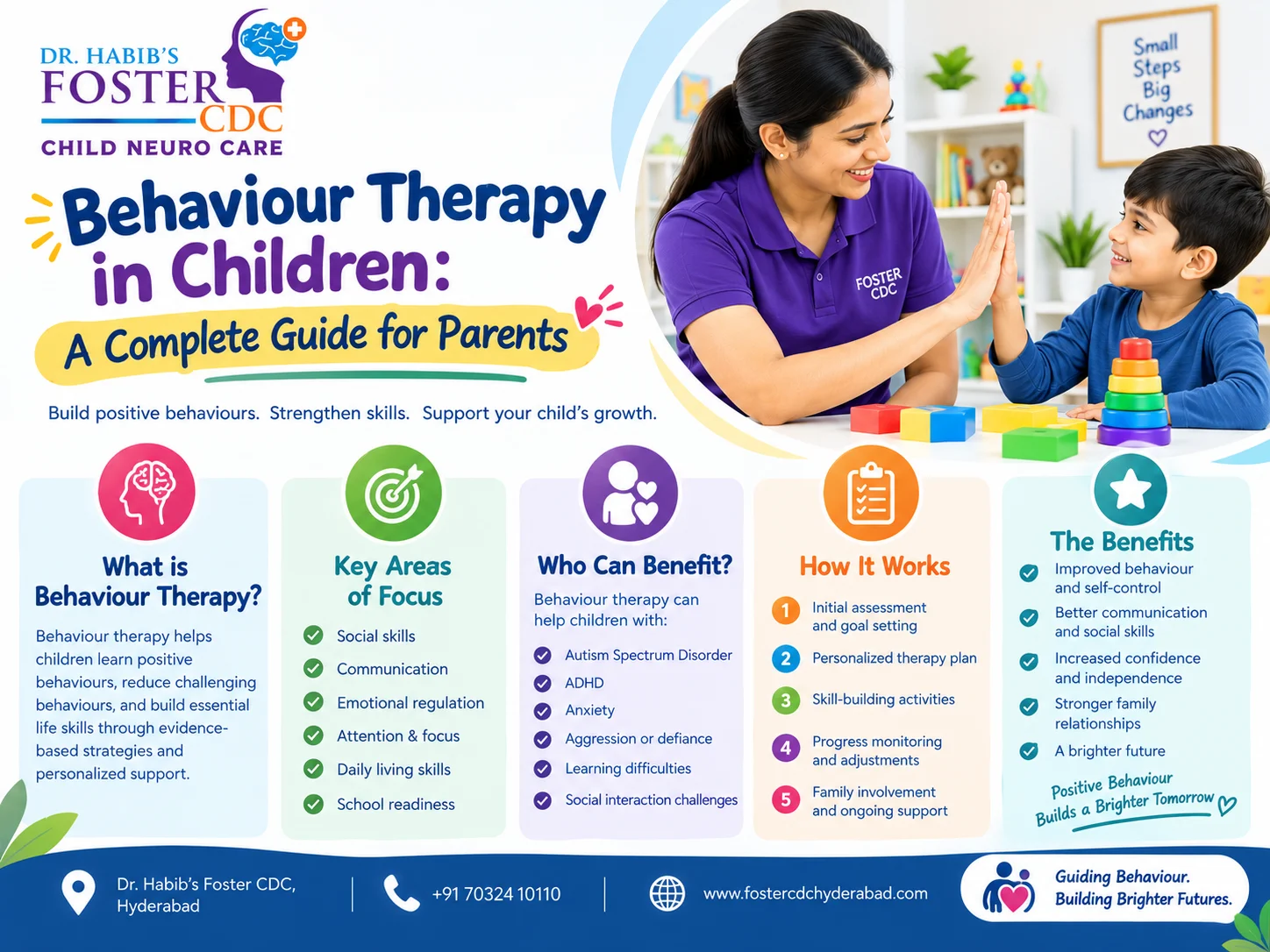
If you want to see how this approach looks in a single discipline, read how we help children with occupational therapy or behaviour therapy.
What We Cannot Promise
No centre can promise a particular outcome. The IAP guideline notes that the degree of delay is the strongest predictor of long-term progress, and that early intervention is linked to gains in everyday functioning, learning and social skills. It also says a global developmental delay label is reviewed over time, and that some children later receive a more specific diagnosis. Be cautious of any centre that guarantees a result or a timeline. What a good team can promise is an honest assessment, written goals, regular reviews and a plan that changes when your child does.
Where to Find Us
We have centres at Toli Chowki, Malakpet and Suncity in Hyderabad. The Toli Chowki centre is on the fourth floor, above ICICI Bank, beside TATA Motors, Brindavan Colony. Our centres page has the details for each location, and you can read about Dr. Habib G Pathan on our experts page.
If you would like an individual assessment, book an appointment with Dr. Habib's Foster CDC. You can also call +91 9391138499.
Frequently Asked Questions
Does my child need a diagnosis before the first visit? No. Guidelines advise seeking assessment and starting support when a delay is noticed, rather than waiting for a formal diagnosis. Bring any earlier reports you have.
Who will assess my child? Developmental care at Foster CDC involves a developmental pediatrician working with other specialists. The assessment uses a standardized tool to set a baseline across the main areas of development.
Which therapies are available? Speech therapy, occupational therapy, behavioural therapy, postural and mobility therapy, early intervention services, special education and parent training. Your child's plan may use one or several.
How will I know whether my child is making progress? Progress is measured against the baseline from the first assessment, using the goals agreed with you. Ask for the goals in writing and for the review schedule.
Are parents involved in therapy? Yes. Parents are part of the therapy team, receiving progress updates and home activities linked to the plan.
What ages do you see? According to our developmental therapy page, developmental therapy can begin in infancy and continue through adolescence.
How often will my child attend, and what will it cost? Both depend on your child's plan, so please confirm them with the team when you book. We do not publish a fixed figure.
Can my child also see a hospital specialist? Yes. Many children see a hospital neurologist or geneticist as well, and our team can coordinate with your child's other doctors.
Dr. Habib G Pathan is a Developmental Pediatrician at Dr. Habib's Foster CDC, Hyderabad. This article is for general information and does not replace an individual medical assessment. Please consult a qualified developmental pediatrician about your child's development.
Other Blogs
Services
- Behavioural Therapy
- Speech Therapy
- Special Education
- Parent Training
- Psychotherapy & Counselling
- Yoga Therapy
- Postural & Mobility Therapy
- Early Intervention Services
- Cognitive Behavioural Therapy
- Occupational Therapy
- Group Teaching
- Teachers' Training
- Certified Courses
- Developmental Therapy
- Autism Therapy