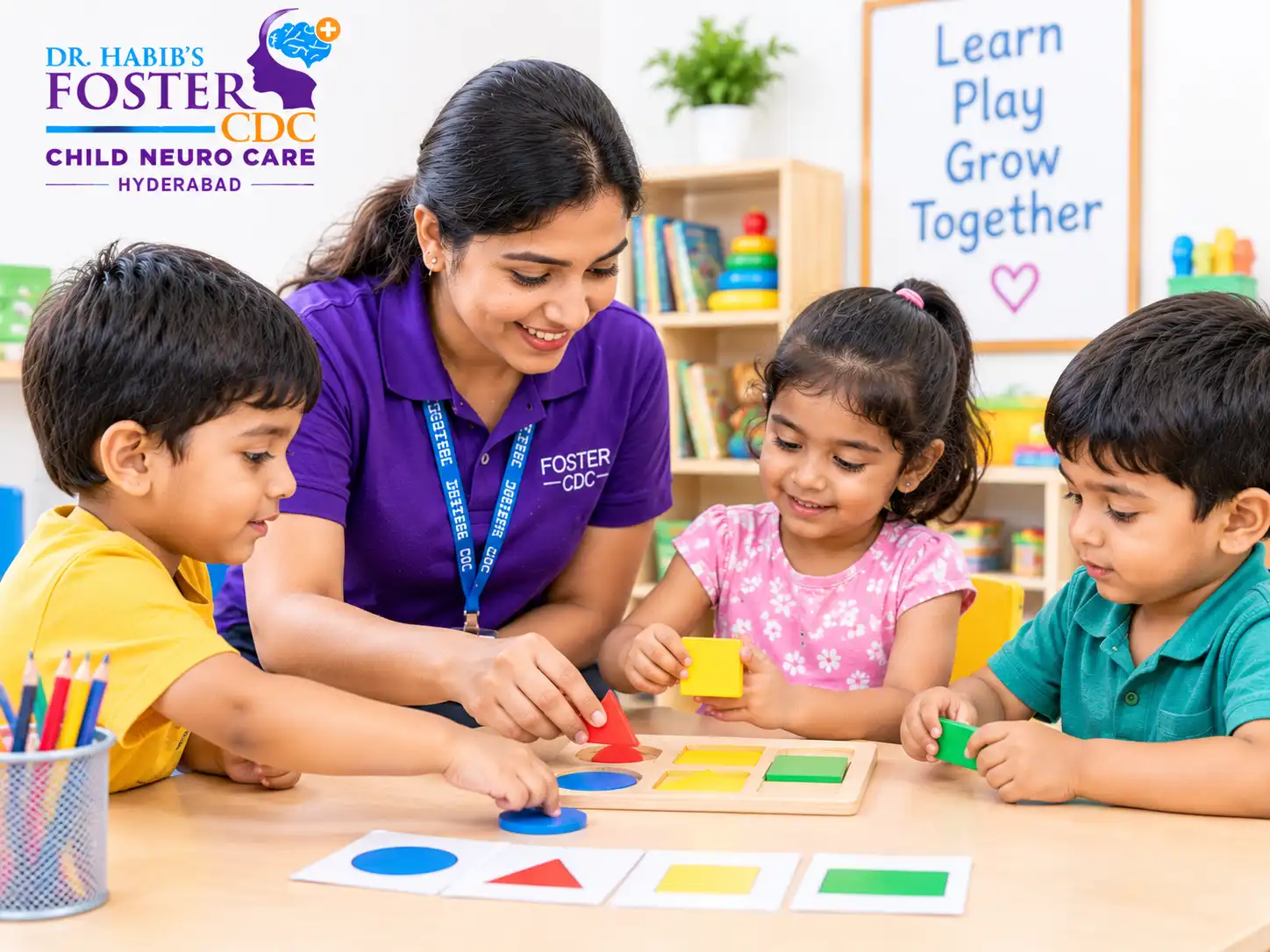
How Dr. Habib's Foster CDC Helps Children with Special Education
Dr. Habib's Foster CDC, Hyderabad Last updated: November 2026
At Dr. Habib's Foster CDC, a parent, teacher or doctor who thinks a child may have a developmental or learning difficulty can ask for an evaluation. The centre assesses the child with tests chosen for that child, then builds an individualized education plan (IEP) with the parents and specialists. The plan is reviewed at least once a year. Support can include group teaching, speech, occupational and behavioural therapy, counselling and parent training.
You are often the first to notice. The child who never finishes the worksheet. The one who goes quiet at group time. The one whose reading seems to have stalled while everything else is fine. You cannot diagnose, and you should not try to. But you can see patterns, and you may be the person who says something.
That raises a practical question: what happens if you do? This guide follows one path, from a teacher's or caregiver's first concern to the first plan review, using how our centre describes its own process.
If you are still deciding whether a child needs support at all, start with our early signs checklist. If you are comparing school settings, our complete guide to special education walks through the options.
Who Can Ask for an Evaluation?
According to our special education blog, a parent, teacher or doctor who believes a child may have a developmental, learning or physical difficulty can request an evaluation from Foster CDC.
In practice, the child's parents need to be part of that conversation. A good way to start is with what you have seen, not a label:
- What the child does or avoids
- Where it happens, and how often
- How long it has been going on
- What helps
The American Academy of Pediatrics (AAP) describes developmental monitoring as a two-way conversation between doctors and early childhood and school professionals. Your notes are part of that conversation. The American Speech-Language-Hearing Association (ASHA) adds that the earlier a possible delay or disorder is addressed, the better.
For wording that avoids blame and labels, see our guide on developmental delay myths for teachers, caregivers and parents.
Step 1: Gather What You Have
Before the first visit, a short, specific note is more useful than a file of papers. Helpful things to prepare:
- Two or three dated examples of what you saw, for instance "10 Nov: did not start the written task, asked to leave class twice"
- One thing that helps, such as a seat near the front, a visual cue or a quiet start
- A sample of the child's work, if the parents agree
- A request to the parents to bring any earlier reports and hearing or vision results
You do not need everything. Bring what you have, and the team will say what else is useful.
Step 2: The Assessment
Our special education blog says the centre organizes an assessment that includes various tests chosen according to the child's needs, and that the results show what support the child requires.
Where a developmental concern is part of the picture, our developmental therapy page describes the use of a standardized tool across social, personal, adaptive, communication, motor and cognitive skills to set a baseline for measuring progress.
Step 3: The Individualized Education Plan (IEP)
According to our special education page, an IEP outlines a child's specific learning goals and the strategies that will be used to reach them, and it is built through collaboration between teachers, parents and specialists. Our blog adds that parents are part of the team, and that the IEP is reviewed at least annually.
Whatever the format, ask three things about any IEP: which goals apply to the classroom or home routine, who delivers each one, and when it will be reviewed. Because teachers, parents and specialists build it together, you should be able to see it.
For examples of what goals can look like, see the IEP section of our complete guide. To see how findings turn into goals, read about personalized therapy plans.
Step 4: Learning Support at Different Ages
Babies and toddlers
Our special education page says early intervention programs for babies and toddlers help them learn to walk, talk, play and develop other skills. The team also teaches and trains caregivers and families on how to help children reach their potential, and supports them in managing problematic behaviours. See our early intervention services.
Preschoolers
The page describes programs for preschoolers, with speech therapy added if needed to meet a child's learning goals.
School-age children
Our blog says Foster CDC provides special education services for eligible children aged 3 to 18, and beyond if more support is needed. The services page lists school-age programs, but does not give details, so please ask the team what is currently offered for your child's age.
Group teaching
Our group teaching page describes small groups of children with diverse abilities learning together. The strategies it lists include:
- Individualized education plans for each child
- Peer support, such as buddies or mentors
- Accessible materials, including multimedia, adaptive technology and tactile resources as needed
- Ongoing training for educators
The page also stresses that group teaching is not suited to every child, and each child's needs are assessed first.
Step 5: Therapies That Run Alongside
Special education rarely works alone. Our special education blog lists related services: speech therapy, occupational therapy, behavioural therapy, psychotherapy and counselling, and child-specific educational programs.
- Speech therapy for language and communication
- Occupational therapy for handwriting, sensory and self-care skills
- Behavioural therapy for attention, routines and behaviour
- Parent training so that practice continues at home
The World Health Organization's 2020 guideline on early childhood development recommends supporting responsive caregiving and early learning, which is why involving families matters from the start.
Step 6: Your Role as a Teacher or Caregiver
After the plan is made, you are one of the people who makes it work.
- Ask to see the goals that apply to the classroom or home routine.
- Use the same words and cues the team uses, so the child hears one consistent message.
- Keep notes on what helps and what does not, and share them.
- Tell the team about changes, such as a new school, a new teacher, or a loss of a skill.
- Ask for a meeting sooner if you are worried about progress, rather than waiting for the annual review.
If you are a teacher who wants to build classroom skills, our site lists a teachers' training service. Please see that page for what it covers.
Questions to Ask Any Centre, Including Us
- How will you assess my child, and will I see the findings?
- Who writes the IEP, and will parents and teachers be part of it?
- How often is it reviewed, and can we ask for a review sooner?
- What support is available for my child's age?
- Which therapies are included, and which are separate?
- How will you coordinate with the school?
A team that answers these plainly is worth listening to. A team that promises quick fixes is not.
Looking for a Special School?
Our site announces a special school for kids with vocational courses and therapies as "coming soon." If you are looking for a full-time special school today, please ask the team what is currently available. Our guide to choosing between school settings can help you compare options in the meantime.
Where to Find Us
We have centres at Toli Chowki, Malakpet and Suncity in Hyderabad. Our centres page has the details. To ask about an evaluation, use our appointment page or call +91 9391138499.
If you would like an individual assessment, book an appointment with Dr. Habib's Foster CDC.
Final Thoughts
A concern from a teacher or caregiver is not an accusation. It is often the first step toward the right support. You do not need to be sure what is going on. You need to describe what you have seen, involve the family, and ask for an evaluation.
Frequently Asked Questions
Can a teacher ask Foster CDC to evaluate a child? According to our special education blog, a parent, teacher or doctor who believes a child may have a developmental, learning or physical difficulty can request an evaluation. It works best when the child's parents are involved.
What ages does special education at Foster CDC cover? Our blog says services are available to eligible children aged 3 to 18, and beyond if more support is needed. Early intervention programs are also described for babies and toddlers.
What happens after the evaluation? The results show what support the child needs. An individualized education plan is then built with the parents, teachers and specialists.
How often is the IEP reviewed? At least once a year, according to our blog. You can ask for a meeting sooner if there are big changes or you are worried about progress.
Does Foster CDC offer group teaching? Yes. The group teaching page describes small groups of children with diverse abilities, with individualized plans, peer support and accessible materials. The team assesses each child's suitability first.
Do children also receive therapy? Our special education blog lists speech, occupational and behavioural therapy, psychotherapy and counselling among related services. Which ones your child needs depends on the assessment.
Is there a special school at Foster CDC? Our site says a special school with vocational courses and therapies is coming soon. Please ask the team what is currently available.
Do we need documents to ask for an evaluation? Bring any reports you have. A disability certificate is a separate process, so ask the team at booking whether you need any particular documents.
Dr. Habib G Pathan is a Developmental Pediatrician at Dr. Habib's Foster CDC, Hyderabad. This article is for general information and does not replace an individual assessment. Please consult a qualified professional about your child's learning and development.
Other Blogs
Services
- Behavioural Therapy
- Speech Therapy
- Special Education
- Parent Training
- Psychotherapy & Counselling
- Yoga Therapy
- Postural & Mobility Therapy
- Early Intervention Services
- Cognitive Behavioural Therapy
- Occupational Therapy
- Group Teaching
- Teachers' Training
- Certified Courses
- Developmental Therapy
- Autism Therapy