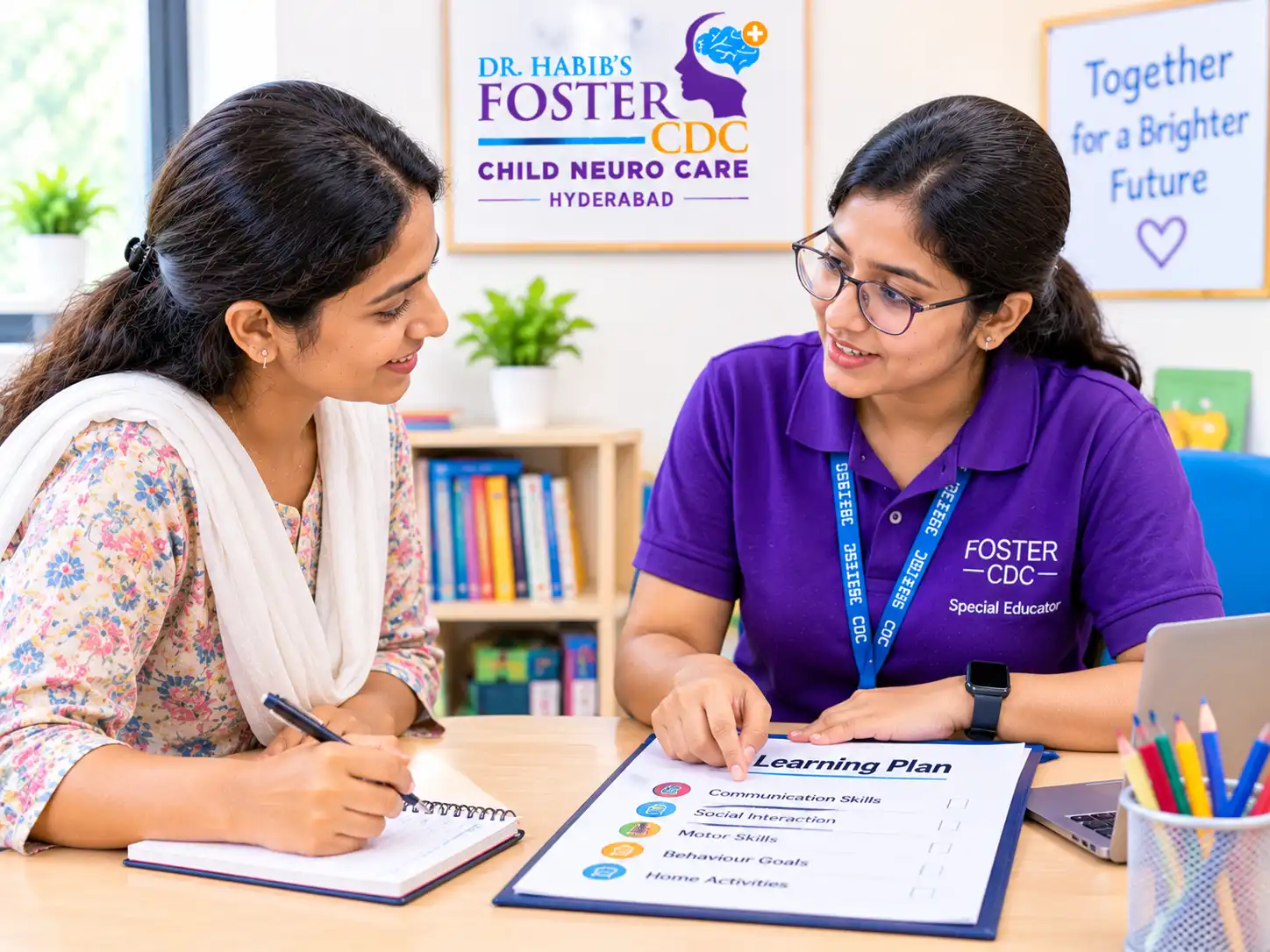
Parent's Guide to Special Education After an Initial Diagnosis: From Report to First IEP
Dr. Habib's Foster CDC, Hyderabad Last updated: November 2026
Quick answer: After a diagnosis, special education begins with three steps: share the useful parts of the report with the school, ask in writing for the support your child needs, and prepare for the first individualized education plan (IEP) meeting with a one-page profile of your child. You do not have to decide everything at once, and you do not have to have all the answers.
The report is in your bag. It has a diagnosis, a few pages of scores, and a line saying your child "may benefit from special education support." Then the school asks whether you have "any documents." (This is an illustration, not a real case.)
If that is where you are, this guide walks through the steps between the report and the first plan, in order. If you are still working out whether your child needs support, start with our early signs checklist. To see how special education works at our centre, read how Foster CDC helps children with special education.
Step 1: Read the Report for What It Means at School
A diagnosis gives your child's difficulty a name. A school needs something different: what your child can do, what is hard, and what helps. As you read, mark three things:
- Strengths, because every plan should start there
- Areas of difficulty, in plain words
- Recommendations, such as extra time, a quiet space, visual supports or therapy
Then ask the clinician two questions: How will this show up in class? and Which recommendations matter most right now? A short, plain answer to those is worth more than any score.
Step 2: Tell the School
Start with the class teacher, and ask whether the school has a coordinator, counsellor or special educator. Then:
- Book a meeting rather than relying on a note.
- Share what the school needs. A summary of the diagnosis and the recommendations is usually enough to start. What you share beyond that is your choice.
- Keep a copy of everything you hand over, with the date.
If you worry that "special education" will mean a different school, it does not have to. It is a way of teaching that can happen in a mainstream classroom with adjustments, with extra help from a special educator, in a small group, or in a special school. Our complete guide to special education compares these settings.
Step 3: Ask for Support in Writing
A short written request leaves a record and gives everyone the same starting point. It can be a few sentences:
Dear [Class Teacher], [Child's name] has been assessed and we would like to share the recommendations with you. Could we arrange a meeting to discuss the support [he/she] needs in class, and to agree a plan with goals and a review date? Thank you.
Indian law backs the request. The Rights of Persons with Disabilities Act, 2016 expects government-funded and recognised schools to provide inclusive education and reasonable accommodation, and refers to giving support, individualised or otherwise, to help a child's academic and social development. A certificate is not needed to ask for an assessment or to begin classroom support. For how certificates work, see our guide to developmental delay treatment in Hyderabad.
Step 4: Prepare a One-Page Profile of Your Child
This is the most useful thing you can bring to the first meeting. Write it in your own words, on one page:
- What my child loves, and what makes them proud
- What is hard for my child, in everyday terms
- What helps, and what makes things worse
- How my child shows that they are struggling, such as going quiet, getting restless or refusing
- My top three hopes for this year
- How to reach me, and when
Bring two copies, one for the teacher and one for you. A page like this changes the meeting from a discussion about a label into a discussion about your child.
Step 5: The First IEP Meeting
According to our special education page, an IEP outlines a child's learning goals and the strategies for reaching them, and is built through collaboration between teachers, parents and specialists. Names and formats vary between schools, so you may hear it called a learning plan or a support plan.
Try to have the class teacher and the special educator or coordinator in the room, and a therapist if possible.
Questions to Ask
- Which three to five goals are the priority this year, and how will we know each one is met?
- What will change in class, for example seating, extra time or simplified instructions?
- Who is responsible for each goal?
- How will you and the class teacher share updates with us?
- When is the first check-in, and when is the full review?
- What would you like us to do at home?
The Indian Academy of Pediatrics (IAP) guideline on developmental delay describes aiming at a child's next immediate milestone, the step just above where they are today. The same idea helps with school goals: they should be small enough to reach and clear enough to measure.
Signs a Plan Needs Work
- Goals are vague, such as "improve behaviour"
- No named person is responsible
- There is no review date
- Nothing is asked of, or offered to, the family
- The class teacher has not seen the plan
If you notice any of these, ask politely for them to be fixed before you sign or agree.
Step 6: After the Meeting
- Ask for a written copy of the plan.
- Share a one-line summary with everyone who teaches your child.
- Put the review dates in your calendar. At Foster CDC, our blog says the IEP is reviewed at least once a year, and you can ask for a meeting sooner if you are worried.
- Keep a short log of new skills and what helped. Our guide to developmental delay after diagnosis has a simple progress log you can adapt.
- Keep the school and the centre talking. The American Academy of Pediatrics (AAP) describes child development support as a two-way conversation between doctors and school professionals.
- Call the team sooner if your child loses a skill, or becomes very distressed about school.
Words You May Hear
- IEP: an individualized education plan, a written plan with goals and strategies for one child
- Accommodation: a change to how a child learns or shows what they know, such as extra time
- Special educator: a trained teacher who adapts learning for children with additional needs
- Shadow teacher: an adult who supports a child inside a mainstream classroom, where a school or family arranges this
- Resource room: a space where a child gets extra help for part of the day, where a school offers it
- Benchmark disability: a term in the 2016 Act for a disability of at least 40% of a specified type, as certified, which is linked to certain legal entitlements
Therapy and Special School Questions
Therapy and special education work alongside each other. Depending on the assessment, your child may also benefit from speech therapy, occupational therapy or behavioural therapy, and from parent training so that practice continues at home.
If you are looking for a special school, our site announces a special school with vocational courses and therapies as "coming soon." Please ask the team what is currently available.
How Foster CDC Can Help
Our special education blog says a parent, teacher or doctor can request an evaluation, and that the assessment includes tests chosen for the child's needs. We have centres at Toli Chowki, Malakpet and Suncity in Hyderabad. Our centres page has the details.
If you would like an individual assessment, book an appointment with Dr. Habib's Foster CDC. You can also call +91 9391138499. If you are a teacher or caregiver, our site lists a teachers' training service. Please see that page for what it covers.
Final Thoughts
A diagnosis can make everything feel urgent, but the next step is small: one conversation with the class teacher, one page about your child, one meeting. Take them one at a time. You know your child better than any report, and the school needs to hear that.
Frequently Asked Questions
What should I do first after my child's diagnosis?
Read the report for what it means in class, then book a meeting with the class teacher. Share a summary and the recommendations, and ask for a plan.
Do I have to share the whole report with the school?
What you share is your choice. A summary of the diagnosis and the recommendations is usually enough for a school to start planning.
What is an individualized education plan, and who writes it?
An IEP is a written plan with goals and strategies for one child. According to our special education page, it is built by teachers, parents and specialists together.
Do we need a disability certificate to start support?
Not to ask for an assessment or to begin classroom support. A certificate is a separate process linked to certain legal entitlements, so ask a doctor about eligibility.
What if the school says it cannot support my child? Ask for the reasons in writing, and ask what support the school can offer. Indian law expects government-funded and recognised schools to provide inclusive education and reasonable accommodation. For questions about your family's rights, consult a qualified adviser.
Will my child need therapy as well?
Often, depending on the assessment. Therapy and special education work alongside each other.
Is a special school the only option after a diagnosis?
No. Special education can happen in a mainstream classroom with adjustments, with extra support, or in a special school. See our complete guide for a comparison.
Where can I get an evaluation in Hyderabad?
Options include a pediatrician or developmental pediatrician, hospital clinics, and child development centres. Dr. Habib's Foster CDC offers assessment at its centres in Toli Chowki, Malakpet and Suncity.
Dr. Habib G Pathan is a Developmental Pediatrician at Dr. Habib's Foster CDC, Hyderabad. This article is for general information and does not replace an individual assessment. Please consult a qualified professional about your child's learning and development.
Other Blogs
Services
- Behavioural Therapy
- Speech Therapy
- Special Education
- Parent Training
- Psychotherapy & Counselling
- Yoga Therapy
- Postural & Mobility Therapy
- Early Intervention Services
- Cognitive Behavioural Therapy
- Occupational Therapy
- Group Teaching
- Teachers' Training
- Certified Courses
- Developmental Therapy
- Autism Therapy