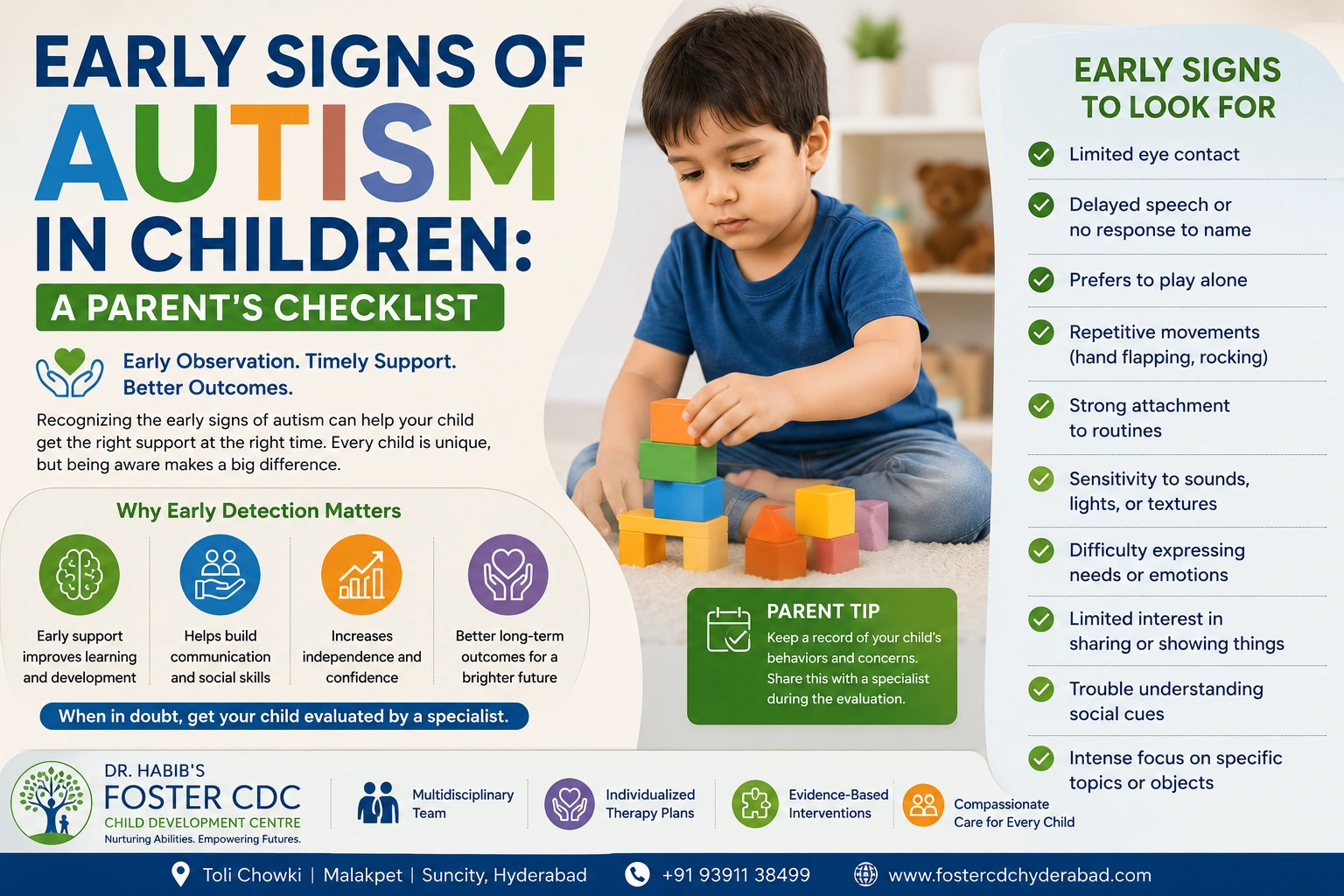
Early Signs of Autism in Children: A Parent's Checklist
Every parent watches their child's first smile, first word, and first steps with a mix of excitement and quiet comparison — is my child on track? For most families that question fades on its own. For some, it lingers, and that instinct is worth listening to.
Autism Spectrum Disorder (ASD) is a developmental condition that affects how a child communicates, interacts socially, and responds to the world around them. It is not caused by parenting style, and it is not something a child will simply "grow out of." What can change the outcome dramatically is when it is identified. Research consistently shows that children who begin therapy before age 3–4 make far greater gains in communication, social skills, and independence than those diagnosed later.
This checklist is designed to help parents in Hyderabad recognise the early signs of autism at each developmental stage, understand what global health bodies recommend, and know exactly what to do next.
Why Early Signs Matter More Than a Formal Label
Many parents wait for a "diagnosis" before taking action. But therapists don't need a label to start helping a child build skills — they need observable signs. The goal of this checklist isn't to diagnose your child at home; it's to help you decide whether it's time to get a professional developmental assessment.
The American Academy of Pediatrics (AAP) recommends that every child be screened for autism at their 18-month and 24-month well-child visits, regardless of whether parents have raised concerns. The World Health Organization (WHO) similarly emphasises population-level early identification, noting that timely, appropriately tailored care can meaningfully improve a child's development and long-term quality of life. The American Speech-Language-Hearing Association (ASHA) adds that delayed or unusual communication patterns — not just "late talking" — are often among the earliest visible red flags.
Age-Wise Checklist: Typical Development vs. Early Signs of Autism
If your child shows a cluster of signs from the right-hand column — rather than a single isolated behaviour — it's a reasonable trigger to seek a professional opinion.
The Core Categories of Early Signs
1. Social Communication
Limited or inconsistent eye contact
Doesn't respond consistently to their name by 12 months
Rarely shares enjoyment or points out interesting objects to a caregiver
Prefers to play alone rather than seeking interaction
2. Language and Speech
No babbling by 12 months, no words by 16 months, no two-word phrases by 24 months
Loss of previously used words or social skills at any age
Unusual tone, pitch, or rhythm of speech
Repeating words or phrases without functional intent (echolalia)
Parents often notice speech delay first, which is why it's closely linked to our speech therapy services — early language intervention frequently overlaps with autism support.
3. Behaviour and Play
Lines up toys or objects repeatedly instead of using them for pretend play
Intense, narrow interests in specific objects or topics
Repetitive movements — hand-flapping, rocking, spinning
Strong resistance to small changes in daily routine
4. Sensory Responses
Over- or under-reaction to sounds, lights, textures, or smells
Unusual sensory-seeking behaviours (smelling objects, staring at spinning items)
Discomfort with certain fabrics, food textures, or grooming activities
What the Experts Recommend
Global paediatric and developmental bodies broadly agree on three points:
Screen early and screen routinely. The AAP's 18- and 24-month screening recommendation exists precisely because signs are often visible well before a child turns two.
Don't wait for certainty. Many parents notice something "different" long before a formal evaluation — that instinct deserves a professional look, not dismissal.
Intervene as early as possible. WHO and ASHA both stress that a child's developing brain is most responsive to therapy in the early years, making early intervention one of the strongest predictors of long-term progress.
What To Do If You Notice These Signs
Track specific behaviours. Note what you observe and when — this is far more useful to a specialist than a general worry.
Book a developmental assessment. A qualified developmental paediatrician or child psychologist can evaluate your child using standardised tools rather than checklists alone.
Start therapy without delay if recommended. Options may include behavioural therapy, speech therapy, occupational therapy, or a combination tailored to your child.
Ask about early intervention programs, which are specifically designed for toddlers and pre-schoolers showing developmental concerns. Learn more about our early intervention services.
Prepare for the first visit. If an assessment is booked, our guide on preparing your child for their first therapy session can help ease the transition for both parent and child.
At Dr. Habib's Foster CDC, our team designs individualised care plans following a comprehensive assessment, involving parents at every stage of goal-setting and progress review.
Frequently Asked Questions
Q1. At what age can autism be identified in a child?
Signs can often be observed as early as 12–18 months, and reliable screening tools such as the AAP-recommended checks are typically administered at 18 and 24 months. A formal diagnosis can be made by a specialist once these signs are confirmed through assessment.
Q2. Does late talking always mean my child has autism?
No. Late talking can stem from many causes, including hearing issues or a general speech delay unrelated to autism. However, if delayed speech is combined with reduced eye contact, limited social interest, or repetitive behaviours, it's worth a professional evaluation.
Q3. Can autism signs appear after a child develops normally for a while?
Yes. Some children show typical development initially and then lose previously acquired skills — this is sometimes called regression, and it should always prompt a specialist consultation regardless of the child's age.
Q4. Is early intervention effective even before a formal diagnosis?
Yes. Therapists can begin working on communication, social, and behavioural goals as soon as a developmental concern is flagged, without waiting for a final diagnostic label.
Q5. Where can I get my child assessed for autism in Hyderabad?
Dr. Habib's Foster CDC offers comprehensive developmental assessments and a full range of therapies across our Toli Chowki, Malakpet, and Bandlaguda Jagir centres. Book an assessment with our team today.
A Note From Dr. Habib G Pathan
"Parents are usually the first to notice that something feels different — and that instinct is valuable. My advice is always the same: don't wait to be certain, get an assessment. Early support gives every child the best possible foundation, whatever the outcome of that assessment turns out to be." — Dr. Habib G Pathan, Developmental Pediatrician, Foster CDC
Ready to take the next step?
If you've noticed any of the signs above, don't wait. Early assessment leads to early support — and early support changes outcomes.
Book an Assessment at Dr. Habib's Foster CDC →
Other Blogs
Services
- Behavioural Therapy
- Speech Therapy
- Special Education
- Parent Training
- Psychotherapy & Counselling
- Yoga Therapy
- Postural & Mobility Therapy
- Early Intervention Services
- Cognitive Behavioural Therapy
- Occupational Therapy
- Group Teaching
- Teachers' Training
- Certified Courses
- Developmental Therapy
- Autism Therapy