
How Dr. Habib's Foster CDC Helps Children with Early Intervention: Plans, Reviews and Next Steps
Dr. Habib's Foster CDC, Hyderabad Last updated: November 2026
At Dr. Habib's Foster CDC, early intervention starts with a comprehensive assessment and an individualised plan, with parents involved in goal-setting and progress reviews. The programs work on behaviour, emotional, social, cognitive and physical development. Our overview describes early intervention for children from birth to 6 years, and our early intervention page says effective support can help at any point in childhood. According to our autism checklist, therapists can begin working on goals as soon as a concern is flagged, without waiting for a final diagnosis.
You have already taken the hardest step. The first assessment is done, the plan is in a folder, and therapy has started. Now you are in the long middle, where progress is real but quiet, and the questions change from "what is happening?" to "how do I make the most of this?"
This guide is for that stage. It explains what early intervention means at our centre, how plans are built and reviewed, what you can do between sessions, and what to ask at each review. If you are still deciding when to start, read our guide on early signs a child needs early intervention. If you want to compare centres, see our complete guide to early intervention.
What Early Intervention Means at Foster CDC
According to our early intervention services page, early intervention is early, effective support aimed at stepping in before a difficulty grows. The page describes two kinds of support:
- Support for children and families who face known risk factors, to help prevent problems from developing
- Targeted support when a specific or diagnosed difficulty has been identified. It cannot prevent the difficulty, but it can reduce its impact on the child's development
The programs work on these areas of development:
- Behaviour and self-regulation: monitoring one's own behaviour, impulses and attention
- Emotional and social development: managing feelings, self-esteem and relationships with other children
- Cognitive development: language and speech, numeracy, reading and writing, and problem-solving
- Physical development
On ages, our overview of therapy programs describes early intervention for children from birth to 6 years, and the early intervention page adds that effective support can improve children's life chances at any point in childhood and adolescence.
How Your Child's Plan Is Built and Reviewed
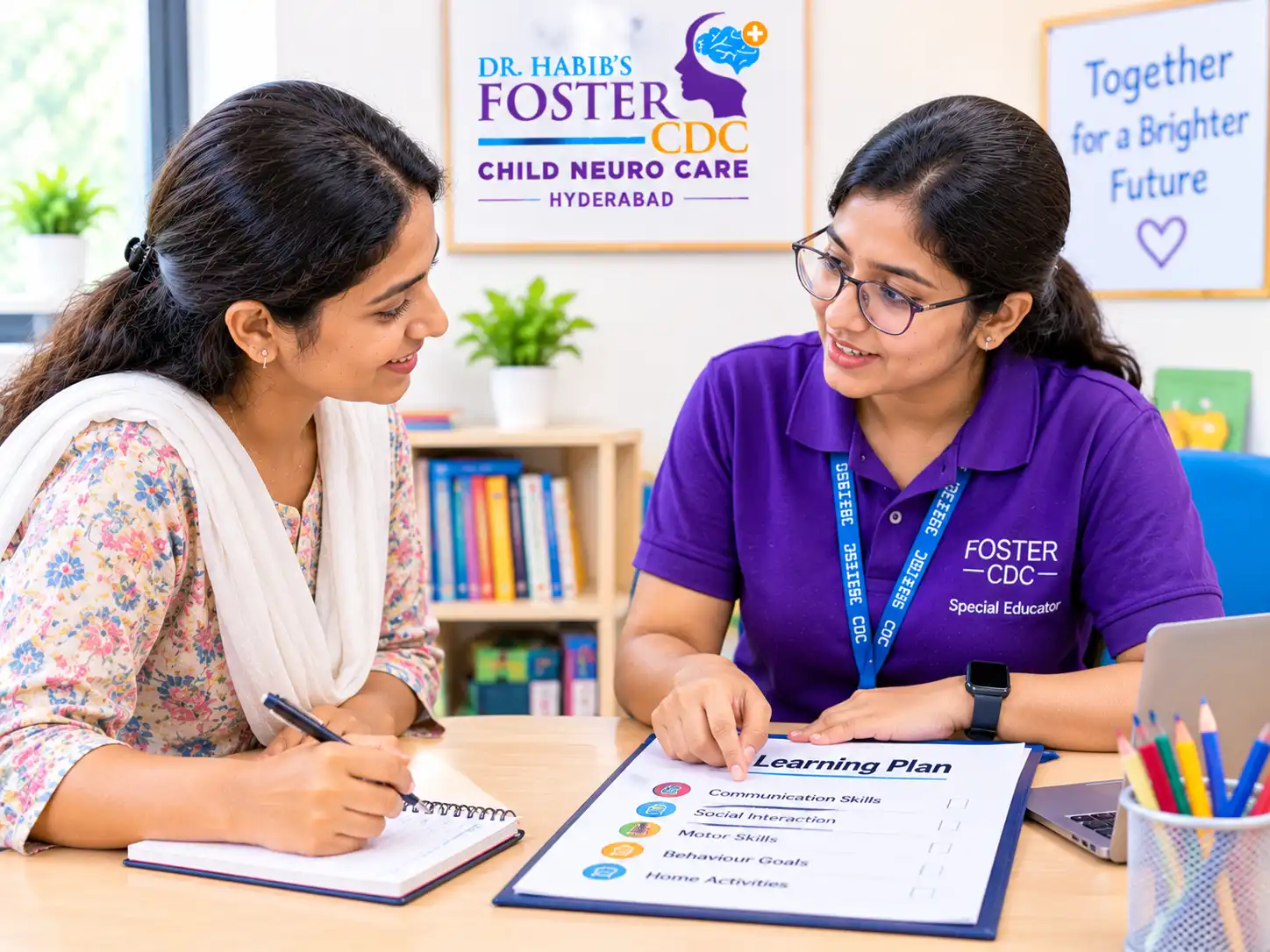
A plan starts with an assessment. Our developmental therapy page says the assessment uses a standardized tool across social, personal, adaptive, communication, motor and cognitive skills, and that therapists set a baseline for measuring progress. According to our early signs of autism checklist, the team designs individualised care plans after a comprehensive assessment, with parents involved at every stage of goal-setting and progress review.
The therapies in a plan are chosen from the assessment. They may include speech therapy, occupational therapy, behavioural therapy, postural and mobility therapy and special education. To see the process from the first visit, read how Foster CDC helps children with developmental delay.
How often sessions and reviews happen is not published on our pages, because it depends on your child's plan. Please ask the team for the goals and the next review date in writing.
Your Role Between Sessions
Our special education page says early intervention programs include training caregivers and families to help children reach their potential. The World Health Organization's 2020 guideline on early childhood development also recommends supporting responsive caregiving and early learning, because children grow through warm, playful interaction with the adults around them.
In practice:
- Pick one or two activities from your therapist, tied to your child's goals
- Attach them to routines you already have, such as mealtimes, bath time and floor play
- Keep a short log of new skills and what helped. Our guide to developmental delay after diagnosis has a simple one you can adapt
- Tell the team about changes, such as a new school, a new sibling, or a loss of a skill
If you want structured coaching, our parent training service covers it.
Questions to Bring to Your Next Review
- What has changed since the baseline?
- Which goals have been met, and which are stuck?
- Should any therapy be added, changed or reduced?
- What should we practise at home before the next visit?
- How will you coordinate with my child's nursery or school?
- When is the next review?
When to Add Another Service
Children often need more than one kind of support, and needs change over time. Mention it at your next review if you notice a new difficulty in an area your child's plan does not yet cover, such as speech, hand skills, movement, behaviour or learning.
Do not wait for the review if your child loses a skill, has seizures or repeated staring spells, or changes suddenly in alertness, feeding or sleep. Our guide on early signs a child needs early intervention explains which signs mean calling the team now.
Early Intervention for Autism at Foster CDC
If autism is part of your child's picture, our autism therapy page describes the centre's services. Our autism checklist says therapists can begin working on communication, social and behavioural goals as soon as a developmental concern is flagged, without waiting for a final diagnostic label.
For what research says, and how to judge any program, read our complete guide to early intervention. In short, evidence supports early, family-involved approaches, but it supports approaches, not guaranteed results, and early intervention supports a child's skills. It does not cure autism. See also our guides to autism treatment options in Hyderabad and autism after an initial diagnosis.
Planning Ahead: Nursery, School and Beyond
As your child moves to nursery or school, share what helps with the teacher, and ask for a meeting. Our guide to the first IEP meeting explains how to tell the school, ask for support in writing and prepare a one-page profile of your child. Our post on how Foster CDC helps children with special education explains the referral and plan process. If a teacher wants to build classroom skills, our site lists a teachers' training service. Please see that page for what it covers.
Where to Find Us
We have centres at Toli Chowki, Malakpet and Suncity (Bandlaguda Jagir) in Hyderabad. Our centres page has the details.
If you would like an individual assessment or a review, book an appointment with Dr. Habib's Foster CDC. You can also call +91 9391138499.
Final Thoughts
The long middle is where early intervention does most of its work. A plan that is written down, a baseline you can measure against, a short log and a regular review turn quiet progress into something you can see. Keep asking questions, and keep sharing what you notice at home. You are part of the team.
Frequently Asked Questions
What does early intervention mean at Foster CDC?
According to our early intervention page, it is early, effective support aimed at stepping in before a difficulty grows. It includes support for children and families who face known risk factors, and targeted support when a specific difficulty has been identified.
What ages does early intervention cover?
Our overview describes it for children from birth to 6 years, and our early intervention page says effective support can help at any point in childhood and adolescence.
Do we need a diagnosis to start?
No. According to our autism checklist, therapists can begin working on goals as soon as a developmental concern is flagged, without waiting for a final diagnostic label.
Who builds my child's plan, and are parents involved?
The plan follows a comprehensive assessment. Parents are involved at every stage of goal-setting and progress review, according to our autism checklist.
How often are plans reviewed?
This depends on your child's plan and is not published on our pages. Please ask the team for the next review date in writing.
Can we add another therapy later?
Often, yes. Needs change over time, so mention new concerns at your next review, and call sooner if your child loses a skill.
Does Foster CDC offer early intervention for autism?
Our site lists autism therapy and early intervention services, and says therapists can begin working on goals before a final diagnosis. Early intervention supports a child's skills. It does not cure autism.
Where are the centres?
Toli Chowki, Malakpet and Suncity (Bandlaguda Jagir) in Hyderabad.
Dr. Habib G Pathan is a Developmental Pediatrician at Dr. Habib's Foster CDC, Hyderabad. This article is for general information and does not replace an individual assessment. Please consult a qualified professional about your child's development.
Other Blogs








Services
- Behavioural Therapy
- Speech Therapy
- Special Education
- Parent Training
- Psychotherapy & Counselling
- Yoga Therapy
- Postural & Mobility Therapy
- Early Intervention Services
- Cognitive Behavioural Therapy
- Occupational Therapy
- Group Teaching
- Teachers' Training
- Certified Courses
- Developmental Therapy
- Autism Therapy