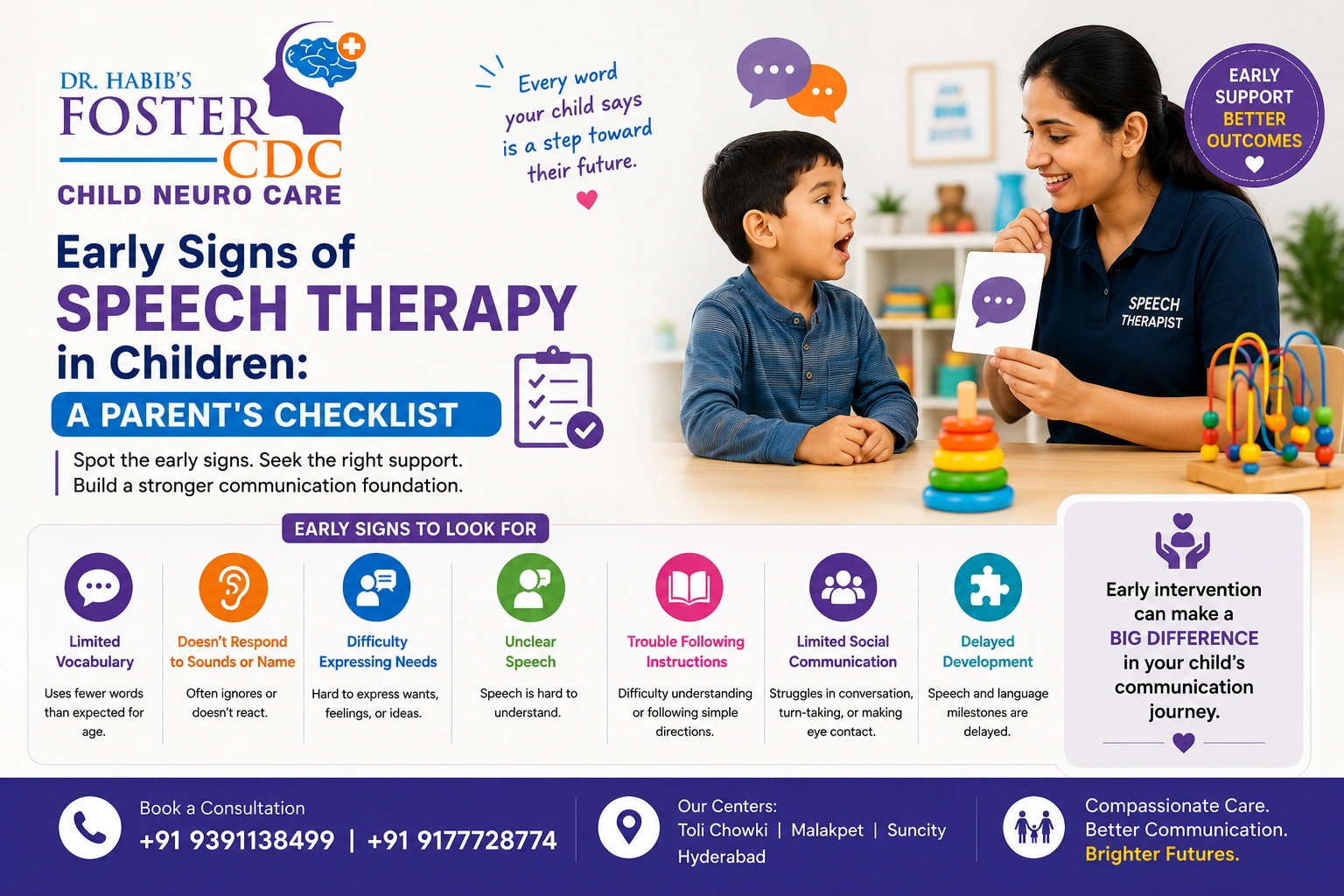
Early Signs of Speech Therapy in Children: A Parent's Checklist
If you've caught yourself wondering whether your child's speech is "on track," you're not overthinking it — you're paying attention. Many parents searching for speech therapy in Hyderabad start with the same nagging question: is this just a phase, or does my child need professional support? This checklist walks you through the early signs, age by age, so you can move from uncertainty to a clear next step.
At Dr. Habib's Foster CDC, guided by Dr. Habib G Pathan, Developmental Pediatrician, we help families tell the difference between typical variation and signs that deserve a closer look. This guide reflects that clinical experience — but it isn't a substitute for a professional evaluation.
Quick Answers
What are early signs a child needs speech therapy?
Common signs include limited babbling by 12 months, few words by 18 months, difficulty combining words by age 2, unclear speech that's hard for others to understand, and frustration when trying to communicate.
At what age should I be concerned about speech delay?
While every child develops at their own pace, it's worth discussing with a pediatrician if your child isn't using single words by 18 months or isn't combining two words by age 2.
Is speech delay in toddlers common?
Yes, speech delay in toddlers is one of the most common developmental concerns parents raise, and many cases improve significantly with early, targeted support.
How do I find a speech therapist near me?
Start by asking your pediatrician for a referral to a licensed speech-language pathologist, or search for a child development centre offering structured speech and language evaluations.
Does speech delay always mean something serious?
No. Speech delay can result from many factors, including normal individual variation, hearing issues, or bilingual environments — an evaluation helps clarify the specific cause.
Can speech therapy really help my child catch up?
Yes. Many children make significant progress with consistent, early speech therapy, especially when it starts before school age.
Why Early Signs Matter
Speech and language skills build on each other — early communication forms the foundation for later skills like reading, social interaction, and classroom learning. Catching potential delays early, rather than waiting to "see if it resolves on its own," gives your child the best chance to build strong communication skills before school starts.
Speech Development Checklist by Age
Common Signs Parents Notice First
Communication Signs
Limited vocabulary compared to peers
Difficulty forming sentences
Trouble following simple instructions
Relying heavily on gestures instead of words
Clarity and Pronunciation Signs
Speech that's hard for family members to understand
Substituting or dropping certain sounds consistently
Speech that's noticeably behind same-age peers
Behavioral Signs Linked to Speech Difficulty
Frustration or tantrums when trying to communicate
Avoiding talking in group settings
Pointing or grunting instead of using words
What Causes Speech Delay in Toddlers?
There's rarely one single cause. Common contributing factors include:
Hearing difficulties — Even mild, undetected hearing loss can affect speech development.
Oral-motor challenges — Difficulty coordinating the muscles used for speech.
Developmental conditions — Speech delay can sometimes occur alongside broader developmental differences.
Environmental factors — Limited language exposure or interaction can play a role, though this is far less common than assumed.
Bilingual environments — Children learning two languages may show temporary differences in vocabulary size, which usually isn't a cause for concern on its own.
A speech-language evaluation helps identify which factors, if any, are contributing to your child's specific delay.
Myths vs Facts About Speech Delay
When to See a Speech Therapist Near Me
Consider scheduling an evaluation if your child:
Isn't using single words by 16–18 months
Isn't combining two words by age 2
Has speech that's hard to understand by age 3
Shows noticeable frustration when trying to communicate
Has regressed in speech or language skills they previously had
Do's and Don'ts
Do:
Track specific words and phrases your child uses and when
Talk to your pediatrician even if you're unsure it's "serious enough"
Seek a formal evaluation from a licensed speech-language pathologist
Practice simple, everyday language interaction at home
Don't:
Assume delay will always resolve without support
Compare your child too strictly to siblings or peers
Wait until school age if signs are present earlier
Rely only on online checklists instead of a professional evaluation
How a Speech Therapy Evaluation Works
Initial screening — A brief assessment of your child's current communication skills.
Comprehensive evaluation — A speech-language pathologist assesses vocabulary, sentence structure, clarity, and understanding.
Hearing check — Often recommended to rule out hearing-related causes.
Personalized therapy plan — Based on findings, a plan is built around your child's specific needs.
Ongoing progress reviews — Goals are tracked and adjusted as your child develops.
If you're exploring speech therapy in Hyderabad, ask potential centres how they structure this evaluation process before committing to a plan.
Key Takeaways
Speech and language milestones follow a general pattern, and noticeable delays are worth discussing with a professional.
Speech delay in toddlers is common and often responds well to early, consistent therapy.
A proper evaluation — not just observation — is the best way to understand the cause and next steps.
Early support builds a stronger foundation for later academic and social skills.
For related guidance, see our articles on why your child may not be speaking yet and signs of speech delay in children.
Frequently Asked Questions
1. What is considered a speech delay in toddlers? A speech delay generally refers to a child not reaching expected language milestones for their age — such as limited vocabulary by 18 months or not combining words by age 2.
2. How can I tell if my child just needs more time versus needing speech therapy? It's best to have a professional evaluation rather than guessing. A speech-language pathologist can assess whether your child's pattern reflects typical variation or a delay needing support.
3. Can hearing problems cause speech delay? Yes. Even mild or undetected hearing loss can significantly affect speech development, which is why hearing checks are often part of a speech evaluation.
4. Is it normal for bilingual children to speak later? Bilingual children may show temporary differences in vocabulary size per language, but this isn't the same as a true speech delay and usually isn't a cause for concern.
5. What happens during a first speech therapy session? The first session usually involves building rapport with your child through play-based activities while the therapist observes communication skills and begins working toward initial goals.
6. How long does speech therapy usually take to show results? This varies by child and the specific delay, but many families notice gradual improvement over weeks to months with consistent therapy and home reinforcement.
7. Can I do anything at home to support my child's speech development? Yes. Simple strategies like narrating daily activities, reading together, and giving your child time to respond can meaningfully support speech development alongside professional therapy.
8. Where can I find a qualified speech therapist near me in Hyderabad? Ask your pediatrician for a referral, or look for a child development centre with licensed speech-language pathologists and a structured evaluation process.
9. Does stuttering count as a sign of speech delay? Stuttering is a distinct speech difference from general delay, though it's also worth having evaluated, especially if it persists or causes frustration for your child.
10. Should I wait until my child starts school to address speech concerns? No. Addressing speech concerns earlier, ideally during toddler or preschool years, is generally associated with stronger outcomes than waiting until school age.
Conclusion
Trusting your instincts as a parent matters — if something about your child's speech feels off, it's worth a closer look rather than waiting to see. Whether your child shows one sign or several from this checklist, a professional evaluation can give you clarity and, if needed, a clear path forward through speech therapy in Hyderabad.
If you've noticed any of these signs, don't wait for certainty before reaching out. Book an assessment with Dr. Habib's Foster CDC in Hyderabad, and take the first step toward understanding your child's communication needs.
This article is for informational purposes only and is not a substitute for professional medical evaluation. Please consult a qualified developmental pediatrician or speech-language pathologist for concerns about your child's development. For further reading, see resources from the World Health Organization (WHO), the American Academy of Pediatrics (AAP), and the American Speech-Language-Hearing Association (ASHA).
Other Blogs


Services
- Behavioural Therapy
- Speech Therapy
- Special Education
- Parent Training
- Psychotherapy & Counselling
- Yoga Therapy
- Postural & Mobility Therapy
- Early Intervention Services
- Cognitive Behavioural Therapy
- Occupational Therapy
- Group Teaching
- Teachers' Training
- Certified Courses
- Developmental Therapy
- Autism Therapy

Special School for Kids with vocational courses & therapies coming soon...