Developmental Delay Treatment in Hyderabad: Your Child's Care Team, Step by Step
By Dr. Habib G Pathan, Developmental Pediatrician, Dr. Habib's Foster CDC, Hyderabad Last updated: October 2026
Quick answer: There is no single treatment for global developmental delay. Care usually has three strands: checking for and treating medical contributors (hearing, vision, thyroid, iron and vitamin B12 among them), starting therapy in the delayed areas (speech, occupational therapy, physiotherapy, behaviour support, special education), and a home program led by parents. Indian pediatric guidance advises starting therapy as soon as a delay is recognised, without waiting for a final diagnosis.
The report has a phrase you may never have seen before: global developmental delay. The doctor explained it kindly, and the appointment ended. Now it is evening, and what you need is practical. Who do we see on Monday? What will they actually do with my child? Is anything being missed?
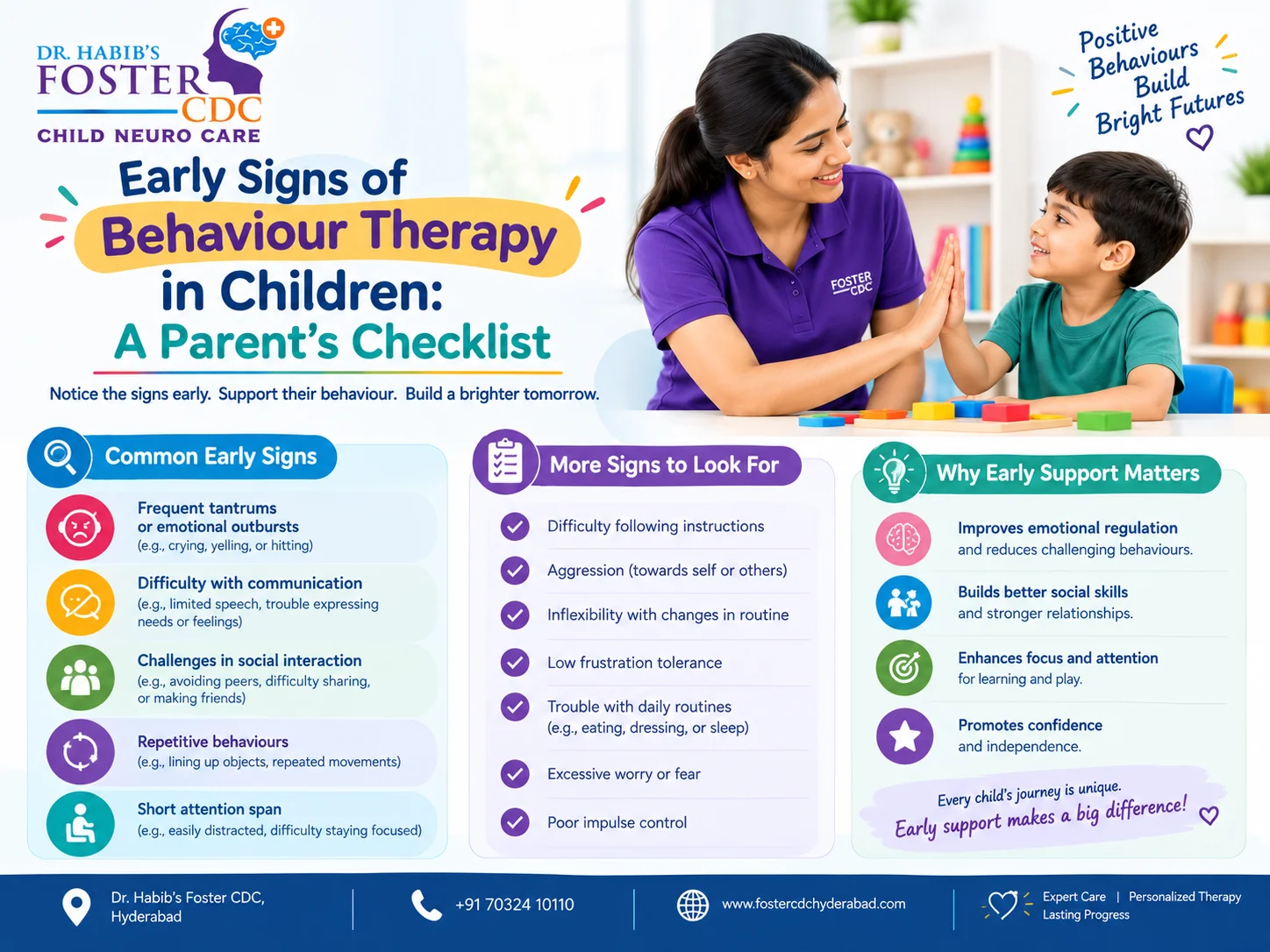
This guide covers the treatment side of that question, in the order things usually happen. It assumes your child has already been assessed or flagged. If you are still at the "is something wrong?" stage, begin with our early signs checklist and our overview of signs, causes and tests, then come back.
What Does "Treatment" Mean for Developmental Delay?
It does not mean one medicine or one procedure. Developmental delay describes how a child's skills are progressing, so treatment has two parts: finding and managing anything medical that is holding development back, and giving the child structured, repeated support in the skills that are lagging. A third part runs through both: the family.
For reference, global developmental delay (GDD) is the label used when a child under five is significantly behind in two or more areas of development. The Indian Academy of Pediatrics (IAP) consensus guideline defines "significant" as performance at least two standard deviations below the average on standardized developmental tests. It also treats GDD as a working label that gets reviewed as the child grows, not a fixed verdict.
Step 1: Check for Causes That Can Be Treated
Before therapy plans are fine-tuned, a good team asks whether something treatable is contributing. The IAP guideline recommends:
- Hearing and vision screening in every child, ideally before standardized developmental testing. Untreated hearing or vision problems can look like delay, or make a delay worse.
- Blood tests aimed at treatable conditions, such as an underactive thyroid, iron deficiency and vitamin B12 deficiency, with further tests when the history or examination points to them.
- Brain imaging, EEG or genetic tests only when there is a reason, such as seizures, an unusual head size, loss of skills, or signs of a genetic syndrome. The guideline asks doctors to plan tests after a careful history and examination, not run a fixed battery on every child.
Two honest points. Which tests your child needs is a medical decision, so it is fair to ask, "What result would change the plan?" And even after thorough testing, a cause is sometimes not found. That is not a failure of the work-up, and therapy does not have to wait for an answer.
Step 2: Start Therapy Without Waiting for a Final Label
Many families hold off therapy "until all the reports are in." The IAP guideline says the opposite: early intervention should begin soon after a delay is recognised, rather than waiting for a formal diagnosis. The American Academy of Pediatrics (AAP) 2020 clinical report on developmental surveillance and screening makes a similar point: a concern raised at a check-up should lead to standardized screening or a direct referral to early intervention and specialty care.
The American Speech-Language-Hearing Association (ASHA) adds a useful distinction. Milestone checklists help parents and doctors notice when to ask questions, but they are not tools for diagnosing or planning care. That job belongs to a proper assessment.
Who Is on the Care Team?
The IAP guideline describes a multidisciplinary team. Not every child needs every member.
| Team member | What they contribute |
|---|---|
| Developmental pediatrician or pediatric neurologist | Leads the plan: diagnosis, medical work-up, related conditions, reviews |
| Speech-language therapist | Communication, understanding, speech sounds, feeding and swallowing |
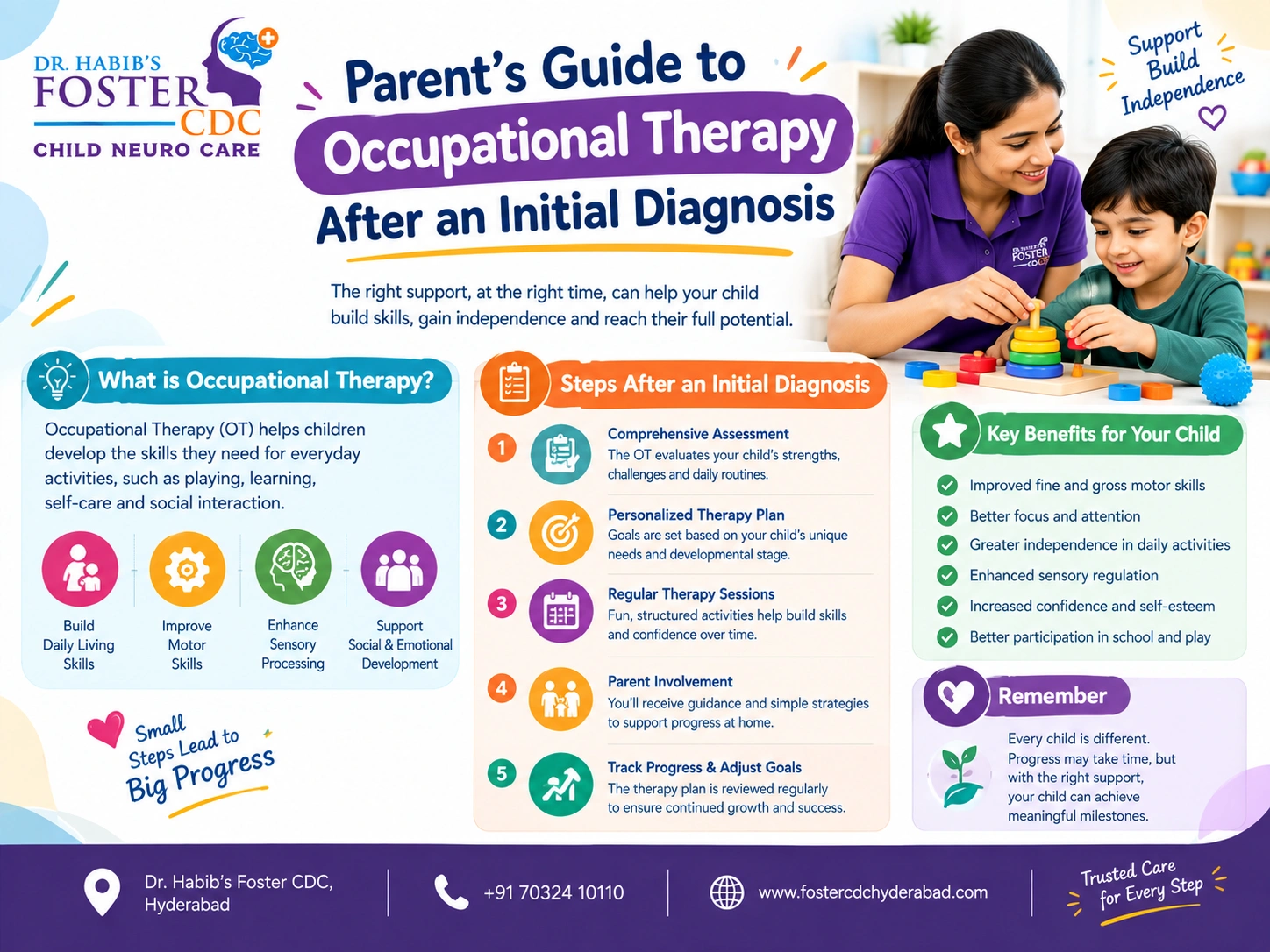
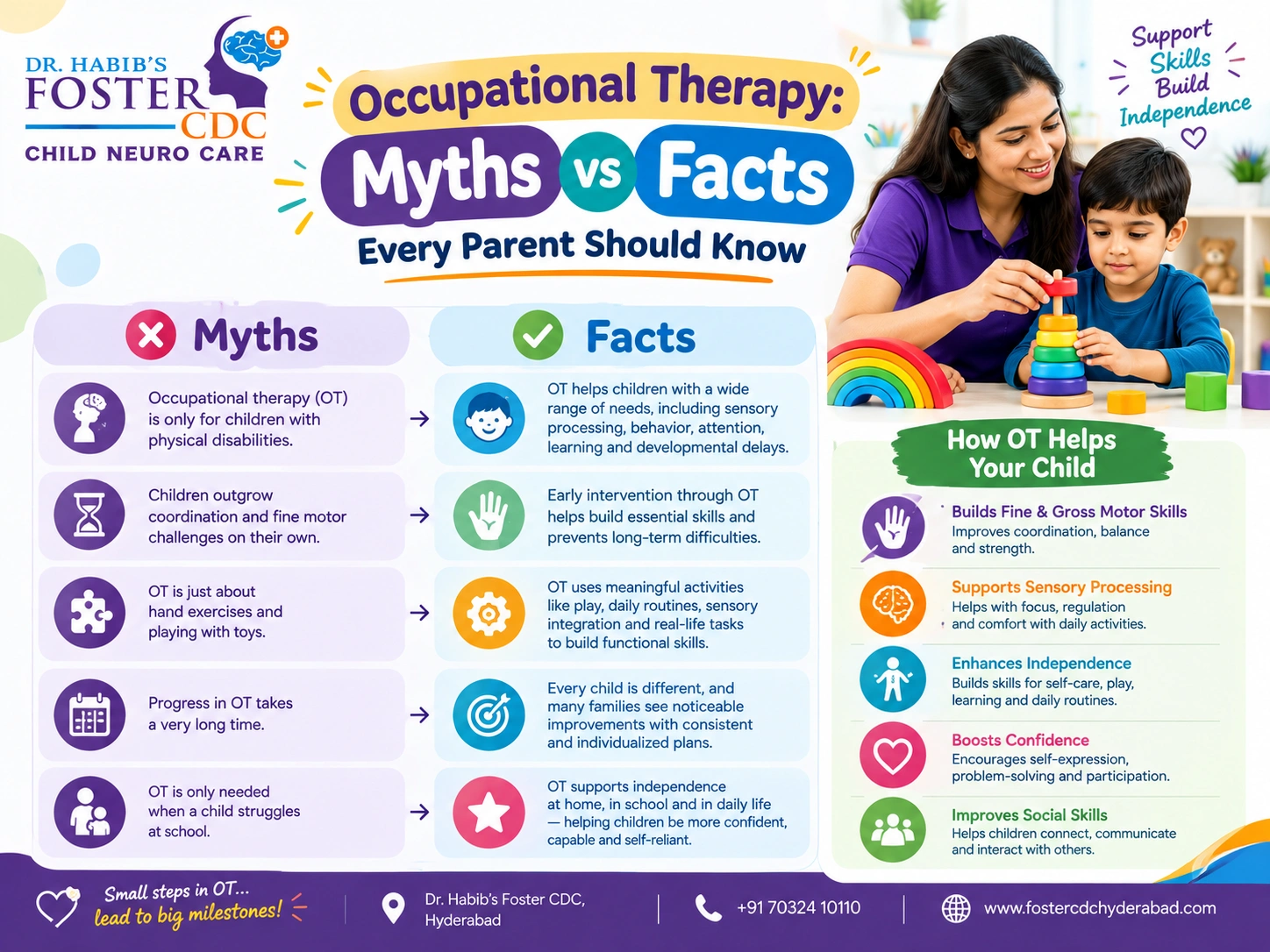
| Occupational therapist | Hand skills, self-care, sensory processing, play |
| Physiotherapist | Movement, posture, balance, muscle tone |
| Clinical psychologist or behaviour therapist | Cognitive and adaptive assessment, behaviour plans, parent coaching |
| Special educator | Learning readiness, preschool and school planning |
| Parents and caregivers | Daily practice, the only people present every day |
A child whose delay is mainly in speech and play may need two or three of these. A child with significant motor and learning delay may need most of them. The point of the plan is to match, not to collect disciplines.
Step 3: Build the Plan Around the "Next Milestone"
The IAP guideline describes a few principles that separate a useful plan from a generic one: goals are individualised, the next immediate milestone is the target, skills from several areas are worked on together, play is the teaching method, and the family practices at home.
Here is what that can look like. This is an illustrative example, not a real case.
A three-year-old points to what she wants but has no words, holds her spoon in a fist, and walks well. Her next milestones might be imitating sounds and using single words such as "more", and holding the spoon with her fingers. At mealtimes, the family pauses before giving the next spoonful and waits for a sound, a gesture or a word. One routine now serves both the speech goal and the hand-skills goal. That is what working on several areas at once looks like in daily life.
A plan worth trusting usually has written goals, a small number of priorities at a time, a stated review date, a defined role for the family, and one person who coordinates the whole team.
How Often, How Long, and How Will We Know It Is Working?
No guideline offers a universal number of sessions. Frequency and duration depend on the child's profile, the severity of the delay, and what else is going on medically. Ask the team to put three things in writing: how often sessions happen, what practice is expected at home, and when the first review is.
At each review, look for:
- New skills, in any area, however small
- Areas that are moving, and areas that have stalled
- Any new concern, or any loss of a skill, which should prompt a medical review rather than waiting for the next scheduled visit
The IAP guideline also advises reviewing the diagnosis itself at least once a year in the early years, so that a related condition is not missed. A simple home log (date, new skill, what helped) makes every review more useful.
What Else May Need Treating Alongside Delay?
Children with global developmental delay are more likely than others to have additional needs. These can include vision or hearing problems, seizures, sleep difficulties, feeding problems, cerebral palsy, attention difficulties and autism. The IAP guideline notes that young children with developmental delay are three to four times more likely to show behaviour problems than typically developing peers, and recommends autism screening at 18 to 24 months, repeated at 3 years if the first screen is negative.
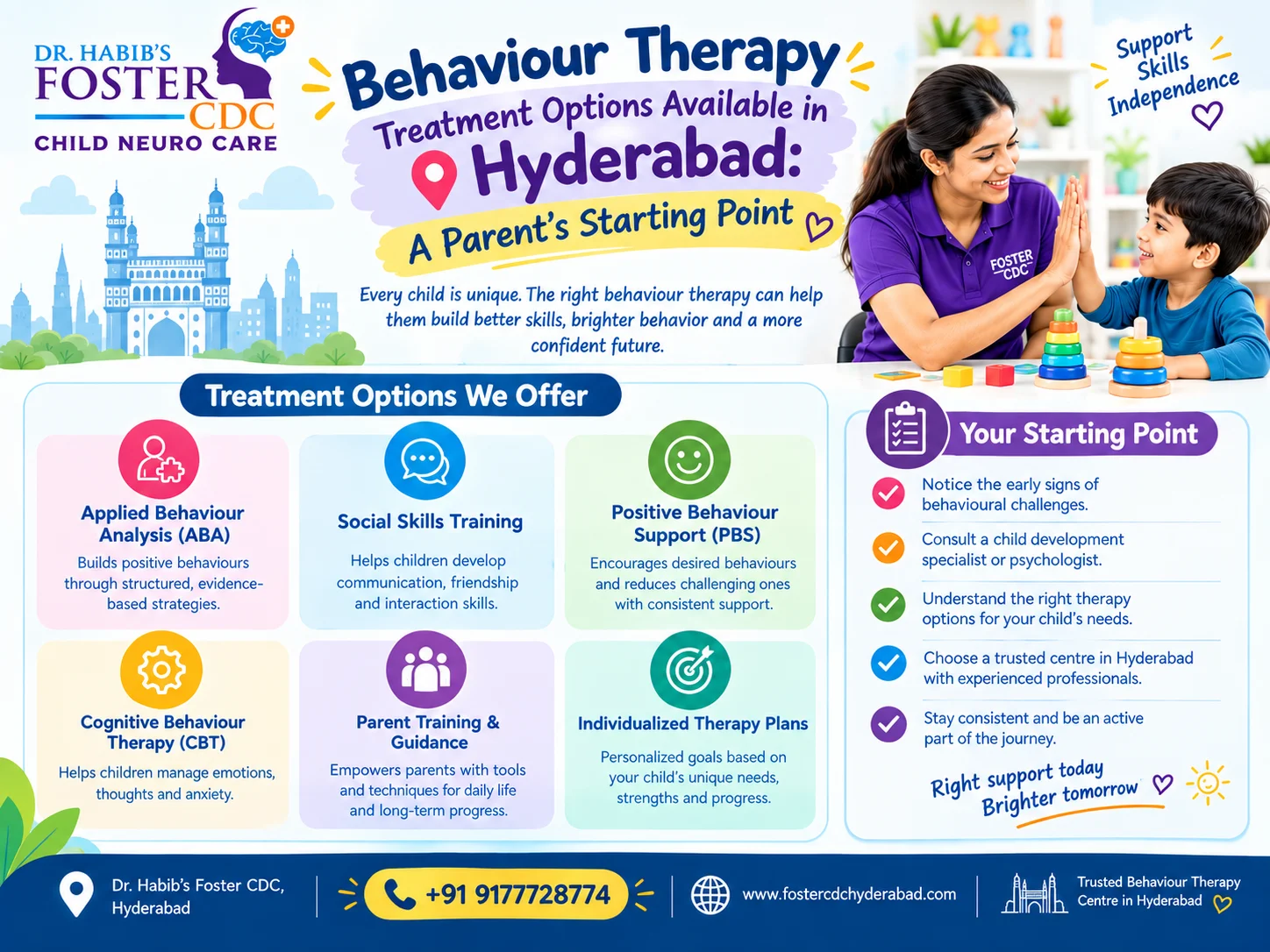
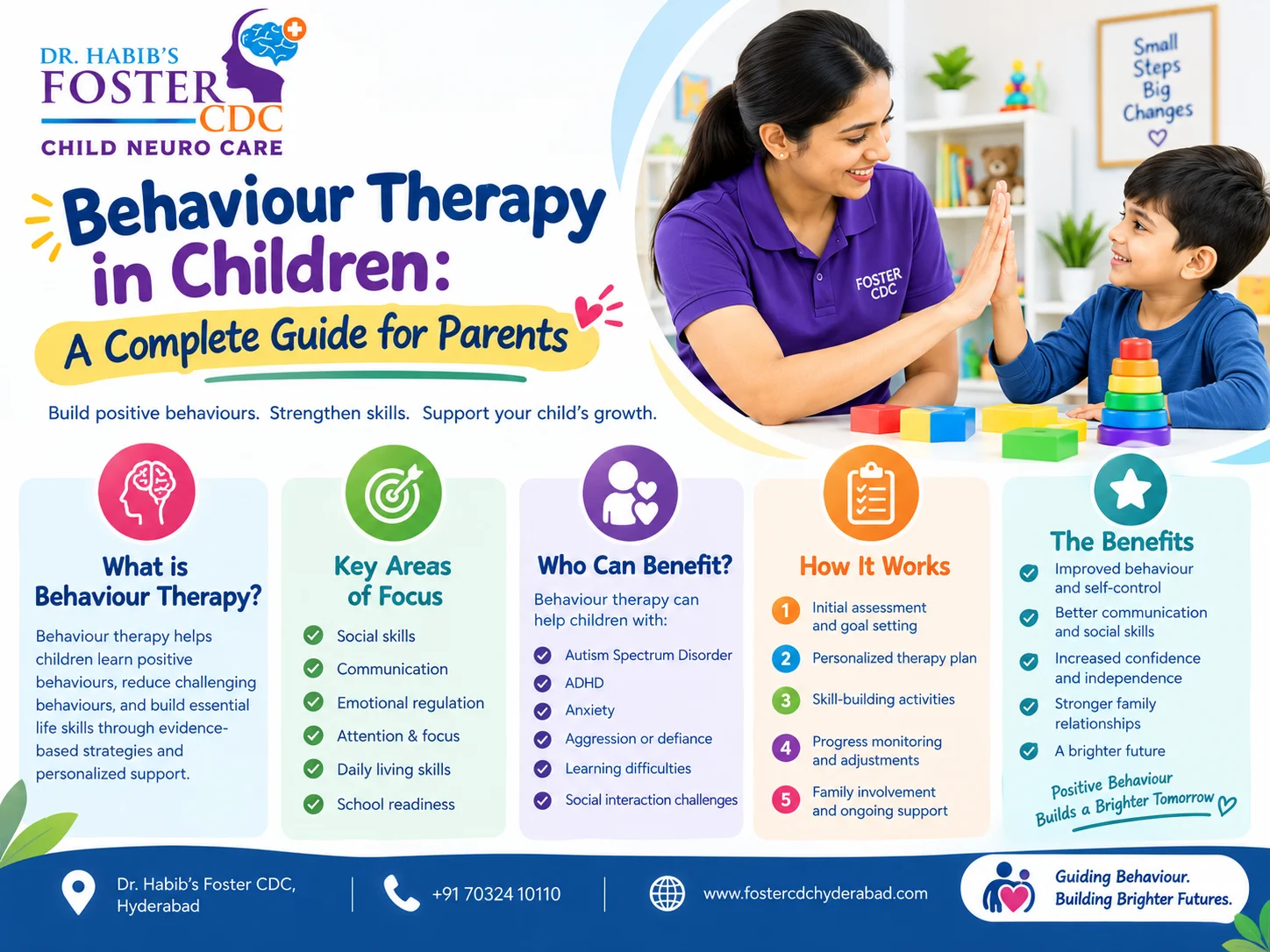
Tell your doctor promptly about staring spells, sudden jerks, unexplained loss of skills, or persistent trouble with sleep or feeding. If behaviour is the main strain at home, our guides to behaviour therapy in children and autism treatment options cover those branches in more depth.
Where Can You Get Treatment in Hyderabad?
Families commonly combine more than one route. The table describes categories of service, not rankings, because availability, fees and waiting times change.
| Route | What it typically offers | Often suits | Worth checking |
|---|---|---|---|
| Government early intervention services (under the national RBSK program, District Early Intervention Centres at district hospitals, ages 0 to 6) | Follow-up of screened children, therapy services such as occupational therapy, physiotherapy, speech-language and psychology support, and referral to higher centres | Families who want public-sector services or a first confirmation and referral | Which centre serves your area, which services are running now, and waiting times. Your pediatrician or district health office can tell you |
| Hospital-based developmental, neurology or genetics clinics | Medical work-up such as imaging, EEG, metabolic and genetic testing, and seizure care | Complex cases, loss of skills, seizures, or a suspected genetic syndrome | How soon you can be seen, and where regular therapy will happen afterwards |
| Child development centres (private or non-profit) | Several therapies under one roof, regular session schedules, parent training | Children who need frequent, coordinated therapy | Therapist credentials, written plans and review dates, and how the team coordinates with your doctors |
The IAP guideline frames care in similar levels: pediatricians and district-level services for milder delay, and tertiary multidisciplinary teams for complex or severe cases. A child can move between levels as needs change.
Questions to Ask Any Centre
- Who leads the plan, and what is their training?
- How do you set a starting point for my child, and with which tools?
- Can I have the goals in writing, with a review date?
- What will I be asked to practice at home, and who will show me?
- How do you coordinate with my child's other doctors and therapists?
- What happens if progress is slower than expected?
Treat any promise of a "cure" or a guaranteed timeline with caution. Honest teams talk about goals and reviews, not guarantees.
Paperwork and Schooling: Disability Certificate, UDID and Preschool
This part is easy to overlook, and it is separate from therapy. Starting therapy does not have to wait for any certificate.
Under India's Rights of Persons with Disabilities Act, 2016, GDD in children aged 1 to 5 years falls under the intellectual disability category for certification purposes. As summarised in the IAP guideline:
- The minimum age for certification is one completed year.
- Children under five receive a temporary certificate, with reassessment after three years or at age five, whichever comes first.
- Assessment is by a medical board that includes a pediatrician or pediatric neurologist, a psychologist and a psychiatrist.
- Applications can be made through the national Swavlamban (UDID) portal or at a government hospital. Telangana may also run its own online process, so confirm current steps with the district hospital.
A certificate can help families access certain government schemes and educational provisions. Rules and benefits vary, so ask the board what applies to your child.
For schooling, the IAP guideline notes that India's Right to Education framework expects children with disabilities to be educated in the least restrictive setting that meets their needs. A special educator can help plan the preschool years. See our special education service for what that support involves.
Turning Therapy Into Daily Routines
The WHO's 2020 guideline on early childhood development recommends supporting responsive caregiving and early learning, because children develop through warm, playful interaction with the adults around them. For a child in therapy, that means practice does not need a special setting.
Ask your therapist for one or two targeted activities, not ten. Then attach them to routines you already have:
- Mealtimes: turn-taking, requesting, trying a new texture
- Bath and dressing: naming body parts, following one-step instructions
- Floor play: imitating actions and sounds, taking turns with a toy
If you want structured coaching, our parent training program teaches exactly this.
What Outcomes Can Families Realistically Expect?
The honest answer is that it depends on the child. According to the IAP guideline, the degree of delay is the most consistent predictor of long-term outcome, and children with milder delay tend to do better than those with moderate to severe delay. Early intervention has been linked to gains in everyday functioning, learning and social skills. Not every child who receives a GDD label goes on to have an intellectual disability. Some later receive a more specific diagnosis, and others make enough progress that the picture changes.
Progress is rarely a straight line. Plateaus and quick jumps both happen. What helps most is a team that reviews honestly and adjusts the plan.
How Foster CDC Approaches Developmental Delay
At Dr. Habib's Foster CDC, developmental care is led by a developmental pediatrician. According to our developmental therapy service page, the assessment uses a standardized tool across areas such as social, adaptive, communication, motor and cognitive skills, and that starting point is used to measure progress. Goals are set together with the family.
Depending on the child's needs, support can include speech therapy, occupational therapy, postural and mobility therapy, behavioural therapy, early intervention services and special education. Our personalized therapy plans article explains how goals are set. The centres page lists our locations: Toli Chowki, Malakpet and Suncity. If your child is nervous about starting, see how to prepare your child for the first therapy session.
Dr. Habib G Pathan's profile is on our experts page.
Five Things That Slow Families Down
- Waiting for every report before starting any therapy
- Skipping the hearing and vision checks because "he seems to see and hear fine"
- Stopping a therapy after one area improves, while others are still behind
- Running several providers who never speak to each other
- Expecting steady, week-by-week progress
Final Thoughts
Treating developmental delay is less about finding one right therapy and more about building a team around your child: medical checks first, therapy started early, goals written down, family practice woven into daily life, and honest reviews. You do not need to have everything in place this week. You need a first appointment and the right questions.
If you would like an individual assessment, book an appointment with Dr. Habib's Foster CDC and we will help you plan the next step.
Frequently Asked Questions
What is the treatment for global developmental delay? There is no single treatment. Care combines medical checks for treatable causes, multidisciplinary therapy matched to the delayed areas (such as speech, occupational therapy, physiotherapy, behaviour support and special education), and a home program led by parents, with regular reviews.
Can therapy start before all the tests are done? Yes. The Indian Academy of Pediatrics advises starting early intervention soon after a delay is recognised, instead of waiting for a formal diagnosis. Your doctor will still arrange the tests that are needed.
Which therapies does a child with developmental delay need? That depends on which areas are delayed. A child with mainly speech delay may need speech therapy and parent coaching, while a child with delays in movement, communication and learning may need several therapies working together.
Is medicine used to treat developmental delay? Medicines do not treat the delay itself. They may be used for treatable causes, such as thyroid hormone for an underactive thyroid or supplements for deficiencies, and for related conditions such as seizures. A doctor decides this for each child.
How long does treatment take? There is no fixed duration. Some children make steady gains over months, while others need support for years. Ask for written goals and a review date so you can see how progress is measured.
Can a child with global developmental delay go to a regular school? Often with support, depending on the child's abilities and any related conditions. Indian guidance expects children with disabilities to be educated in the least restrictive setting that meets their needs, and special educators can help plan this.
Do we need a disability certificate to start therapy? No. The certificate is a separate process under the Rights of Persons with Disabilities Act, 2016, and may help with access to some schemes. Therapy does not have to wait for it.
When should I seek urgent medical attention? See a doctor promptly if your child loses skills they once had, has seizures or repeated staring spells, or has sudden changes in alertness, feeding or sleep.
Where can I get a developmental assessment in Hyderabad? Options include government early intervention services, hospital-based developmental or neurology clinics, and child development centres. Dr. Habib's Foster CDC offers developmental assessment at its Toli Chowki, Malakpet and Suncity centres.
Dr. Habib G Pathan is a Developmental Pediatrician at Dr. Habib's Foster CDC, Hyderabad. This article is for general information and does not replace an individual medical assessment. Please consult a qualified developmental pediatrician about your child's development.
Other Blogs


Services
- Behavioural Therapy
- Speech Therapy
- Special Education
- Parent Training
- Psychotherapy & Counselling
- Yoga Therapy
- Postural & Mobility Therapy
- Early Intervention Services
- Cognitive Behavioural Therapy
- Occupational Therapy
- Group Teaching
- Teachers' Training
- Certified Courses
- Developmental Therapy
- Autism Therapy