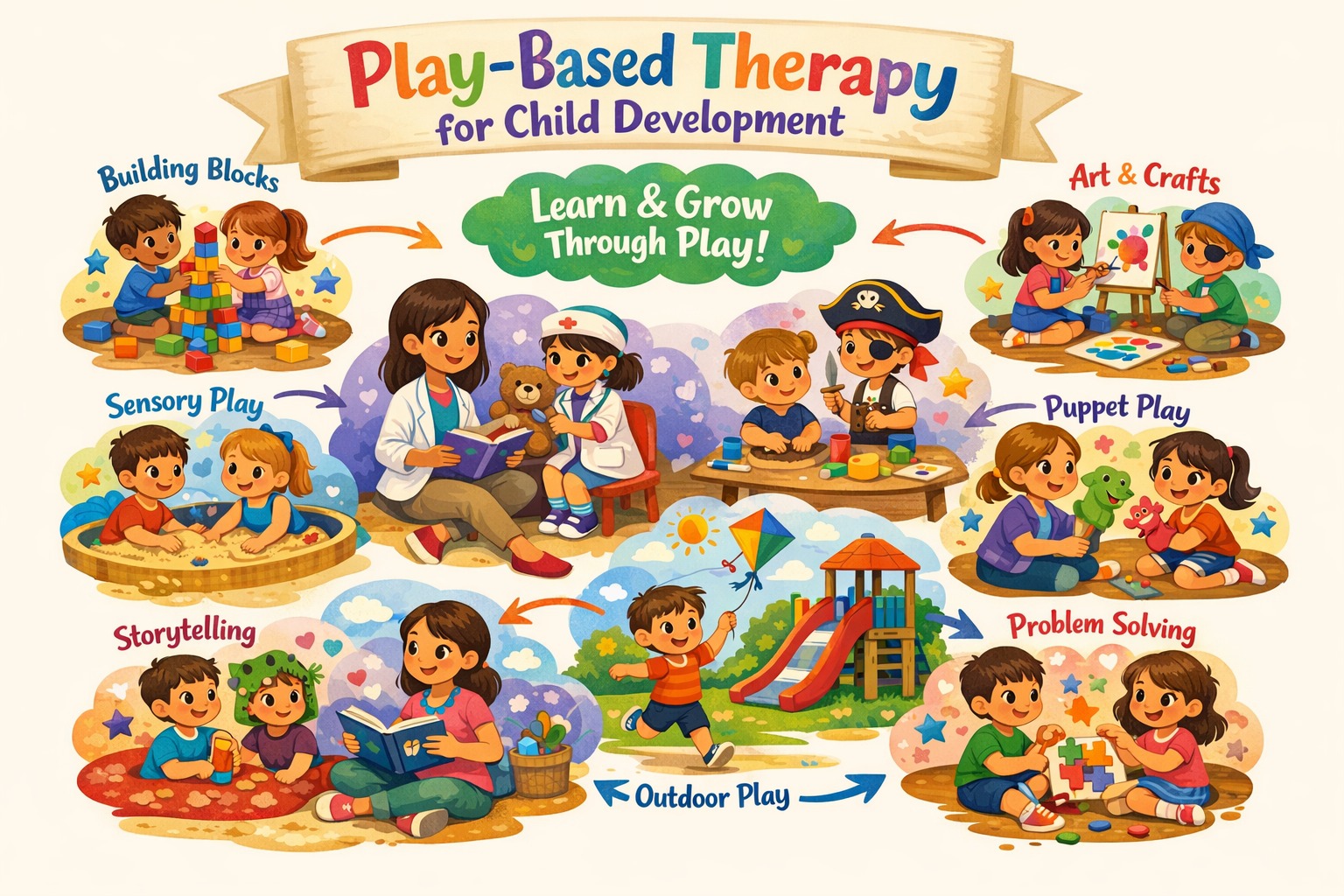
Play Based Therapy for Child Development: Benefits, Activities and Real Growth Guide
Every parent notices it at some
point.
Maybe your child avoids eye
contact. Maybe they prefer playing alone. Or perhaps simple things like
expressing feelings or following instructions feel harder for them than
expected.
And then comes the question that
quietly sits in your mind.
Is something wrong?
The honest answer is not
necessarily.
Every child develops at their own
pace. Sometimes, they just need the right environment that feels safe, engaging
and natural.
That is exactly where play based therapy for child
development makes a powerful difference.
What is
Play Based Therapy?
Play based therapy is not just
playing. It is a structured therapeutic approach where children learn, express
and grow through guided play activities.
At an early age, children do not
always communicate through words. They communicate through actions through
play.
Instead of forcing learning, this
method allows children to explore emotions naturally, build social skills and
improve communication without pressure.
Think of it like this.
A child who struggles to speak
might open up while playing with toys or storytelling.
A child with anxiety may feel
more comfortable expressing feelings through drawing or games.
It is learning without the child even realizing they are
learning.
Who Needs
Play Therapy?
1 Autism
Spectrum Disorder
2 ADHD
3 Speech
delay or communication difficulties
4 Social
anxiety or lack of confidence
5 Developmental
delays
6 Emotional
regulation issues
7 Learning
difficulties
Even children who seem quiet or withdrawn can benefit from
structured play therapy sessions.
Types of
Play Based Therapy Activities
Art Based
Therapy
1 Children
express feelings through drawing and crafts.
2 Improves
creativity and imagination.
3 Helps
release emotions and build focus.
Game
Based Therapy
1 Includes
puzzles and structured games.
2 Improves
attention span and thinking skills.
Group
Play Activities
1 Helps
children interact with others.
2 Builds
social confidence and communication.
Storytelling
Therapy
1 Uses
stories and role play.
2 Improves
language and emotional understanding.
Expressive
Arts
1 Includes
music, dance and movement.
2 Helps
in emotional expression and reduces stress.
Parent
Child Interaction Therapy
1 Parents
actively participate.
2 Improves
bonding and behavior management.
Benefits
of Play Therapy for Children
1 Better
emotional control
2 Improved
communication skills
3 Increased
confidence
4 Reduced
anxiety and stress
5 Better
social interaction
6 Improved
focus and learning ability
For example, a child who avoids speaking may start
communicating after engaging in storytelling and role play therapy sessions.
When Should
You Start Play Therapy?
The earlier, the better.
Play therapy works best during
early childhood from ages two to eight.
Early intervention helps prevent bigger developmental
issues and improves long term learning.
Play
Therapy vs Normal Play
|
Play Based Therapy |
Normal Play |
|
Structured
and goal oriented |
Free
and unstructured |
|
Guided
by therapist |
Self
directed |
|
Focused
on development |
Focused
on fun |
Frequently
Asked Questions
Is play therapy safe for
children? Yes, all activities are designed to support safe growth.
How can parents identify early
signs? Look for difficulty in speaking, lack of interaction or focus issues.
Can parents help at home? Yes,
structured routines and engagement can help in mild cases.
How often should therapy sessions be done? Three to five
times a week for intensive support and two to three times for moderate support.
Final
Thoughts
Play based therapy is not just a
treatment. It is a strong foundation for a child's future.
It supports brain development,
emotional growth and social confidence.
Children simply play and grow naturally.
Take the
Next Step
If your child shows signs of
developmental delay or communication challenges, consult a child development
expert today.
Other Blogs
Services
- Behavioural Therapy
- Speech Therapy
- Special Education
- Parent Training
- Psychotherapy & Counselling
- Yoga Therapy
- Postural & Mobility Therapy
- Early Intervention Services
- Cognitive Behavioural Therapy
- Occupational Therapy
- Group Teaching
- Teachers' Training
- Certified Courses
- Developmental Therapy
- Autism Therapy