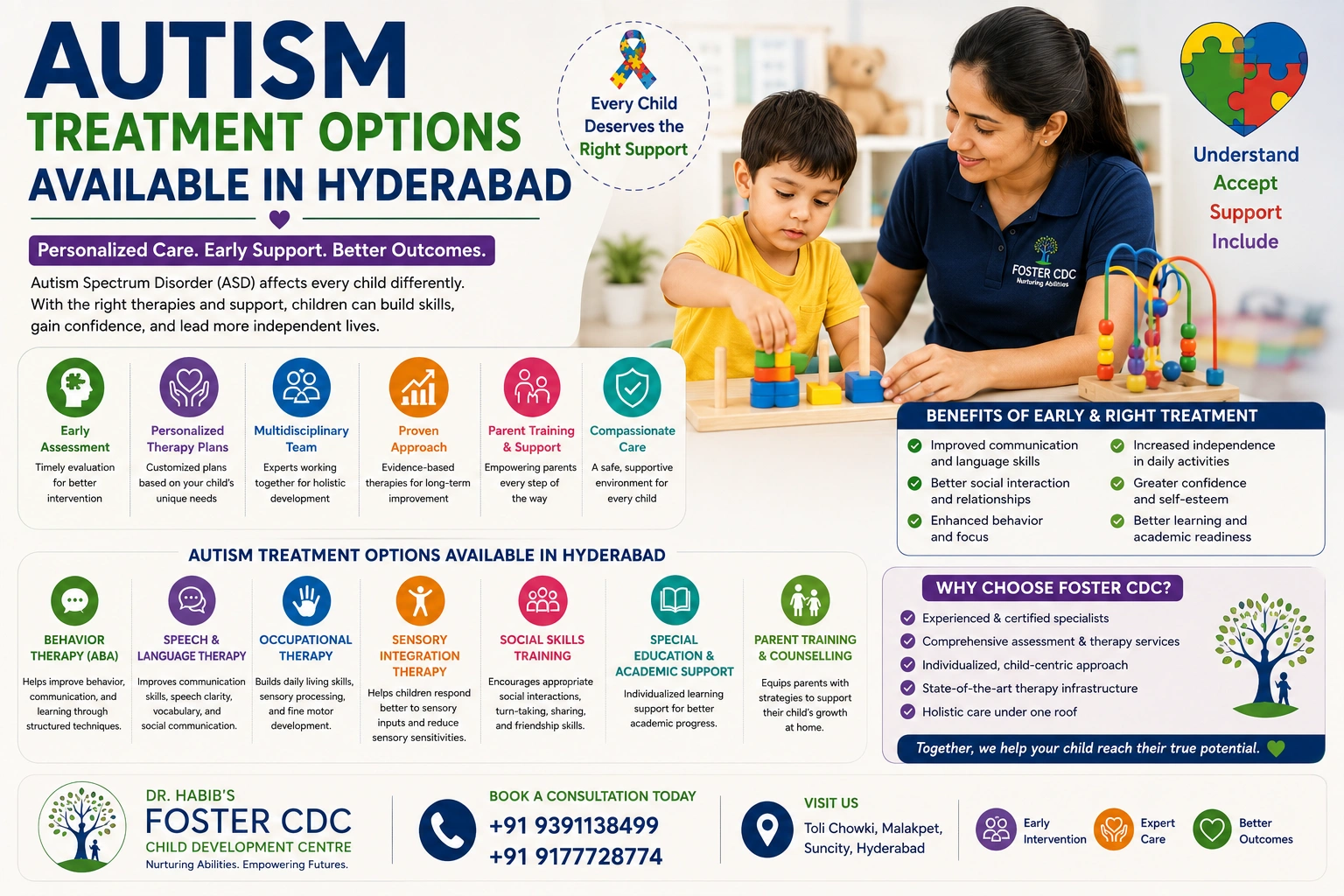
Autism Treatment Options Available in Hyderabad
If your child has recently received an autism diagnosis in Hyderabad, one of the first questions most parents ask is: "What happens next?" The good news is that autism treatment today isn't one-size-fits-all — it's a combination of therapies tailored to your child's specific strengths and challenges. This guide walks you through the treatment options available in Hyderabad, how they work together, and how to choose the right approach for your child.
At Dr. Habib's Foster CDC, guided by Dr. Habib G Pathan, Developmental Pediatrician, we help families build individualized treatment plans rather than following a single fixed program. This article reflects that clinical experience — but it isn't a substitute for a professional evaluation.
Quick Answers
What is the best treatment for autism?
There's no single "best" treatment — the most effective approach combines therapies matched to the child's needs, such as speech therapy, occupational therapy, and behavioral intervention, all delivered consistently over time.
Is autism treatable?
Autism isn't a condition that's "cured," but with the right combination of therapies, most children make measurable progress in communication, social skills, and daily independence, especially when treatment starts early.
What therapies are used for autism?
Common therapies include Applied Behavior Analysis (ABA), speech-language therapy, occupational therapy, sensory integration therapy, DIR/Floortime, and parent training — often used in combination rather than alone.
How soon after diagnosis should treatment start?
Ideally, treatment should begin as soon as possible after an autism diagnosis in Hyderabad is confirmed. Early, consistent intervention during the toddler and preschool years is linked to stronger long-term outcomes.
Do all autistic children need the same treatment plan?
No. Treatment plans should be personalized based on the child's age, communication level, sensory needs, and behavioral profile — a plan that works well for one child may not suit another.
How long does autism treatment typically last?
There's no fixed duration. Some children need intensive support for several years, while others transition to lighter, maintenance-level support as skills develop. Progress is typically reviewed regularly and the plan adjusted accordingly.
Why Treatment Should Follow a Proper Diagnosis
Before exploring treatment options, it's worth understanding why diagnosis matters so much. A structured autism diagnosis in Hyderabad — involving developmental screening, clinical observation, and standardized assessment tools — gives therapists a clear picture of your child's specific strengths, sensory sensitivities, and communication style. Without this, treatment can end up generic rather than targeted, which slows progress.
Main Autism Treatment Options in Hyderabad
1. Applied Behavior Analysis (ABA)
ABA is one of the most researched approaches for autism. It breaks down skills — communication, social interaction, self-care — into small, teachable steps, reinforced through consistent positive feedback.
2. Speech-Language Therapy
Many autistic children experience delayed speech or difficulty with social communication. Speech therapy addresses vocabulary, sentence structure, conversational skills, and non-verbal communication like gestures and eye contact.
3. Occupational Therapy
Occupational therapy in autism focuses on daily living skills, fine motor coordination, and sensory regulation — helping children manage everyday tasks like dressing, eating, and handwriting.
4. Sensory Integration Therapy
Many autistic children experience heightened or reduced sensitivity to sound, light, or touch. Sensory integration therapy uses structured activities to help the nervous system process these inputs more comfortably.
5. DIR/Floortime
This approach follows the child's lead during play to build emotional connection, communication, and thinking skills, rather than using structured drills.
6. Parent Training and Coaching
Parents are taught practical strategies to reinforce therapy goals at home — turning everyday routines like mealtime or bedtime into opportunities for skill-building.
7. Special Education Support
For school-age children, individualized education plans and special education support help bridge academic learning with the child's developmental pace.
Comparison Table: Autism Treatment Approaches
Myths vs. Facts About Autism Treatment
How to Choose the Right Treatment Plan in Hyderabad
Do's:
Start with a comprehensive developmental assessment before choosing therapies
Ask centres how they measure and track progress
Involve yourself directly in home-based reinforcement activities
Reassess and adjust the plan every few months as your child grows
Don'ts:
Don't choose a therapy centre based on marketing claims alone
Don't expect overnight results — meaningful progress takes consistent time
Don't rely on a single therapy type if your child's needs are multi-dimensional
Don't skip follow-up assessments once therapy begins
What a Typical Treatment Journey Looks Like
Assessment — A developmental pediatrician confirms the diagnosis and identifies specific needs.
Individualized Plan — A combination of therapies is recommended based on the assessment.
Active Therapy Phase — Regular sessions begin, often multiple times a week depending on severity.
Progress Review — Therapists track measurable goals and adjust the plan periodically.
Transition & Maintenance — As skills develop, therapy intensity may reduce, shifting toward maintenance and school integration support.
Common Mistakes Parents Make When Choosing Treatment
Delaying treatment while searching for a "perfect" therapy option
Switching centres frequently, which disrupts progress
Focusing only on speech while ignoring sensory or behavioral needs
Not asking for measurable, written progress goals
Key Takeaways
Autism treatment works best as a combination of therapies, not a single fixed program.
A proper autism diagnosis in Hyderabad should come before building a treatment plan, so therapy is targeted rather than generic.
ABA, speech therapy, occupational therapy, sensory integration, and parent training are among the most commonly used approaches.
Consistency and parent involvement matter as much as the specific therapy chosen.
Explore related guidance on autism therapy in Hyderabad and the challenges in autism treatment many families navigate along the way.
Frequently Asked Questions
1. What is the most effective treatment for autism?
There isn't a single "most effective" treatment — outcomes are usually best when therapies like ABA, speech therapy, and occupational therapy are combined and tailored to the child's specific needs.
2. Can autism treatment start without a formal diagnosis?
Some early intervention support can begin based on developmental screening, but a full autism diagnosis in Hyderabad helps ensure the treatment plan is properly targeted to the child's needs.
3. How many hours of therapy does an autistic child need per week?
This varies widely based on severity and age — ranging from a few hours to more intensive weekly schedules. A developmental pediatrician can recommend an appropriate starting point.
4. Is ABA therapy suitable for every autistic child?
ABA can benefit many children, but it isn't the only effective option. Some children respond better to play-based or relationship-focused approaches like DIR/Floortime, often alongside ABA.
5. Can occupational therapy help with sensory issues in autism?
Yes. Occupational therapy, often combined with sensory integration techniques, is commonly used to help children manage sensitivities to touch, sound, and movement.
6. Do older children and teens still benefit from autism therapy?
Yes. While early intervention shows the strongest research support, therapy can still meaningfully improve communication, independence, and social skills at any age.
7. How do I know if a treatment plan is working?
Look for measurable, specific goals set by your therapy team, along with regular progress reviews — not just general reassurance that "things are improving."
8. Is parent training really necessary alongside therapy?
Yes. Reinforcing therapy goals through consistent daily routines at home significantly improves how well skills transfer beyond the therapy room.
9. What should I look for in an autism treatment centre in Hyderabad?
Look for a multidisciplinary team, individualized assessment-based planning, transparent progress tracking, and active parent involvement in the process.
10. Can autism treatment plans change over time?
Yes. As children grow and develop new skills, treatment plans should be reassessed and adjusted — some therapies may reduce in intensity while new goals are introduced.
Conclusion
Choosing the right autism treatment path can feel overwhelming, especially with so many therapy options available. But there's no need to choose just one — the most effective plans combine therapies suited to your child's specific communication, sensory, and behavioral profile, built on a clear autism diagnosis in Hyderabad. With consistency, family involvement, and the right team, many children make steady, meaningful progress over time.
If you're ready to explore a personalized treatment plan for your child, book an assessment with Dr. Habib's Foster CDC in Hyderabad and take the next step with a team that builds plans around your child — not the other way around.
This article is for informational purposes only and is not a substitute for professional medical evaluation. Please consult a qualified developmental pediatrician for concerns about your child's development. For further reading, see resources from the World Health Organization (WHO), the American Academy of Pediatrics (AAP), and the American Speech-Language-Hearing Association (ASHA).
Other Blogs



Services
- Behavioural Therapy
- Speech Therapy
- Special Education
- Parent Training
- Psychotherapy & Counselling
- Yoga Therapy
- Postural & Mobility Therapy
- Early Intervention Services
- Cognitive Behavioural Therapy
- Occupational Therapy
- Group Teaching
- Teachers' Training
- Certified Courses
- Developmental Therapy
- Autism Therapy