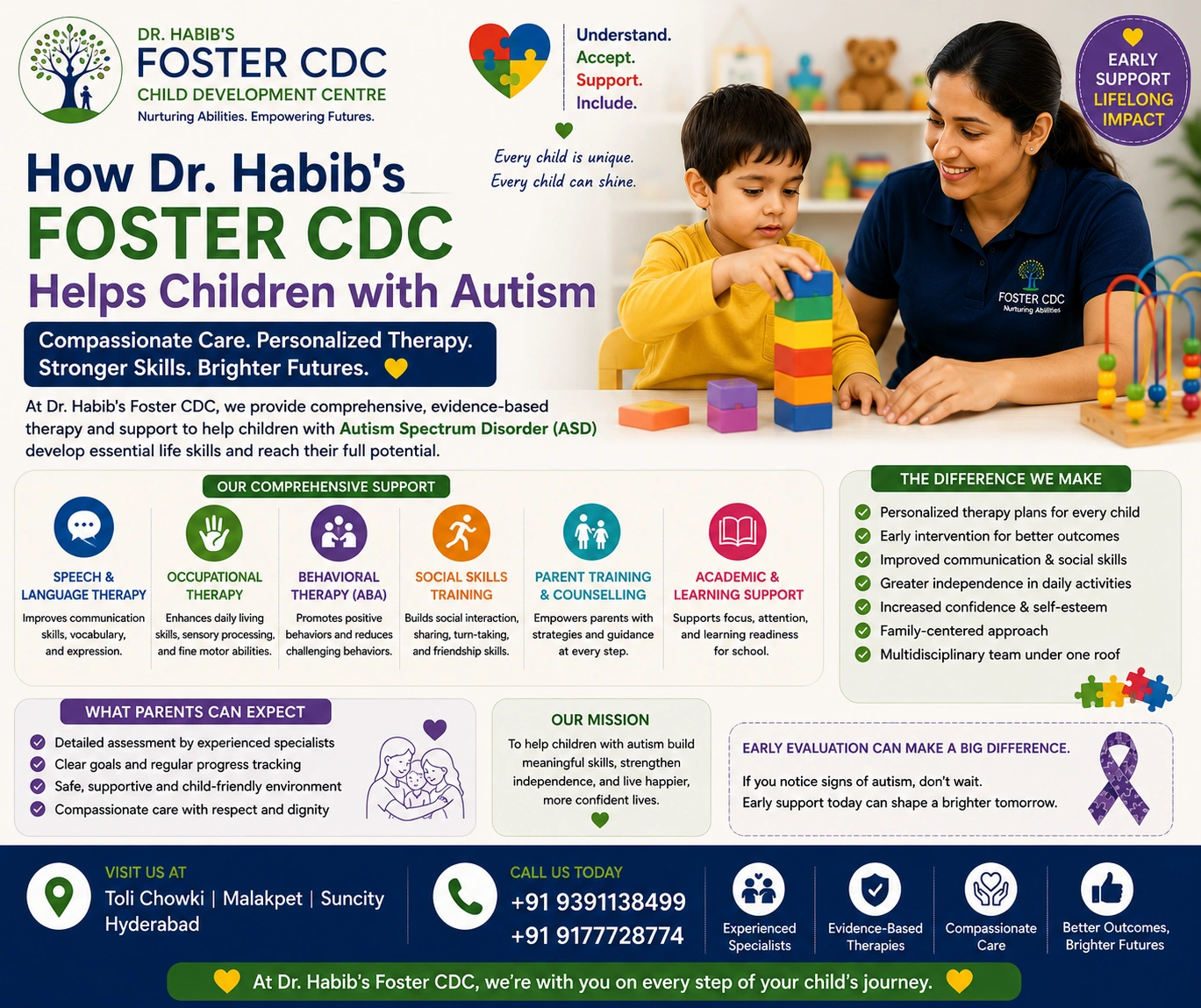
How Dr. Habib's Foster CDC Helps Children with Autism
Quick Answer
Dr. Habib's Foster CDC helps children with autism through a multidisciplinary approach — a structured developmental assessment followed by a personalised plan combining speech therapy, occupational therapy, behavioural therapy, and parent training, delivered by a team of developmental pediatricians and specialists across its Toli Chowki, Malakpet, and Suncity centres in Hyderabad.
Why a Multidisciplinary Approach Matters
Autism affects different children in different ways — one child may struggle mainly with communication, another with sensory sensitivities, another with social interaction or motor coordination. No single therapy addresses every area on its own, which is why leading developmental centres bring several specialists together under one roof rather than sending families from clinic to clinic.
At Foster CDC, every child's plan is built around this principle. Rather than a generic programme, each child moves through an assessment, a personalised plan, and ongoing review — with parents involved as active partners at every stage.
The Foster CDC Approach, Step by Step
1. Developmental Assessment A qualified developmental pediatrician evaluates the child's communication, social behaviour, motor skills, and sensory responses, often alongside standardised screening tools. This forms the baseline for everything that follows.
2. Personalised Therapy Plan Based on the assessment, the team designs a plan drawing on the specific combination of therapies the child needs — not a one-size-fits-all package.
3. Structured Therapy Sessions Children attend regular sessions with trained therapists, using consistent, goal-tracked techniques rather than ad hoc activities.
4. Parent Training Parents are coached on how to reinforce therapy goals at home — because progress made in a 45-minute session compounds when it's practised throughout the week.
5. Ongoing Review Plans are periodically reassessed and adjusted as the child develops, so therapy evolves with the child rather than staying static.
Core Services for Children with Autism
Not every child needs every service — the assessment stage is what determines the right combination for each individual case.
Meet the Team
Foster CDC's clinical team includes Dr. Habib G. Pathan alongside Dr. Zafar Sultana, Dr. Sadiya Akhter, and Dr. Arun Kumar, spanning developmental pediatrics, therapy, and special education — allowing most of a child's care to be coordinated within a single centre rather than fragmented across providers.
Why Families Choose Foster CDC
Three accessible centres across Hyderabad — Toli Chowki, Malakpet, and Suncity (Bandlaguda Jagir)
One coordinated team instead of separate, disconnected specialists
Assessment-led planning, not generic programmes
Active parent involvement built into the process, not an afterthought
Ongoing progress review as the child grows
Frequently Asked Questions
1. What age group does Foster CDC work with? The centre works with children across early childhood and school-age years, with therapy plans adjusted to the child's developmental stage.
2. Do you diagnose autism, or only provide therapy? Foster CDC's developmental pediatricians conduct assessments that can identify autism spectrum disorder and also provide the full range of follow-up therapies.
3. How long does a typical therapy plan run? Duration varies by child and goals — plans are reviewed periodically and adjusted rather than fixed to a single timeline.
4. Can I choose which centre my child attends? Yes — families can choose the Toli Chowki, Malakpet, or Suncity centre based on convenience.
5. Is parent involvement really necessary? Yes. Reinforcing therapy techniques at home is one of the strongest predictors of steady progress between sessions.
6. Does Foster CDC offer special education alongside therapy? Yes, special education is available for children who need learning support in addition to developmental therapies.
7. What happens in the first assessment visit? A developmental pediatrician evaluates the child's communication, behaviour, and skills, and discusses next steps with the family.
8. Are therapy plans the same for every child with autism? No — plans are personalised based on each child's specific assessment results and needs.
9. How do I know if my child needs occupational therapy or speech therapy first? The initial assessment determines which areas need the most attention and in what sequence.
10. How do I book an assessment? You can book an assessment directly through Foster CDC's website or by contacting your nearest centre.
Book a Developmental Assessment
Every child's path looks different — the first step is a proper assessment. Book an assessment with Dr. Habib's Foster CDC today.
Other Blogs




Services
- Behavioural Therapy
- Speech Therapy
- Special Education
- Parent Training
- Psychotherapy & Counselling
- Yoga Therapy
- Postural & Mobility Therapy
- Early Intervention Services
- Cognitive Behavioural Therapy
- Occupational Therapy
- Group Teaching
- Teachers' Training
- Certified Courses
- Developmental Therapy
- Autism Therapy