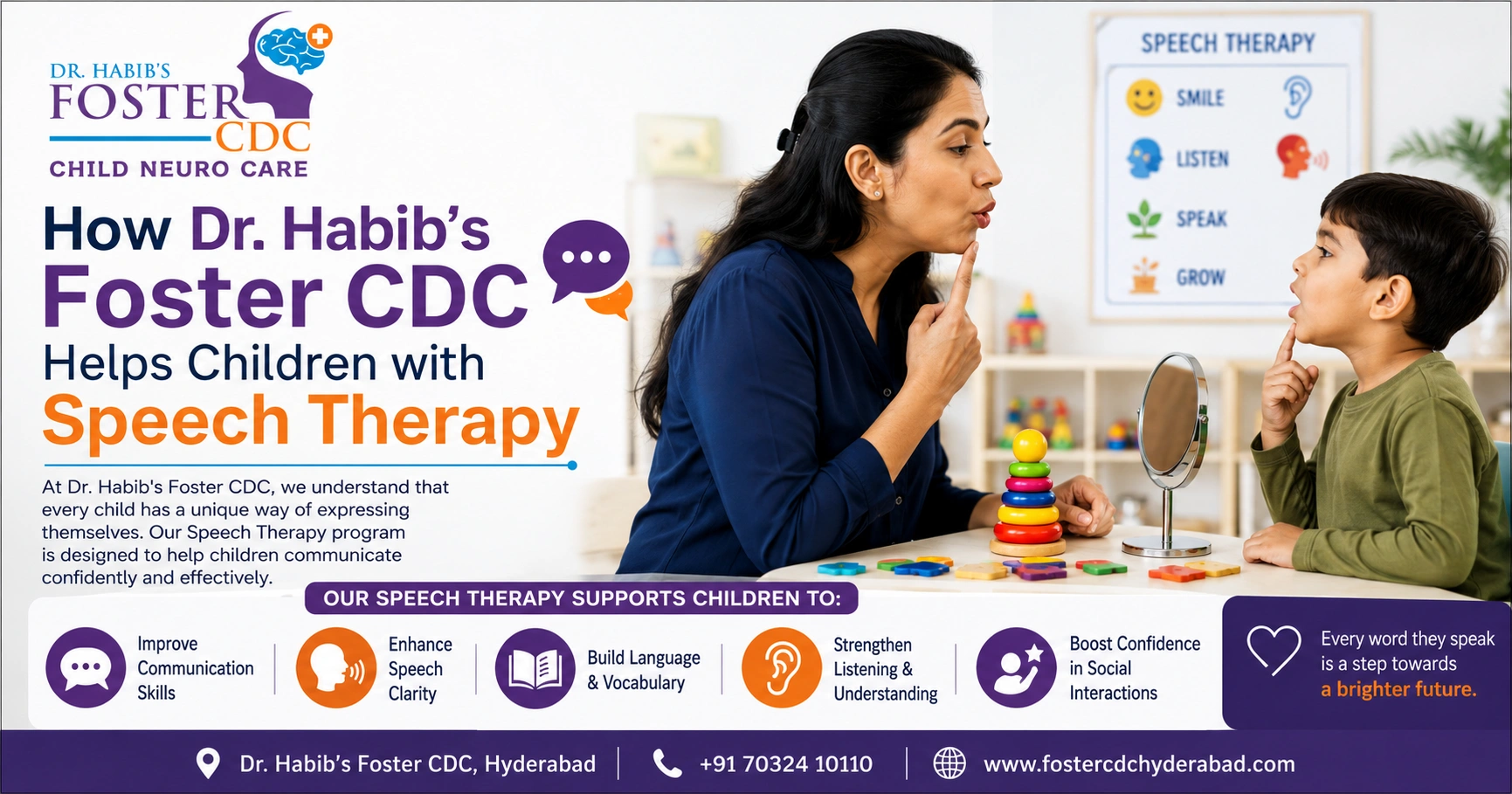
How Dr. Habib's Foster CDC Helps Children with Speech Therapy
Dr. Habib's Foster CDC helps children with speech and language delays through a structured developmental assessment followed by a personalised speech therapy plan — combining one-on-one speech-language sessions, parent training, and, where needed, occupational or behavioural support — delivered by trained specialists across its Toli Chowki, Malakpet, and Suncity centres in Hyderabad.
Why Early Speech Therapy Matters
Speech and language skills develop on a fairly predictable timeline in early childhood — but "predictable" doesn't mean identical for every child. Bodies such as the American Speech-Language-Hearing Association (ASHA) track general milestones — most children begin combining two words together between roughly 18 and 22 months, with vocabulary expanding into the hundreds of words by age two — and treat a meaningful delay from this pattern as one of the earliest signals that a child may benefit from professional support. The World Health Organization similarly frames early childhood development, including communication skills, as a window where timely support has an outsized impact on long-term outcomes.
The evidence on timing is consistent: the further a child moves away from the first three years of life without support, the less effective later intervention tends to be — which is why the American Academy of Pediatrics recommends routine developmental surveillance rather than a "wait and see" approach when a delay is suspected. A structured care plan built around a child's specific needs, delivered through regular therapist contact, is what early-intervention research consistently points to as central to addressing developmental delays effectively, including speech delays.
This is the thinking behind how Foster CDC structures its speech therapy program: identify the delay early, build a plan around the individual child, and involve parents throughout — rather than offering a generic set of exercises to every child who walks through the door.
The Foster CDC Approach, Step by Step
Developmental & Speech-Language Assessment — A speech-language specialist and developmental pediatrician evaluate the child's receptive language (understanding), expressive language (speaking), articulation, and social use of language, often using standardised screening tools alongside clinical observation.
Personalised Therapy Plan — Based on the assessment, the team designs a plan targeting the specific gap — articulation, vocabulary, sentence structure, fluency, or social communication — rather than a one-size-fits-all worksheet.
Structured Therapy Sessions — Children attend regular one-on-one sessions using consistent, goal-tracked techniques such as modelling, prompting, and play-based language stimulation.
Parent Training — Parents are coached on how to extend therapy techniques into everyday routines — mealtimes, playtime, bedtime — since consistent practice between sessions has a direct bearing on progress.
Ongoing Review — Progress is reassessed periodically, and the plan is adjusted as the child's speech and language skills develop.
Types of Speech Therapy Techniques Used at Foster CDC
Not every child needs every technique — the initial assessment determines which combination fits the child's specific profile.
Meet the Team
Foster CDC's clinical team includes Dr. Habib G. Pathan alongside Dr. Zafar Sultana, Dr. Sadiya Akhter, and Dr. Arun Kumar, spanning developmental pediatrics, speech-language therapy, and special education — allowing most of a child's care to be coordinated within a single centre rather than fragmented across multiple providers.
Why Families Choose Foster CDC for Speech Therapy
Three accessible centres across Hyderabad — Toli Chowki, Malakpet, and Suncity (Bandlaguda Jagir)
Assessment-led, individualised speech therapy plans — not generic exercise sheets
One coordinated team, so speech therapy connects with occupational, behavioural, or developmental support if a child needs it
Active parent involvement built into every stage of the process
Ongoing progress review as the child's communication skills grow
Frequently Asked Questions
Why does my child show signs of speech delay?
Speech delays can stem from several factors — hearing issues, developmental conditions, limited language exposure, or no identifiable cause at all. An assessment is the only reliable way to understand what's behind a specific child's delay.
At what age should I be concerned about my toddler's speech?
If a toddler isn't combining words by around 2 years, has a very limited vocabulary for their age, or is difficult to understand well past the toddler years, it's worth having a speech-language evaluation.
Do you diagnose speech delays, or only provide therapy?
Foster CDC's specialists conduct assessments that identify the nature of a speech or language delay and then provide the full range of follow-up therapy.
How long does speech therapy typically take to show results?
This varies by child, the nature of the delay, and consistency of practice at home — plans are reviewed periodically rather than fixed to one timeline.
Can I choose which Foster CDC centre my child attends?
Yes — families can choose the Toli Chowki, Malakpet, or Suncity centre based on convenience.
Is parent involvement really necessary in speech therapy?
Yes. Practising language-building activities at home between sessions is one of the strongest predictors of steady progress.
Does Foster CDC offer support for non-verbal children?
Yes — for children with minimal verbal speech, the team can incorporate augmentative and alternative communication (AAC) strategies alongside spoken-language therapy.
How do I know if my child needs speech therapy or a broader developmental evaluation?
The initial assessment helps determine whether the concern is isolated to speech and language or connects to a broader developmental picture that may need additional support.
What happens in the first speech therapy assessment visit?
A speech-language specialist evaluates the child's understanding, expression, and articulation, and discusses next steps with the family. (See our guide on preparing your child for their first therapy session for what to expect.)
How do I book a speech therapy assessment?
You can book an assessment directly through Foster CDC's website or by contacting your nearest centre.
Book a Speech Therapy Assessment
Every child's communication journey looks different — the first step is a proper assessment. Book an assessment with Dr. Habib's Foster CDC today.
Other Blogs

Services
- Behavioural Therapy
- Speech Therapy
- Special Education
- Parent Training
- Psychotherapy & Counselling
- Yoga Therapy
- Postural & Mobility Therapy
- Early Intervention Services
- Cognitive Behavioural Therapy
- Occupational Therapy
- Group Teaching
- Teachers' Training
- Certified Courses
- Developmental Therapy
- Autism Therapy