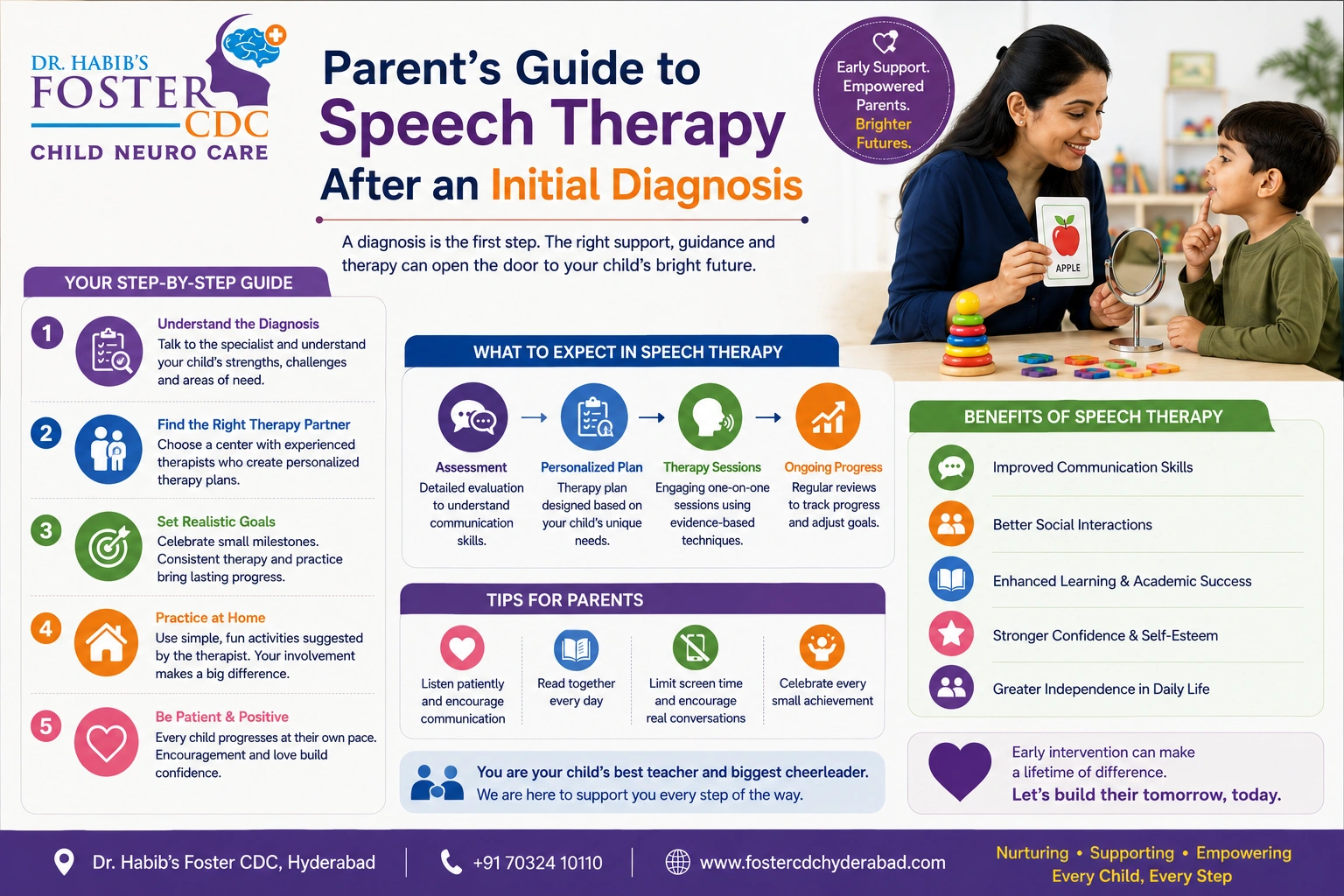
Parent's Guide to Speech Therapy After an Initial Diagnosis
An initial speech delay diagnosis isn't the end of the process — it's the start of a plan. In the weeks right after, focus on three things: understanding what the evaluation actually found, connecting with the right kind of therapy support for your child's age, and setting up a consistent routine of sessions and home practice. You're not alone in this — speech and language delays are one of the most common developmental concerns parents encounter, affecting roughly one in four children in their early years.
What an Initial Diagnosis Actually Means
Hearing that your child has a speech or language delay can feel overwhelming, especially if you weren't expecting it. It helps to know that a diagnosis at this stage is descriptive, not predictive — it identifies where your child's communication skills currently stand relative to typical milestones, not how their story ends. Pediatric guidelines distinguish between developmental surveillance (ongoing observation at every well-child visit) and developmental screening (a more formal, structured check) — a diagnosis usually follows the screening step, once a speech-language pathologist has completed a full evaluation.
It's also worth knowing this is common. Estimates suggest close to one in four children need some form of speech support during their early years, and speech or voice-related disorders are among the most frequently diagnosed developmental concerns in early childhood. A diagnosis is a signal that your child needs a specific kind of support — not a reflection of your parenting or a fixed ceiling on your child's potential.
What to Do in the First Few Weeks After Diagnosis
Read the evaluation report carefully, and ask questions. Ask the evaluating specialist to walk you through exactly which areas are delayed — articulation, vocabulary, sentence structure, or understanding — since this shapes what therapy will focus on.
Get a referral to a licensed speech-language pathologist, if you don't already have one. A diagnosis on its own doesn't provide therapy; it's the basis for building a plan with a qualified specialist.
Ask about the recommended intervention setting. Options vary by your child's age — a centre-based program, a school-linked service, or telehealth sessions may all be relevant, and it's worth understanding which fits your child.
Set up a consistent session schedule. Progress in speech therapy tends to track closely with consistency, so establishing a regular rhythm early matters more than finding a "perfect" schedule.
Ask what you can do at home between sessions. Most therapy plans include specific activities parents can build into daily routines — mealtimes, playtime, bedtime stories — that reinforce what happens in sessions.
Revisit the plan periodically. A speech delay diagnosis isn't static — plans are typically reviewed and adjusted as your child's skills develop.
Speech Support Options After Diagnosis, by Age
Which pathway fits best depends on your child's age, the nature of the delay, and what's practically accessible to your family — this is usually part of the conversation with your evaluating specialist.
What Progress Typically Looks Like
Progress after a diagnosis isn't usually linear, and timelines vary from child to child. What tends to matter most, according to specialists who work in this field, is consistency — regular therapist contact combined with steady practice at home — rather than the intensity of any single session. Parents are often surprised at how much of the progress happens in ordinary daily moments, not just during formal therapy time.
How Foster CDC Supports Families After Diagnosis
At Dr. Habib's Foster CDC, a diagnosis is the starting point for a personalised therapy plan — built around the specific gaps identified in your child's evaluation, delivered through regular one-on-one sessions, and paired with parent coaching so progress continues outside the therapy room. The team reviews progress periodically and adjusts the plan as your child develops, so the approach evolves alongside your child rather than staying fixed. For a closer look at how sessions are structured, see How Dr. Habib's Foster CDC Helps Children with Speech Therapy.
Frequently Asked Questions
Why does my child show signs of speech delay even after starting therapy? It's normal for progress to take time — a diagnosis marks the start of a plan, not an instant fix, and improvement usually builds gradually with consistent sessions and home practice.
What's the first thing I should do after getting a speech delay diagnosis? Ask the evaluating specialist to explain exactly which skills are delayed, then get connected with a licensed speech-language pathologist to begin building a therapy plan.
Is a diagnosis the same as knowing my child needs therapy forever? No. A diagnosis reflects where your child stands right now — most children make steady progress with consistent support, and plans are adjusted or scaled back as skills improve.
My child is under 3 — what kind of support is available? Early intervention programs, often centre- or home-based, are the typical pathway for children under 3, alongside private clinic-based speech therapy.
My child is over 3 — does school play a role in speech therapy? Yes, many families coordinate speech support through their child's preschool or school's special education services alongside or instead of private therapy.
How often should speech therapy sessions happen after a diagnosis? This depends on the severity of the delay and your specialist's recommendation — but consistency, more than frequency alone, is what specialists tend to emphasise.
What can I do at home to support my child between therapy sessions? Most plans include specific home activities — narrating daily routines, reading together, and modelling words during play — that reinforce what's covered in sessions.
Will my child's therapy plan stay the same over time? No — plans are typically reviewed periodically and adjusted as your child's communication skills develop.
Can telehealth speech therapy work as well as in-person sessions? For many children, yes — telehealth has become a valid option that also makes it easier for parents to observe and learn strategies directly.
How do I get started with Foster CDC after my child's diagnosis? You can book an assessment directly through Foster CDC's website or by contacting your nearest centre to begin building a personalised therapy plan.
Book a Speech Therapy Assessment
Already have a diagnosis in hand? The next step is a personalised plan. Book an assessment with Dr. Habib's Foster CDC today.
Other Blogs

Services
- Behavioural Therapy
- Speech Therapy
- Special Education
- Parent Training
- Psychotherapy & Counselling
- Yoga Therapy
- Postural & Mobility Therapy
- Early Intervention Services
- Cognitive Behavioural Therapy
- Occupational Therapy
- Group Teaching
- Teachers' Training
- Certified Courses
- Developmental Therapy
- Autism Therapy