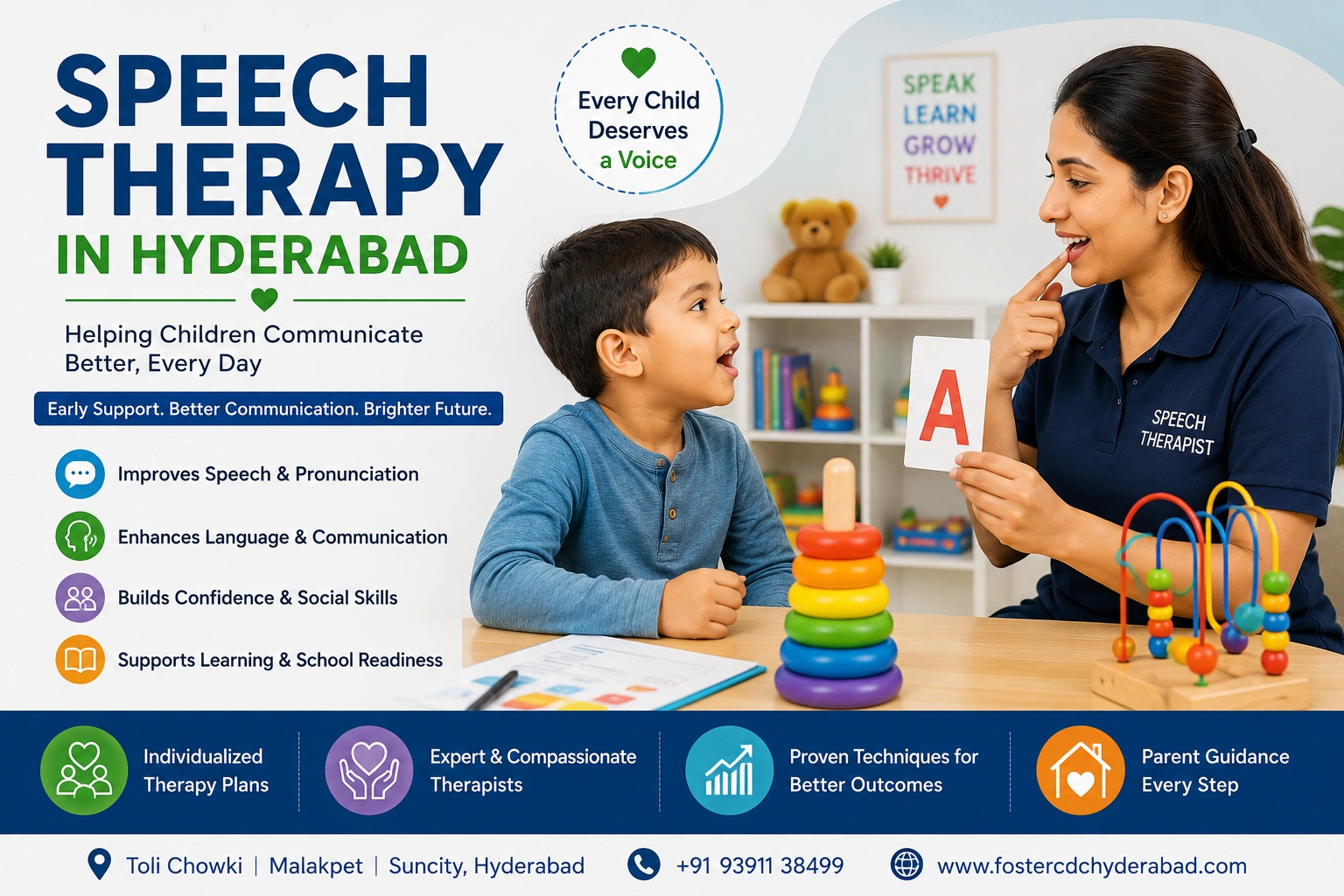
Speech Therapy in Hyderabad: A Complete Guide for Parents
Every parent wants to hear their child speak clearly, ask questions, tell stories, and connect with the world through words. But for many families in Hyderabad, that journey isn't always straightforward. If your child struggles to form words, string sentences together, or communicate their needs, you're not alone — and help is closer than you think.
Speech therapy in Hyderabad has become one of the most sought-after interventions for children with communication delays, articulation issues, and developmental challenges. At Dr. Habib's Foster CDC, families across Toli Chowki, Malakpet, and Suncity have found structured, compassionate support for their children's communication journeys.
This guide walks you through everything you need to know — what speech therapy involves, when to seek it, what to expect, and how to choose the right center for your child.
What Is Speech Therapy?
Speech therapy is a specialized form of clinical intervention designed to improve a person's ability to communicate. It's delivered by a trained speech-language pathologist (SLP) who assesses a child's speech, language, and communication patterns, then builds a treatment plan around their specific needs.
Speech therapy isn't just about "talking better." It covers a wide range of communication skills, including:
- Understanding language (receptive language)
- Using language to express thoughts (expressive language)
- Pronouncing sounds correctly (articulation)
- Voice quality and fluency
- Social communication and conversation skills
- Feeding and swallowing support in some cases
For children, early intervention tends to produce the strongest outcomes, which is why pediatricians often recommend an evaluation as soon as a delay is suspected.
Signs Your Child May Need Speech Therapy
Every child develops at their own pace, but certain patterns are worth discussing with a specialist. Common signs include:
- Limited vocabulary compared to same-age peers
- Difficulty forming simple sentences by age 2–3
- Frequent frustration when trying to communicate
- Trouble understanding simple instructions
- Stuttering or unusual speech rhythm
- Difficulty pronouncing common sounds past the expected age
- Limited eye contact or social communication (sometimes seen alongside autism spectrum conditions)
If you notice several of these patterns, it's reasonable to consult a pediatrician or speech-language pathologist for an assessment — earlier evaluation generally means more options for support.
Common Speech and Language Disorders in Children
Speech and communication challenges come in several forms, and understanding the differences helps parents know what kind of support their child might need.
Articulation Disorders
Difficulty producing specific sounds correctly, such as substituting one sound for another (e.g., "wabbit" instead of "rabbit").
Language Disorders
Trouble understanding language (receptive) or using words and sentences to express ideas (expressive).
Fluency Disorders (Stuttering)
Interruptions in the flow of speech, such as repeated sounds, prolonged sounds, or blocks.
Voice Disorders
Problems with pitch, volume, or voice quality that affect how a child sounds when speaking.
Social Communication Disorders
Difficulty using language appropriately in social situations — often seen in children with autism spectrum conditions.
How Speech Therapy Helps
Speech therapy offers structured, measurable support across several developmental areas. Based on individual assessment, it can help with:
- Building early language and vocabulary
- Improving articulation and pronunciation
- Strengthening comprehension and following instructions
- Increasing fluency and confidence while speaking
- Supporting voice quality and vocal strength
- Preparing children for school readiness
- Building self-esteem through improved communication
- Supporting swallowing and oral-motor coordination where relevant
Progress varies from child to child, and outcomes depend on the nature of the delay, consistency of therapy, and the level of family involvement — no responsible therapist can guarantee a fixed timeline or result, and it's worth being cautious of any center that promises one.
The Speech Therapy Process: What to Expect
Step 1: Initial Assessment
A speech-language pathologist evaluates your child's communication skills, often alongside a developmental pediatrician, to identify the nature and extent of the delay.
Step 2: Individualized Treatment Planning
Based on the assessment, the therapist designs a plan targeting specific goals — whether that's articulation, vocabulary building, or fluency.
Step 3: Structured Therapy Sessions
Sessions typically involve play-based activities, structured exercises, and repetition designed to build skills gradually and keep the child engaged.
Step 4: Parent Involvement and Home Practice
Therapists usually guide parents on simple activities to reinforce learning at home, since consistency between sessions and home life supports better outcomes.
Step 5: Progress Review
Regular reviews help track improvement and adjust the therapy plan as needed.
Speech Therapy Techniques Used by Specialists
| Technique | What It Targets | Typical Use Case |
|---|---|---|
| Articulation Therapy | Sound production errors | Mispronounced letters/sounds |
| Language Intervention | Vocabulary, grammar, comprehension | Delayed language development |
| Voice Therapy | Pitch, volume, vocal quality | Hoarseness or voice strain |
| Fluency Therapy | Speech rhythm and flow | Stuttering |
| Oral-Motor Therapy | Muscle strength and coordination | Feeding/swallowing difficulties |
| Social Communication Training | Conversational and social language use | Autism spectrum-related communication challenges |
Speech Therapy vs. Waiting It Out: Why Early Intervention Matters
Many parents wonder whether a child will simply "grow out of" a speech delay. While some mild delays do resolve naturally, professional guidance helps distinguish between typical variation and a delay that needs support. Early intervention — generally before age 5 — is widely associated with better long-term communication outcomes, since a child's brain is highly adaptable to new learning during these years.
Waiting and watching is sometimes appropriate, but it should be a decision made with a pediatrician or speech-language pathologist, not guesswork.
Myths vs. Facts About Speech Therapy
Myth: Speech therapy is only for children who can't talk at all. Fact: It also helps children with mild articulation issues, stuttering, voice problems, and social communication challenges.
Myth: Bilingual homes cause speech delays. Fact: Research does not support this — bilingualism itself doesn't cause speech or language disorders.
Myth: Speech therapy shows results in a fixed number of sessions. Fact: Timelines vary widely based on the child's condition, age, and consistency of practice.
Myth: Only young children benefit from speech therapy. Fact: Teenagers and adults — including stroke survivors — can also benefit significantly.
Common Mistakes Parents Make
- Waiting too long to seek an evaluation, hoping the child will "catch up" on their own
- Comparing their child's pace strictly to siblings or peers instead of getting a professional opinion
- Skipping home practice activities recommended by the therapist
- Choosing a center based on cost alone rather than qualified, certified specialists
- Expecting therapy to work without consistent attendance
Do's and Don'ts for Parents Supporting Speech Therapy at Home
Do:
- Talk to your child often, using simple, clear language
- Read aloud together daily
- Celebrate small improvements
- Stay consistent with therapy schedules
- Follow the specific home activities suggested by your therapist
Don't:
- Correct every mistake harshly or repeatedly, which can increase frustration
- Compare your child's progress publicly with other children
- Skip sessions without informing the therapist
- Rely solely on screen time for language exposure
Choosing the Right Speech Therapy Center in Hyderabad
When evaluating a speech-language pathologist Hyderabad families can trust, consider:
- Certification — Is the therapist registered with the Rehabilitation Council of India (RCI)?
- Experience with children — Do they specialize in pediatric communication disorders?
- Individualized plans — Is therapy tailored to your child, or is it a one-size-fits-all program?
- Multidisciplinary support — Does the center offer access to developmental pediatricians, occupational therapists, or behavioural specialists when needed?
- Location and accessibility — Are there multiple centers, and are appointment slots manageable for your schedule?
Dr. Habib's Foster CDC operates across Toli Chowki, Malakpet, and Suncity, offering speech therapy, early intervention services, occupational therapy, and related pediatric developmental support under one roof.
Quick Answers
What is Speech Therapy?
Speech therapy is a specialized intervention delivered by a trained speech-language pathologist to improve communication skills — including articulation, language comprehension, expression, fluency, and voice quality — in both children and adults.
When should parents seek speech therapy for their child?
Parents should consider an evaluation if their child shows limited vocabulary, unclear speech, difficulty following instructions, stuttering, or frustration while communicating — ideally as soon as a delay is suspected, since earlier support tends to help more.
Can speech delay improve with therapy?
Many children show meaningful improvement with consistent, individualized speech therapy, though outcomes vary depending on the type and severity of the delay and how consistently therapy is followed.
How long does speech therapy typically take?
There's no fixed timeline. Duration depends on the child's age, the nature of the speech or language disorder, its severity, and consistency of attendance and home practice.
Is speech therapy only for children?
No. Teenagers and adults — including those recovering from strokes or dealing with voice or fluency disorders — can also benefit from speech therapy.
Does bilingualism cause speech delays?
No. Growing up in a bilingual household is not considered a cause of speech or language disorders.
Are virtual speech therapy sessions effective?
Virtual sessions can be effective for many children and offer added convenience, though a qualified therapist should assess whether in-person or online sessions best suit your child's specific needs.
Frequently Asked Questions
1. How do I know whether my child needs speech therapy? If your child shows delayed language, unclear pronunciation, or difficulty understanding instructions, a pediatrician or speech-language pathologist can conduct an initial assessment. This often includes screening for hearing issues, since hearing difficulties can sometimes present as speech delays.
2. Who can benefit from speech therapy? Speech therapy benefits people of all ages — from toddlers with speech delays to adults recovering from strokes. The specific approach is tailored based on individual assessment and needs.
3. What types of disorders does speech therapy address? It addresses articulation disorders, language delays, fluency disorders like stuttering, voice disorders, and social communication challenges, including those associated with autism spectrum conditions.
4. How long does it take to see results from speech therapy? Results vary by child, depending on the severity of the disorder, age, and consistency of therapy and home practice. Regular attendance and parent involvement typically support steadier progress.
5. Are speech therapists certified professionals? Yes. Qualified speech-language pathologists in India typically hold certification and registration with the Rehabilitation Council of India (RCI) after specialized training.
6. Is speech therapy covered by insurance in India? Coverage varies by insurer and policy. It's best to check directly with your insurance provider regarding coverage for speech-language pathology services.
7. Can speech therapy help with accent modification? Yes, some speech-language pathologists offer accent modification support for personal or professional communication goals, though this is a separate service from clinical speech-language therapy for children.
8. What age is best to start speech therapy? Early intervention, often before age 5, is generally associated with better outcomes, but children and adults of any age can benefit from an assessment and therapy if needed.
9. Does speech therapy help children with autism? Yes. Speech-language pathologists commonly work with autistic children to build communication, language comprehension, and social communication skills as part of a broader developmental support plan.
10. What should I expect during the first speech therapy session? The first session usually involves an assessment of your child's current speech and language abilities, followed by a discussion of goals and a proposed treatment plan tailored to your child's needs.
Key Takeaways
- Speech therapy supports communication development in children and adults through individualized, evidence-based intervention.
- Early evaluation matters — don't wait too long if you notice consistent signs of delay.
- Progress depends on the child, the disorder type, and consistency of therapy and home practice.
- Choosing a certified, experienced speech-language pathologist matters more than choosing based on cost alone.
- No responsible provider can promise fixed timelines or guaranteed outcomes — be cautious of centers that do.
Conclusion
Every child's communication journey looks different, and that's completely normal. What matters most is recognizing early signs, seeking a professional assessment when something feels off, and staying consistent with the guidance your speech-language pathologist provides. Speech therapy isn't a quick fix — it's a structured, supportive process that helps children build the confidence and skills to express themselves fully.
If you've noticed signs of a speech or language delay in your child, consider scheduling an assessment with a qualified speech-language pathologist. At Dr. Habib's Foster CDC, families across Hyderabad can access individualized speech therapy alongside related developmental support — all in one place.
Other Blogs


Services
- Behavioural Therapy
- Speech Therapy
- Special Education
- Parent Training
- Psychotherapy & Counselling
- Yoga Therapy
- Postural & Mobility Therapy
- Early Intervention Services
- Cognitive Behavioural Therapy
- Occupational Therapy
- Group Teaching
- Teachers' Training
- Certified Courses
- Developmental Therapy
- Autism Therapy