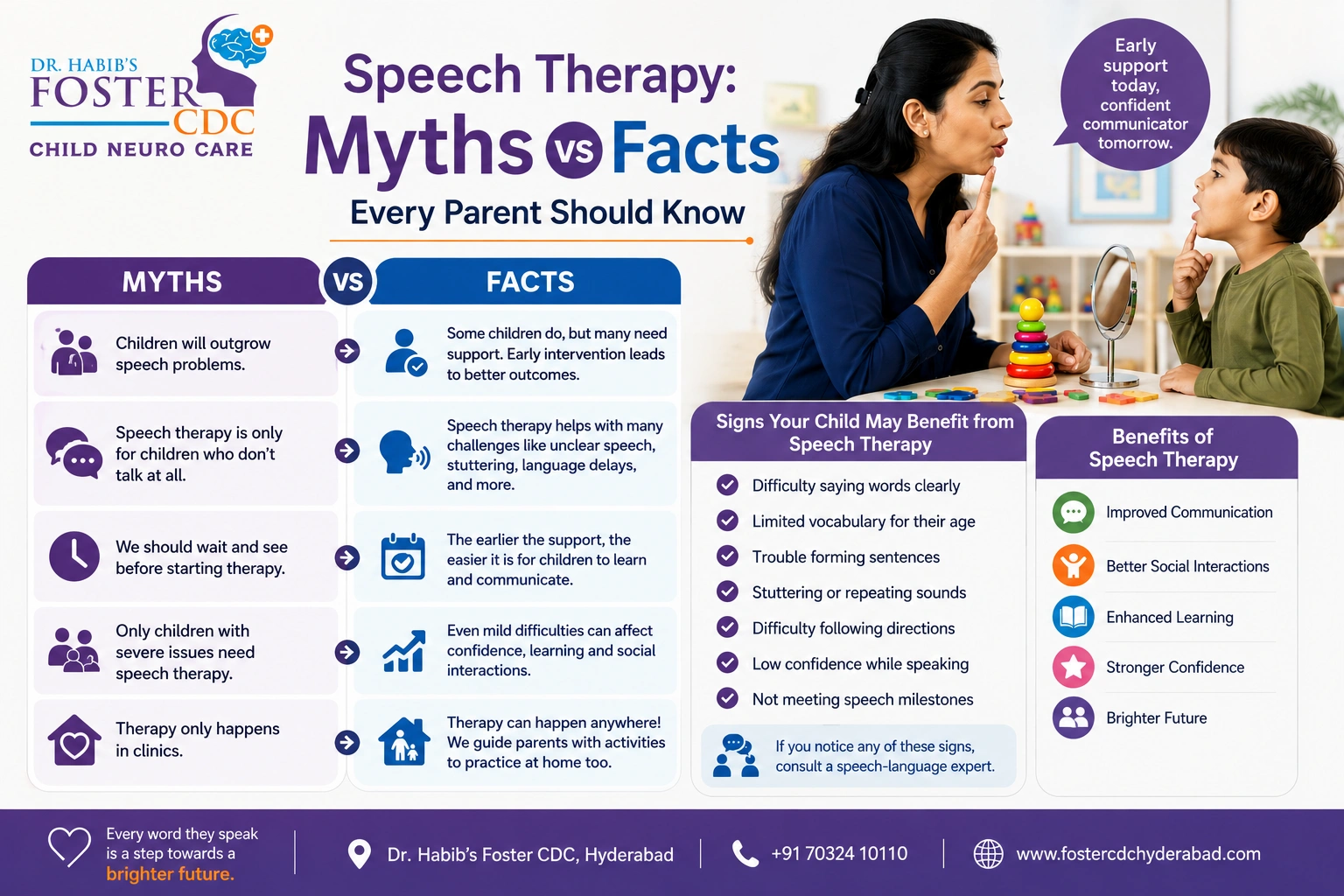
Speech Therapy: Myths vs Facts Every Parent Should Know
Many common beliefs about speech delay — "boys just talk later," "he'll grow out of it," "therapy is only for children who can't speak at all" — aren't well supported by developmental guidelines from bodies like ASHA, the AAP, and the WHO. Knowing the facts helps parents recognize a genuine delay early and seek support at the right time, instead of waiting past the window when intervention tends to work best.
Why Myths About Speech Delay Are So Common
Every parent hears well-meaning advice from relatives, friends, or even strangers about a child's speech. Much of it is reassuring but not evidence-based — and reassurance can be exactly what stands between a parent and getting their child seen. The American Speech-Language-Hearing Association (ASHA) publishes general speech and language milestones precisely because "every child is different" is only true within a range, not without limits. The American Academy of Pediatrics (AAP) recommends routine developmental screening at specific well-child visits for the same reason — relying on impressions alone tends to miss delays that a structured check would catch. The World Health Organization (WHO) frames the first few years of life as a critical window for communication development, where support started early tends to produce meaningfully better outcomes than support started later.
With that framing, here are the most common myths parents hear about speech therapy — and what the evidence actually says.
Myths vs Facts
When to Move From "Just in Case" to an Actual Assessment
A myth-vs-fact list is useful, but it isn't a diagnosis. If a few of these sound familiar — especially the ones about "growing out of it" or the pediatrician not raising a concern — the most reliable next step is a dedicated speech-language assessment rather than more waiting. At Dr. Habib's Foster CDC, this starts with a developmental and speech-language evaluation by a specialist, followed by a personalised plan if support is needed — outlined in more detail in How Dr. Habib's Foster CDC Helps Children with Speech Therapy.
Frequently Asked Questions
Is it true that late talkers usually catch up by themselves? Some do, but a meaningful number don't — which is why milestone tracking and evaluation matter more than assuming a child will "grow out of it."
Does being raised bilingual delay speech development? No. Bilingualism itself isn't a cause of speech or language delay.
Can screen time help my child learn to talk faster? Not reliably — interactive, back-and-forth communication with caregivers is what drives early language growth, not passive screen exposure.
Is speech therapy only for children with severe speech problems? No — it also helps with milder concerns like unclear articulation, stuttering, or vocabulary that's behind for the child's age.
Why does my child show signs of speech delay? Speech delays can come from several sources — hearing issues, developmental conditions, limited language exposure at home, or sometimes no identifiable cause. An assessment is the reliable way to understand what's behind it.
My toddler understands everything I say — should I still be concerned about speech? Understanding language well doesn't rule out a delay in expressive speech; both are worth evaluating together.
My pediatrician didn't mention any concerns — is a separate speech evaluation still worth it? Yes, if you have concerns yourself. A dedicated speech-language assessment looks more closely at communication skills than a routine check-up typically does.
Is 2 years too early to start speech therapy? No — early intervention, including in the toddler years, is generally when speech therapy has the most impact.
How long does a speech therapy program usually take? It varies by child and the nature of the delay — plans are reviewed periodically rather than tied to a fixed timeline.
How do I get my child assessed at Foster CDC? You can book a speech-language assessment directly through Foster CDC's website or by contacting your nearest centre.
Book a Speech Therapy Assessment
If any of these myths sound familiar, the next step isn't more waiting — it's an assessment. Book an assessment with Dr. Habib's Foster CDC today.
Other Blogs


Services
- Behavioural Therapy
- Speech Therapy
- Special Education
- Parent Training
- Psychotherapy & Counselling
- Yoga Therapy
- Postural & Mobility Therapy
- Early Intervention Services
- Cognitive Behavioural Therapy
- Occupational Therapy
- Group Teaching
- Teachers' Training
- Certified Courses
- Developmental Therapy
- Autism Therapy