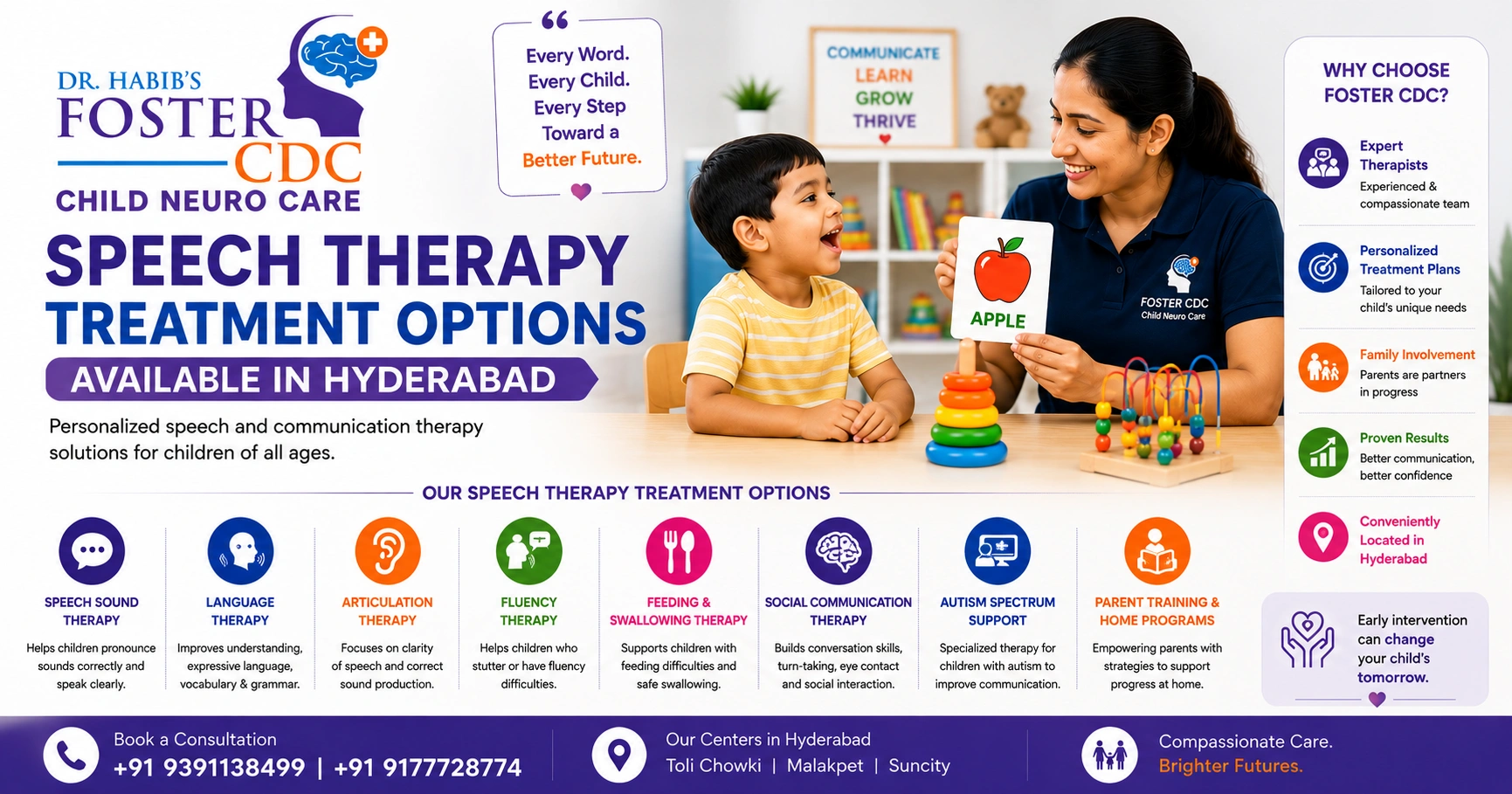
Speech Therapy Treatment Options Available in Hyderabad
Whether you're a teacher who's noticed a student struggling to communicate clearly, or a caregiver helping a family navigate next steps, finding the right speech therapist near me can feel like a lot of options with very little clarity on what actually differs between them. This guide breaks down the speech therapy treatment options available in Hyderabad, so you can help guide a family — or make a confident referral — with the full picture in hand.
At Dr. Habib's Foster CDC, guided by Dr. Habib G Pathan, Developmental Pediatrician, we regularly work alongside teachers and caregivers who play a key role in identifying children who could benefit from speech therapy. This guide reflects that collaborative experience, but it isn't a substitute for a professional evaluation.
Quick Answers
What treatment options are available for speech therapy in Hyderabad?
Options typically include clinic-based individual therapy, group therapy sessions, school-based support, home-based programs, and teletherapy — each suited to different needs and circumstances.
How do I find a good speech therapist near me?
Look for a licensed speech-language pathologist affiliated with a reputable child development centre, one that conducts a thorough evaluation before recommending a treatment approach.
Can a teacher refer a child for speech therapy?
Yes. Teachers often notice communication difficulties early and can recommend that parents discuss concerns with a pediatrician or seek a speech-language evaluation directly.
Is teletherapy as effective as in-person speech therapy?
For many children, teletherapy can be effective, particularly for older children or milder delays, though in-person therapy is often preferred for younger children or more complex needs.
How is group therapy different from individual sessions?
Group therapy focuses on social communication and peer interaction, while individual sessions allow for more concentrated, one-on-one work on specific speech or language goals.
What role do caregivers and teachers play in speech therapy success?
Caregivers and teachers reinforce therapy goals in daily routines and classroom settings, which significantly supports how well skills transfer beyond therapy sessions.
Why Treatment Setting Matters
Not every child needs the same type of speech therapy program. A child with mild articulation difficulty may do well with weekly individual sessions, while a child with more complex language delays might benefit from a combination of clinic-based therapy and classroom support. Understanding the available options helps caregivers and teachers guide families toward the right fit rather than a generic recommendation.
Speech Therapy Treatment Options in Hyderabad
1. Clinic-Based Individual Therapy
One-on-one sessions with a speech-language pathologist, focused on the child's specific goals in a structured clinical setting. This is often the starting point after a formal evaluation.
2. Group Therapy Sessions
Small groups of children work on communication skills together, which is especially useful for building social communication, turn-taking, and peer interaction skills.
3. School-Based Support
Some speech-language pathologists work directly with schools to support children within the classroom environment, coordinating with teachers on communication strategies.
4. Home-Based Programs
Therapists guide caregivers on structured activities to practice at home, often used alongside clinic sessions to reinforce progress in familiar, everyday settings.
5. Teletherapy
Remote sessions conducted via video call, offering flexibility for families with scheduling or distance constraints — though suitability depends on the child's age and needs.
6. Intensive Therapy Programs
Short-term, higher-frequency therapy blocks designed for children who need more concentrated support over a defined period, often used for specific goals or during school breaks.
Comparison Table: Speech Therapy Program Types
How Teachers and Caregivers Can Help
Recognizing Signs in the Classroom or Care Setting
Difficulty following multi-step instructions
Limited vocabulary compared to same-age peers
Speech that's frequently unclear to classmates or caregivers
Avoidance of group conversations or storytelling activities
Frustration when trying to express needs verbally
Making an Effective Referral
Document specific observations rather than general impressions
Share examples of communication difficulty across different settings
Encourage parents to seek a formal evaluation rather than diagnosing informally
Offer to collaborate with the therapy team once treatment begins
Supporting Therapy Goals Day-to-Day
Use simple, clear language and allow extra response time
Reinforce specific vocabulary or phrases suggested by the therapist
Create low-pressure opportunities for the child to communicate
Stay in regular contact with parents about progress and strategies
Myths vs Facts About Speech Therapy Options
Do's and Don'ts When Choosing a Treatment Option
Do:
Base the choice on a formal evaluation, not assumptions about severity
Ask therapists to explain why a specific program type is recommended
Consider the family's logistical realities alongside clinical needs
Stay flexible — programs can be adjusted as the child progresses
Don't:
Choose a program type based on cost alone without considering fit
Assume one option is universally "better" than another
Skip coordination between school, home, and therapy settings
Overlook the caregiver's role in reinforcing progress
What to Ask When Comparing Speech Therapy Centres
What treatment options do you offer, and how do you decide which fits a specific child?
How do you coordinate with teachers or caregivers outside of sessions?
What does progress tracking look like across different program types?
Can treatment options be combined or adjusted as needs change?
What's the typical process for moving from evaluation to a treatment plan?
Key Takeaways
Speech therapy in Hyderabad includes multiple treatment formats — clinic-based, group, school-based, home-based, teletherapy, and intensive programs.
The right option depends on the child's specific needs, age, and family circumstances, not a fixed formula.
Teachers and caregivers play a meaningful role in early identification and reinforcing therapy goals day-to-day.
Comparing centres should focus on evaluation quality, coordination, and flexibility — not marketing alone.
For more on the therapy process itself, see our guide on speech therapy in children and speech therapy vs. occupational therapy.
Frequently Asked Questions
1. What's the difference between clinic-based and school-based speech therapy?
Clinic-based therapy takes place in a dedicated therapy setting with one-on-one focus, while school-based therapy integrates support directly into the child's classroom environment, often coordinated with teachers.
2. Is teletherapy a good option for young children?
Teletherapy can work for some young children, but in-person therapy is often preferred for very young or more complex cases where hands-on guidance is beneficial.
3. How do I know if my child needs group or individual therapy?
This depends on their specific goals — individual therapy suits focused skill-building, while group therapy is valuable for social communication and peer interaction practice.
4. Can a teacher recommend a specific type of speech therapy?
Teachers can share observations and encourage families to seek a formal evaluation, but the specific treatment recommendation should come from a licensed speech-language pathologist.
5. How long do intensive speech therapy programs typically last?
Intensive programs are usually short-term and higher-frequency, often spanning a few weeks, and are typically used to target specific goals within a defined period.
6. Can treatment options be combined for one child?
Yes. Many children benefit from a combination — for example, clinic-based sessions alongside home-based reinforcement or school coordination.
7. What should caregivers focus on between therapy sessions?
Caregivers can reinforce specific vocabulary or strategies suggested by the therapist, create everyday opportunities for communication, and maintain consistent routines.
8. How do I find a reliable speech therapist near me in Hyderabad?
Look for a licensed speech-language pathologist at a reputable child development centre that conducts a thorough evaluation and offers a range of treatment options suited to different needs.
9. Does insurance typically cover speech therapy in India?
Coverage varies by provider and policy, so it's best to confirm directly with your insurance company and the therapy centre regarding billing.
10. How often should treatment options be reassessed?
Regularly — most therapy teams review progress every few months and adjust the treatment format or intensity based on how the child is responding.
Conclusion
Understanding the range of speech therapy treatment options available in Hyderabad — from clinic-based sessions to teletherapy and school coordination — makes it much easier to guide a family toward the right fit, rather than a generic recommendation. Whether you're a teacher noticing early signs or a caregiver helping compare options, informed guidance makes a real difference in getting a child the support they need.
If you're helping a family take the next step, book an assessment with Dr. Habib's Foster CDC in Hyderabad, and connect them with a team that builds treatment plans around the child's specific needs.
Other Blogs


Services
- Behavioural Therapy
- Speech Therapy
- Special Education
- Parent Training
- Psychotherapy & Counselling
- Yoga Therapy
- Postural & Mobility Therapy
- Early Intervention Services
- Cognitive Behavioural Therapy
- Occupational Therapy
- Group Teaching
- Teachers' Training
- Certified Courses
- Developmental Therapy
- Autism Therapy