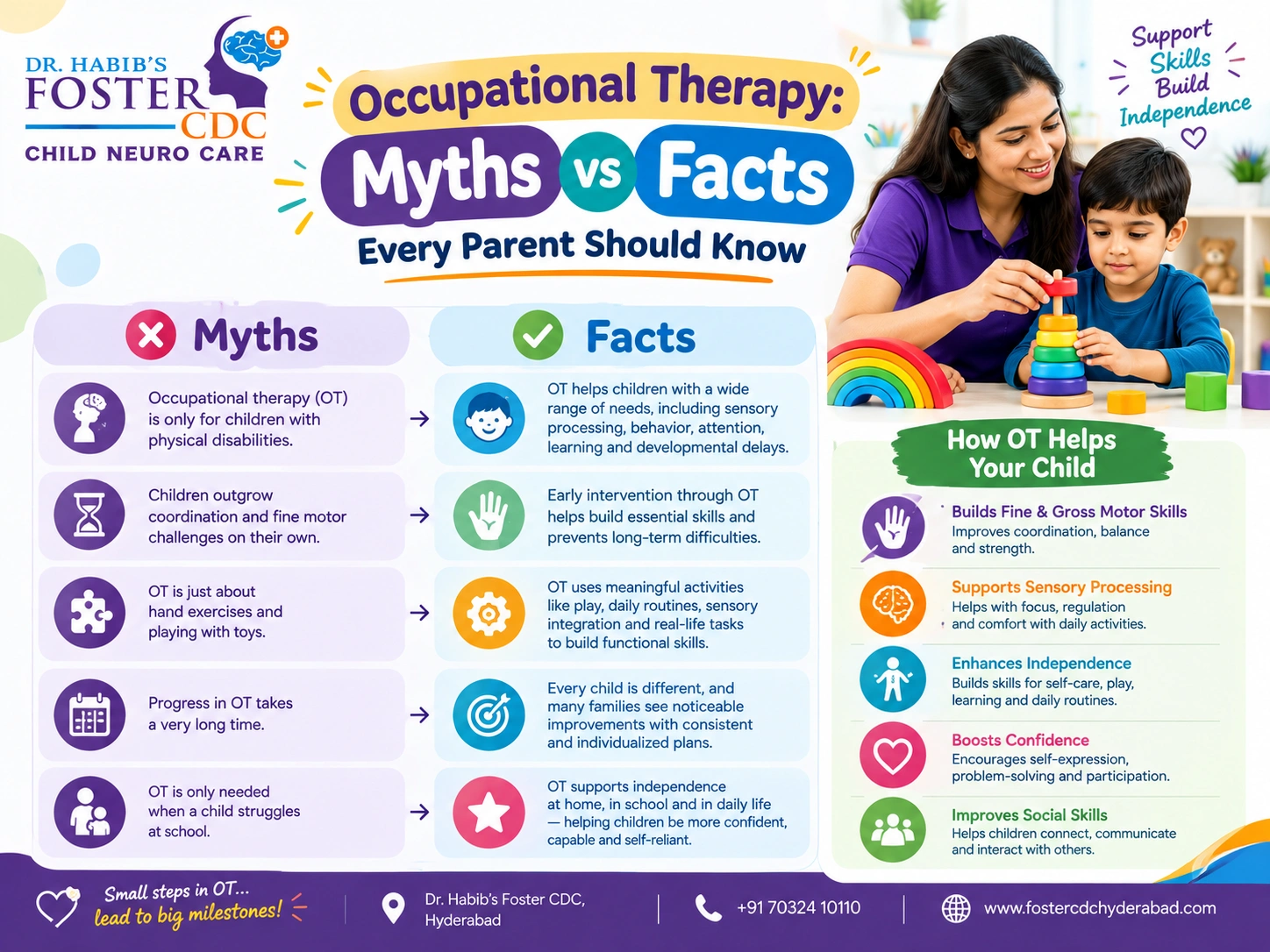
Occupational Therapy: Myths vs Facts Every Parent Should Know
By Dr. Habib G Pathan, Developmental Pediatrician, Dr. Habib's Foster CDC, Hyderabad
If you've recently been told that your child could benefit from occupational therapy (OT), you've probably also received a flood of well-meaning advice from relatives, friends, and internet forums — much of it contradictory, and some of it flat-out wrong. As a developmental pediatrician who has spent years working with children and families at Foster CDC in Hyderabad, I hear the same misconceptions again and again. Left unaddressed, these myths often delay children from getting help at the age when intervention makes the biggest difference.
This article separates fact from fiction so you can make informed decisions about your child's development — without the guilt, confusion, or unnecessary waiting.
What Occupational Therapy Actually Is
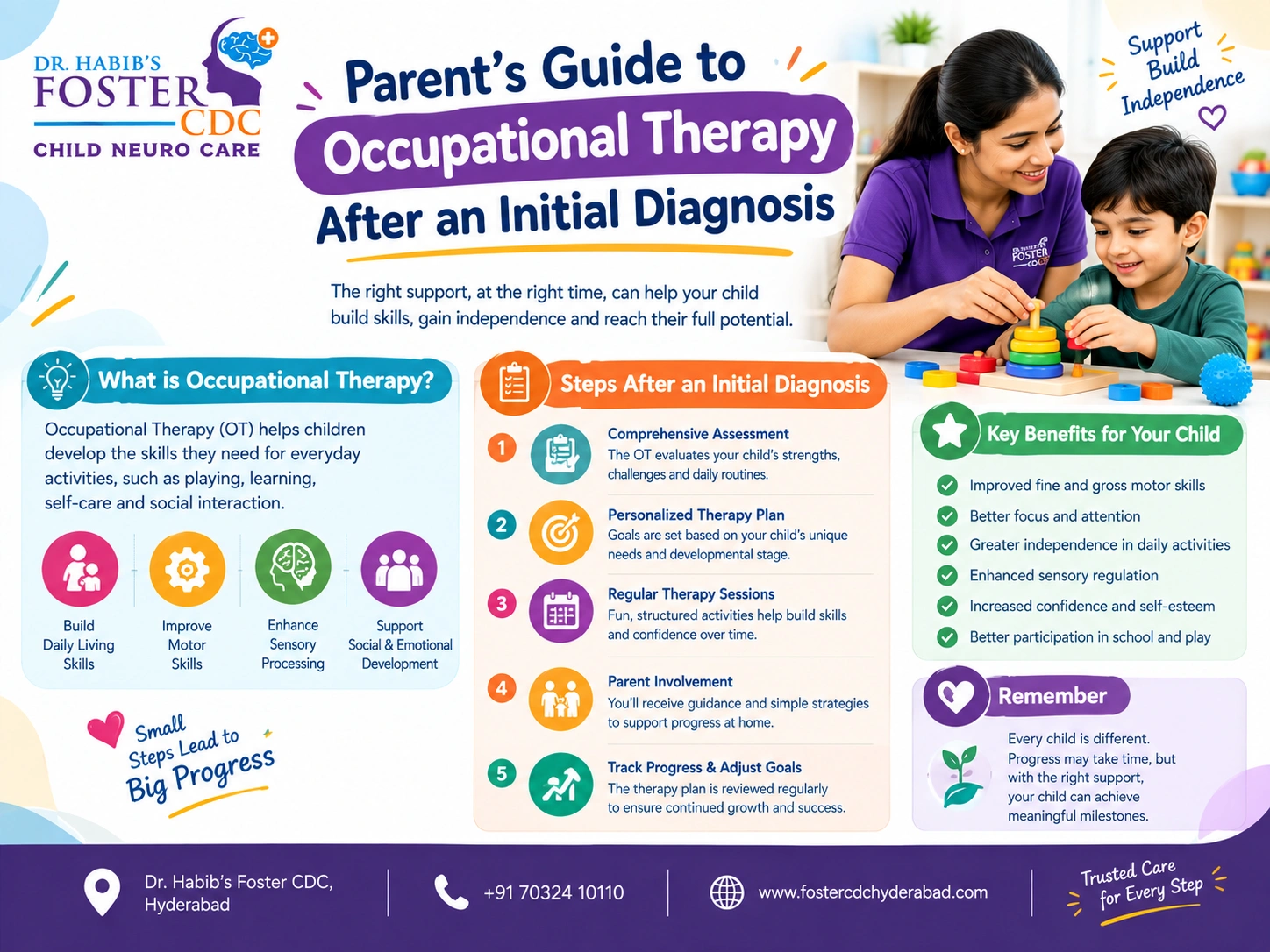
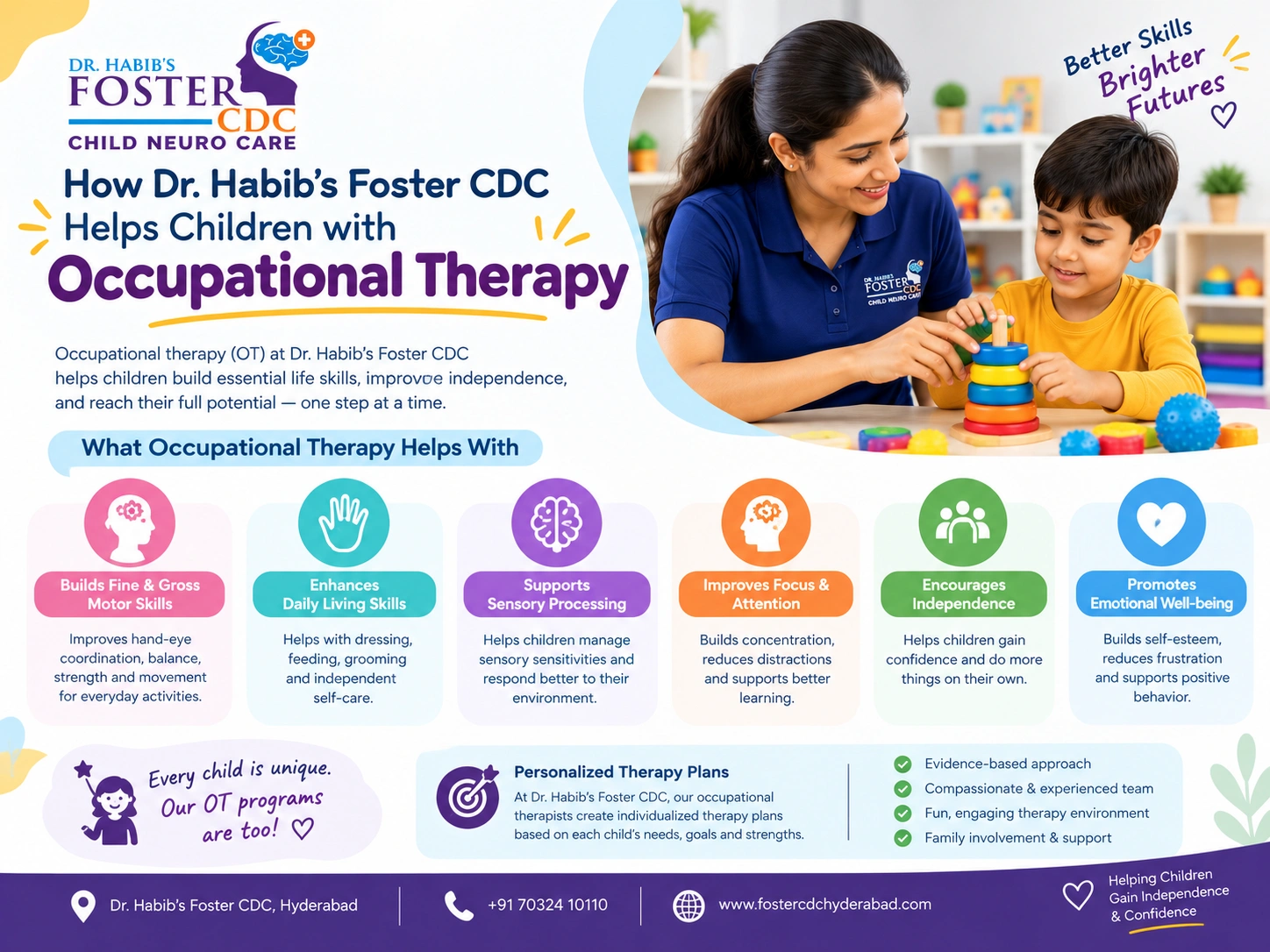
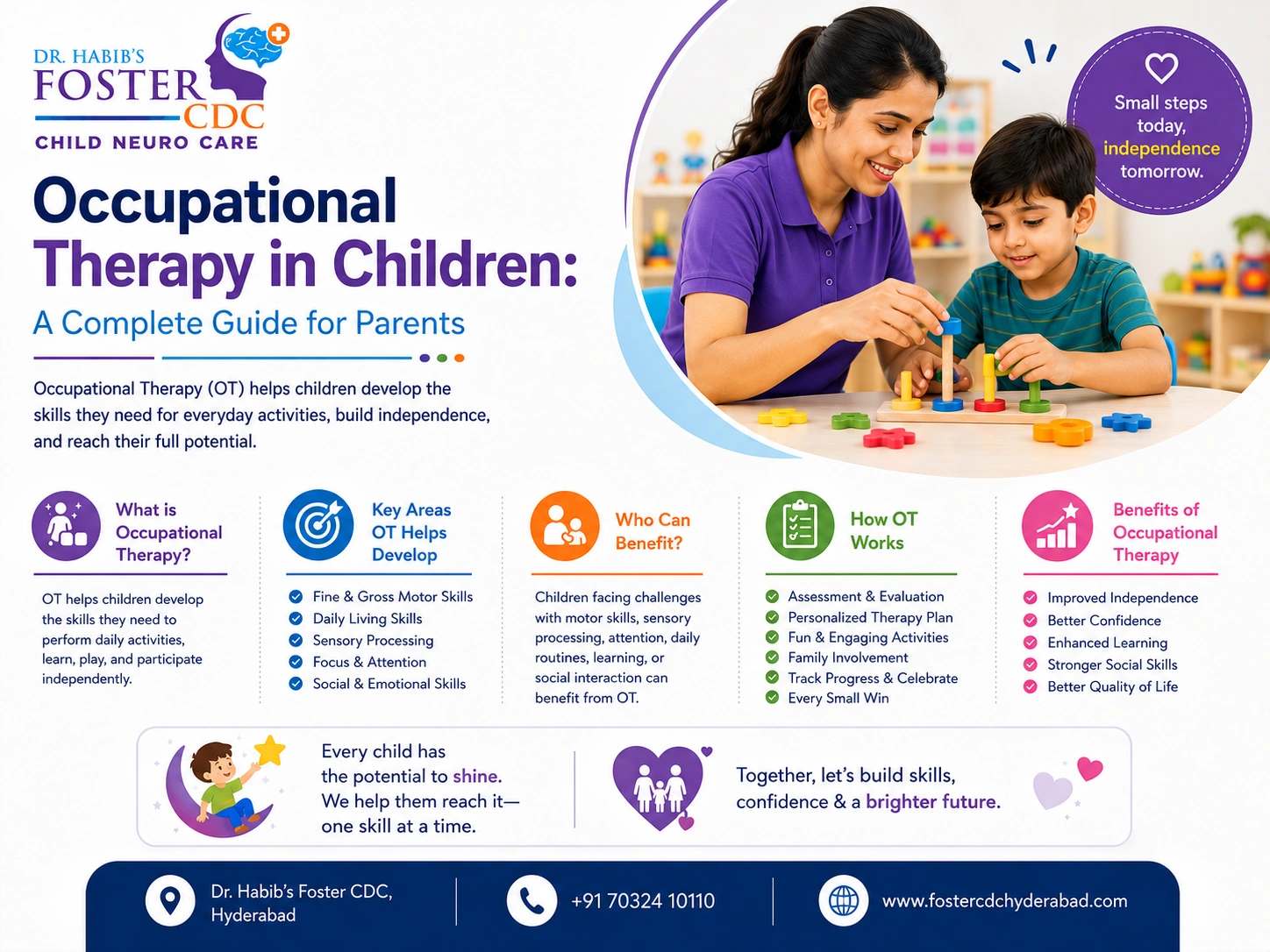
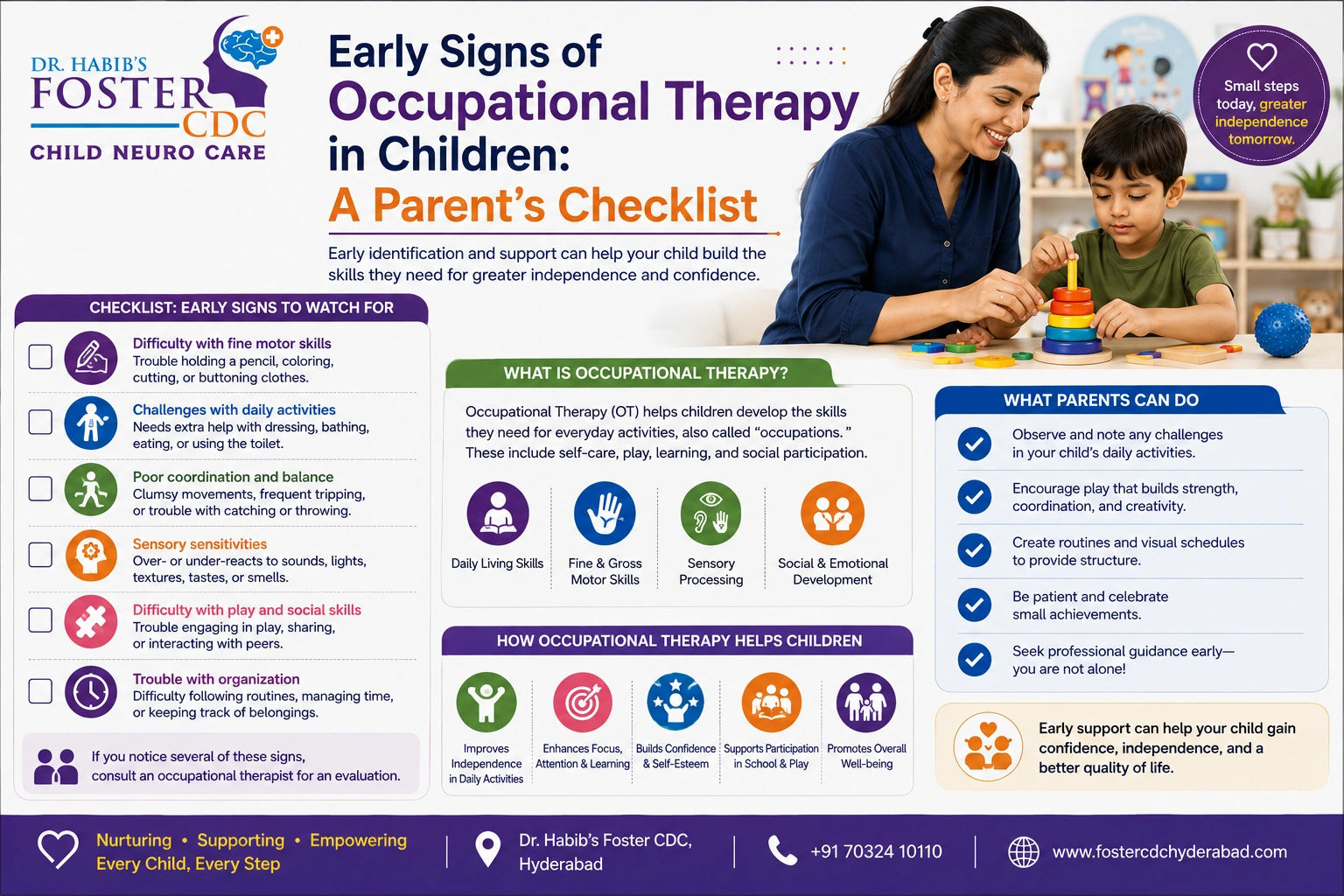
Occupational therapy for children is not about "jobs" or "occupations" in the adult sense. In pediatric care, a child's "occupation" is simply what they need and want to do every day: play, eat, get dressed, write, run, climb, and interact with others. A pediatric occupational therapist evaluates how a child processes sensory information, coordinates movement, and performs daily tasks, then builds a targeted plan — often including sensory integration therapy, fine motor skills activities, and functional skill-building — to help the child participate more fully at home, at school, and in play.
Globally recognized bodies such as the World Health Organization (WHO), the American Academy of Pediatrics (AAP), and the American Speech-Language-Hearing Association (ASHA) all emphasize the same core principle: early identification and early intervention for developmental concerns lead to significantly better long-term outcomes than a "wait and watch" approach. That single point is where most of the myths below start to fall apart.
Myth 1: "Occupational Therapy Is Only for Children with Autism"
Fact: OT supports a wide range of children — not just those on the autism spectrum.
This is probably the most common misconception we encounter at Foster CDC. While occupational therapy is indeed a core part of autism intervention, it is equally valuable for children with:
Attention-deficit/hyperactivity disorder (ADHD)
Developmental coordination disorder (clumsiness beyond the norm)
Cerebral palsy and other motor impairments
Down syndrome and other genetic conditions
Learning difficulties affecting handwriting or classroom participation
Sensory processing differences with no other diagnosis at all
Premature birth history with developmental delays
Simple delays in fine motor or self-care skills, even in typically developing children
If your child struggles to hold a pencil, gets overwhelmed by loud environments, avoids certain textures of food or clothing, or seems "behind" their peers in coordination, that alone is reason enough to get an OT assessment — regardless of whether any other diagnosis is present or suspected.
Myth 2: "My Child Will Simply Grow Out of It"
Fact: Some delays resolve on their own; many do not, and waiting can cost precious developmental time.
It's true that children develop at different paces, and not every quirk needs treatment. But there's an important difference between normal variation and a genuine developmental delay. The challenge is that parents — and even well-meaning pediatricians without developmental training — often can't tell the difference without a proper assessment.
The AAP recommends that children be screened for developmental delays at regular well-child visits, specifically because early brain development (particularly in the first five years) offers a window of neuroplasticity where intervention is most effective. Delaying assessment on the assumption that a child will "catch up" means potentially missing the period when therapy delivers the greatest impact.
A helpful rule of thumb: if a delay is affecting your child's ability to participate in daily life — play, feeding, school readiness, social interaction — it's worth an evaluation rather than an indefinite wait.
Myth 3: "Occupational Therapy Is the Same as Physiotherapy"
Fact: The two professions overlap but target different goals.
This confusion is understandable since both are movement-based therapies, but their focus is different:
In many cases, particularly for children with cerebral palsy, developmental delays, or complex conditions, OT and PT are used together as complementary parts of the same overall plan — not as substitutes for one another.
Myth 4: "Therapy Only Works If the Child Is Very Young"
Fact: Early intervention is ideal, but OT can meaningfully help children well beyond the toddler years.
While it's accurate that intervention in the early years (particularly 0–6) tends to produce the most dramatic gains due to the brain's plasticity at that age, this doesn't mean therapy becomes pointless afterward. School-age children and even adolescents benefit from occupational therapy for issues like handwriting difficulties, organizational skills, sensory regulation, and social participation. The right time to start OT is when a concern is identified — not a fixed birthday.
Myth 5: "If the Teacher Hasn't Flagged a Problem, There Isn't One"
Fact: Teachers are valuable observers, but they are not trained to diagnose developmental or sensory processing concerns.
Classroom teachers manage 20–40 children at a time and are focused primarily on academic performance and behavior management, not developmental screening. A child who is quietly struggling — avoiding handwriting tasks, becoming overwhelmed during group activities, or withdrawing during noisy transitions — can easily go unnoticed in a classroom setting, especially if they aren't disruptive. Parental observations at home (mealtimes, dressing, play, sibling interactions) are often the first and most reliable indicators of a sensory or motor concern.
Myth 6: "Occupational Therapy Is Just Play — It Won't Really Change Anything"
Fact: OT sessions look playful because play is the primary "language" through which young children learn, but every activity is clinically structured.
A session that looks like swinging, building with blocks, or playing with textured materials is, in reality, carefully designed sensory integration therapy targeting specific neurological and motor goals — improving balance, body awareness, attention regulation, or tactile tolerance. ASHA and pediatric OT bodies consistently point to structured, evidence-based play as one of the most effective therapeutic tools available for this age group, precisely because it keeps children engaged long enough for real neurological change to occur.
Myth 7: "A Formal Diagnosis Is Required Before Starting OT"
Fact: You do not need a diagnosis to begin an occupational therapy assessment.
Many parents delay seeking help because they're waiting for a psychiatrist or specialist to formally label their child's condition first. In reality, an occupational therapist can conduct a functional assessment based on observed skills and challenges, and begin intervention where appropriate — often in parallel with the diagnostic process, not after it. Waiting for a label before acting on a visible functional concern only delays support the child could already be receiving.
Myth 8: "Once Therapy Starts, It Will Continue Forever"
Fact: OT is typically goal-based and time-limited, with progress reviewed regularly.
At Foster CDC, every child's OT plan includes specific, measurable goals — for example, independently using a spoon, tolerating a haircut, or holding a pencil with a mature grip. Progress is reviewed periodically, and therapy is adjusted, stepped down, or concluded as goals are met. Long-term therapy is sometimes appropriate for children with complex or lifelong conditions, but it is never a default — it is a decision based on the child's individual needs and progress.
When Should You Consider an Occupational Therapy Assessment?
Some common early signs parents in Hyderabad bring to our attention include:
Difficulty with age-appropriate fine motor tasks (holding a spoon, crayon, buttons, zippers)
Extreme reactions to textures, sounds, lights, or certain clothing/food
Delayed milestones in sitting, crawling, walking, or hand dominance
Poor balance or frequent clumsiness compared to peers
Trouble with attention, transitions, or self-regulation
Avoidance of playground equipment or group play
Messy or illegible handwriting well past the expected age
Difficulty with self-care tasks like dressing, brushing teeth, or using cutlery
None of these signs alone confirms a diagnosis — but any combination is a reasonable basis to seek a professional developmental assessment rather than waiting.
How Foster CDC Approaches Occupational Therapy
At Dr. Habib's Foster CDC, every child begins with a comprehensive developmental assessment conducted by our multidisciplinary team, not a one-size-fits-all screening. Based on the findings, we design an individualized therapy plan that may combine sensory integration therapy, fine motor skill-building, and functional daily-living training, with clear, trackable goals and regular progress reviews shared with parents. Our approach is rooted in a family-centered model: parents are trained alongside their child so that progress made in the therapy room carries over into daily life at home.
Final Thoughts
Misinformation is often the biggest barrier standing between a child and the help they need — not the therapy itself. If your child shows any of the signs discussed above, the most useful next step isn't searching for more opinions online; it's a proper developmental assessment from a qualified pediatric team.
Concerned about your child's development? Book an assessment with Dr. Habib's Foster CDC today and get clarity from Hyderabad's trusted child development centre.
Frequently Asked Questions
1. At what age should a child start occupational therapy if delays are suspected? There is no minimum age. OT can begin in infancy if concerns are identified, and remains beneficial through the school-age years and adolescence.
2. Does my child need a doctor's referral for an OT assessment? While a pediatrician's referral can be helpful for context, most occupational therapists can conduct an initial assessment directly based on a parent's concerns.
3. How long does a typical occupational therapy program last? This varies by child and goals — some children need a few months of focused sessions, while others with complex or lifelong conditions may need ongoing, periodically reviewed support.
4. Is occupational therapy only for children with a formal diagnosis like autism or ADHD? No. Many children receive OT purely for functional delays — such as fine motor difficulties or sensory sensitivities — with no other diagnosis present.
5. What is the difference between occupational therapy and sensory integration therapy? Sensory integration therapy is a specific therapeutic approach often used within occupational therapy sessions; it is not a separate, standalone service.
6. Can occupational therapy help with handwriting problems in school-age children? Yes. Handwriting difficulties are one of the most common reasons school-age children are referred for OT, and are usually highly responsive to targeted intervention.
Dr. Habib G Pathan is a Developmental Pediatrician at Dr. Habib's Foster CDC, Hyderabad, specializing in early childhood developmental assessment and intervention.
Other Blogs


Services
- Behavioural Therapy
- Speech Therapy
- Special Education
- Parent Training
- Psychotherapy & Counselling
- Yoga Therapy
- Postural & Mobility Therapy
- Early Intervention Services
- Cognitive Behavioural Therapy
- Occupational Therapy
- Group Teaching
- Teachers' Training
- Certified Courses
- Developmental Therapy
- Autism Therapy