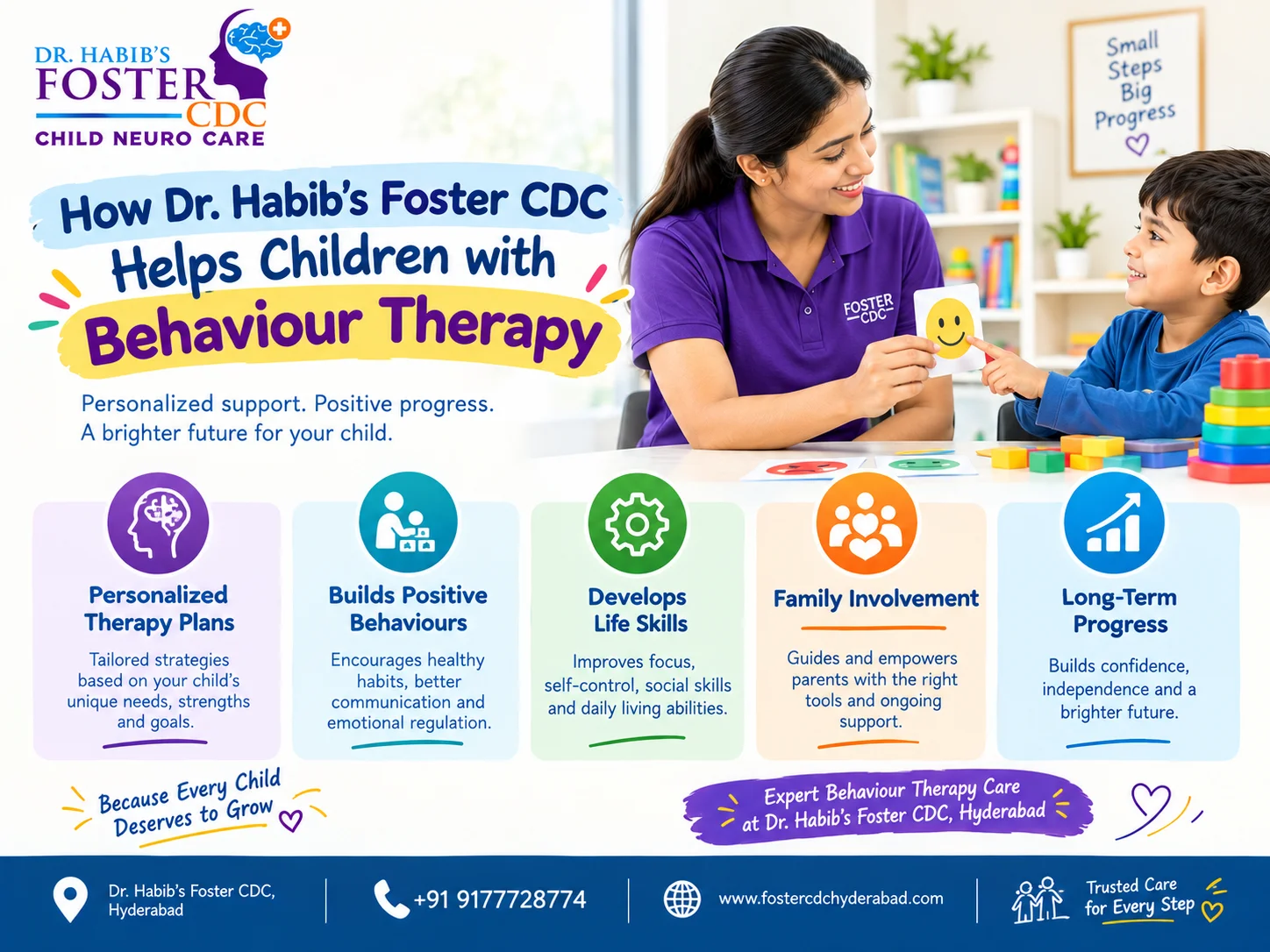
How Dr. Habib's Foster CDC Helps Children with Behaviour Therapy
A recent diagnosis or a pediatrician's referral often leaves parents with a name for what's going on — but very little sense of what actually happens next, or what getting help is supposed to look like in practice. If you're at that stage right now, this article walks through exactly how we approach behaviour therapy at Foster CDC: what makes our process different from a generic program, what a family can expect session by session, and why the details of how therapy is delivered matter just as much as whether a child receives it at all.
Why the "How" Matters as Much as the "What"
It's easy to assume that behaviour therapy is behaviour therapy — that once a child starts sessions, progress will follow more or less automatically. In reality, outcomes vary significantly based on how a program is structured: whether it's built around an individualized assessment or a generic template, whether parents are trained and involved or left outside the room, and whether progress is tracked with real data or just general impressions.
Guidance from the American Academy of Pediatrics and the World Health Organization consistently points to the same factors as drivers of good outcomes in child behavioural intervention: early start, individualized planning, consistent implementation across settings, and active family involvement. Our approach at Foster CDC is built directly around those four pillars — not as a slogan, but as the actual structure of how we work with every family who comes through our doors.
Step One: A Real Assessment, Not a Template
Every child who comes to Foster CDC for behaviour therapy begins with a comprehensive developmental and behavioural assessment — never a pre-set package assigned based on a diagnosis label alone. This typically includes:
- Structured observation of the child during play, structured tasks, and transitions
- Functional behaviour analysis to identify what's triggering specific behaviours and what's reinforcing them
- Parent interviews, since you know your child's patterns across settings far better than any single clinic visit can reveal
- Review of developmental history and any prior diagnoses or evaluations, so therapy builds on — rather than repeats — work already done
This matters because two children with the same diagnosis can have completely different behavioural profiles, triggers, and needs. A plan built on a real assessment targets what's actually happening with your child, not a generic version of the diagnosis.
Step Two: An Individualized, Measurable Plan
From the assessment, our team builds a treatment plan with specific, measurable goals — not vague aims like "reduce tantrums" but concrete, trackable targets such as "follows a two-step instruction independently in 8 of 10 attempts" or "transitions between activities without escalation." Depending on what the assessment reveals, this plan may draw on ABA-informed strategies, parent-child interaction coaching, social skills training, or a combination, always matched to the child's specific needs rather than applied as a fixed package.
What a Session at Foster CDC Actually Looks Like
| Element | What Happens | Why It's Structured This Way |
|---|---|---|
| Session format | 45–60 minute individual sessions, frequency based on assessed need | Allows enough time for meaningful practice without overwhelming the child |
| Activities | Structured play, guided practice, real-time behavioural coaching | Children learn regulation and social skills more effectively through applied practice than instruction alone |
| Therapist approach | Consistent, trained clinicians who track data within each session | Enables objective progress measurement, not just subjective impressions |
| Parent role | Active training and coaching, not passive observation | Behaviour change holds best when strategies carry over consistently into daily routines |
| Coordination | Communication with speech-language and occupational therapy colleagues when relevant | Behavioural concerns often overlap with communication or sensory needs — isolated treatment misses the full picture |
| Progress review | Formal review every 4–8 weeks, shared directly with parents | Keeps the plan responsive rather than static, and keeps you informed at every stage |
Why Parent Involvement Is Built In, Not Optional
One of the most consistent findings in child behaviour therapy research is that progress made in a clinic session rarely holds on its own — it needs to be reinforced in the environments where the child actually spends most of their time: home, school, with extended family. That's why our programs actively train parents in the same strategies our therapists use, rather than treating therapy as something that happens exclusively behind a clinic door.
In practice, this means you'll leave sessions not just with an update, but with specific, workable strategies for situations you're actually facing — the morning routine that always ends in a meltdown, the sibling conflict that escalates every evening, the transition out of screen time that never goes smoothly. Small, consistent wins in these everyday moments compound far more effectively than occasional clinic-only progress.
Coordinated Care, Not Siloed Therapy
Behavioural concerns rarely exist in isolation. A child struggling with frequent meltdowns might also have underlying communication gaps that make frustration harder to express appropriately; a child with difficulty following instructions might also have sensory sensitivities that make certain environments genuinely harder to cope with. At Foster CDC, our behaviour-focused clinicians work alongside colleagues in speech-language therapy and occupational therapy, so when a child's profile points to overlapping needs, that coordination happens within the same team rather than across separate, disconnected providers you'd otherwise have to manage yourself.
Setting Honest Expectations
We don't promise fixed timelines for "fixing" a behaviour, and we'd encourage you to be cautious of any provider who does. What we do commit to is a transparent, structured process: a real assessment, clear goals, regular data-driven reviews, and honest conversations about what's working and what needs to change. Some families see meaningful shifts in targeted behaviours within a few months; others, particularly where more complex or longstanding patterns are involved, need longer-term, periodically reviewed support. Either way, you'll always know exactly where your child stands and why the plan looks the way it does.
If You're Just Starting This Process
If you're newly navigating a diagnosis and trying to work out what questions to even ask, our early signs checklist and our complete guide to behaviour therapy approaches are useful companion reads — the first helps you recognize what's worth raising with a professional, and the second walks through the different treatment approaches (ABA, CBT, PCIT, and others) in more depth, so you can have an informed conversation when you do come in for an assessment.
Final Thoughts
A diagnosis or referral is the starting point, not the plan itself — and the structure of what comes next genuinely shapes how much progress your child makes. At Foster CDC, that structure is built around real assessment, individualized goals, active parent involvement, and coordinated care, because that's what the evidence consistently shows works.
Ready to see what a plan built specifically for your child looks like? Book an assessment with Dr. Habib's Foster CDC and take the next step with a clear, professional picture of what support can look like.
Frequently Asked Questions
1. Do I need a formal diagnosis before starting behaviour therapy at Foster CDC? No. While many families come to us after a diagnosis, we also work with children based purely on a functional behavioural assessment, with or without a formal diagnosis already in place.
2. How soon after a diagnosis can my child start behaviour therapy? As soon as an assessment can be scheduled — there's no required waiting period, and earlier intervention is generally associated with better outcomes.
3. Will I be involved in my child's behaviour therapy sessions? Yes. Parent training and coaching are a built-in part of our approach, since consistency between sessions and daily life is one of the strongest predictors of progress.
4. Does Foster CDC coordinate with other specialists my child may be seeing? Yes. Our behaviour therapy team works alongside our speech-language and occupational therapy colleagues, and we're also happy to coordinate with your child's pediatrician or other external specialists.
5. How is progress tracked during behaviour therapy at Foster CDC? We track specific, measurable target behaviours session by session and conduct formal progress reviews every 4–8 weeks, with results shared directly with parents.
6. What happens if my child isn't making expected progress? We reassess and adjust the plan — a lack of expected progress is information that reshapes the approach, not a reason to simply continue unchanged.
Dr. Habib G Pathan is a Developmental Pediatrician at Dr. Habib's Foster CDC, Hyderabad, specializing in early childhood developmental assessment and intervention.
Other Blogs




Services
- Behavioural Therapy
- Speech Therapy
- Special Education
- Parent Training
- Psychotherapy & Counselling
- Yoga Therapy
- Postural & Mobility Therapy
- Early Intervention Services
- Cognitive Behavioural Therapy
- Occupational Therapy
- Group Teaching
- Teachers' Training
- Certified Courses
- Developmental Therapy
- Autism Therapy