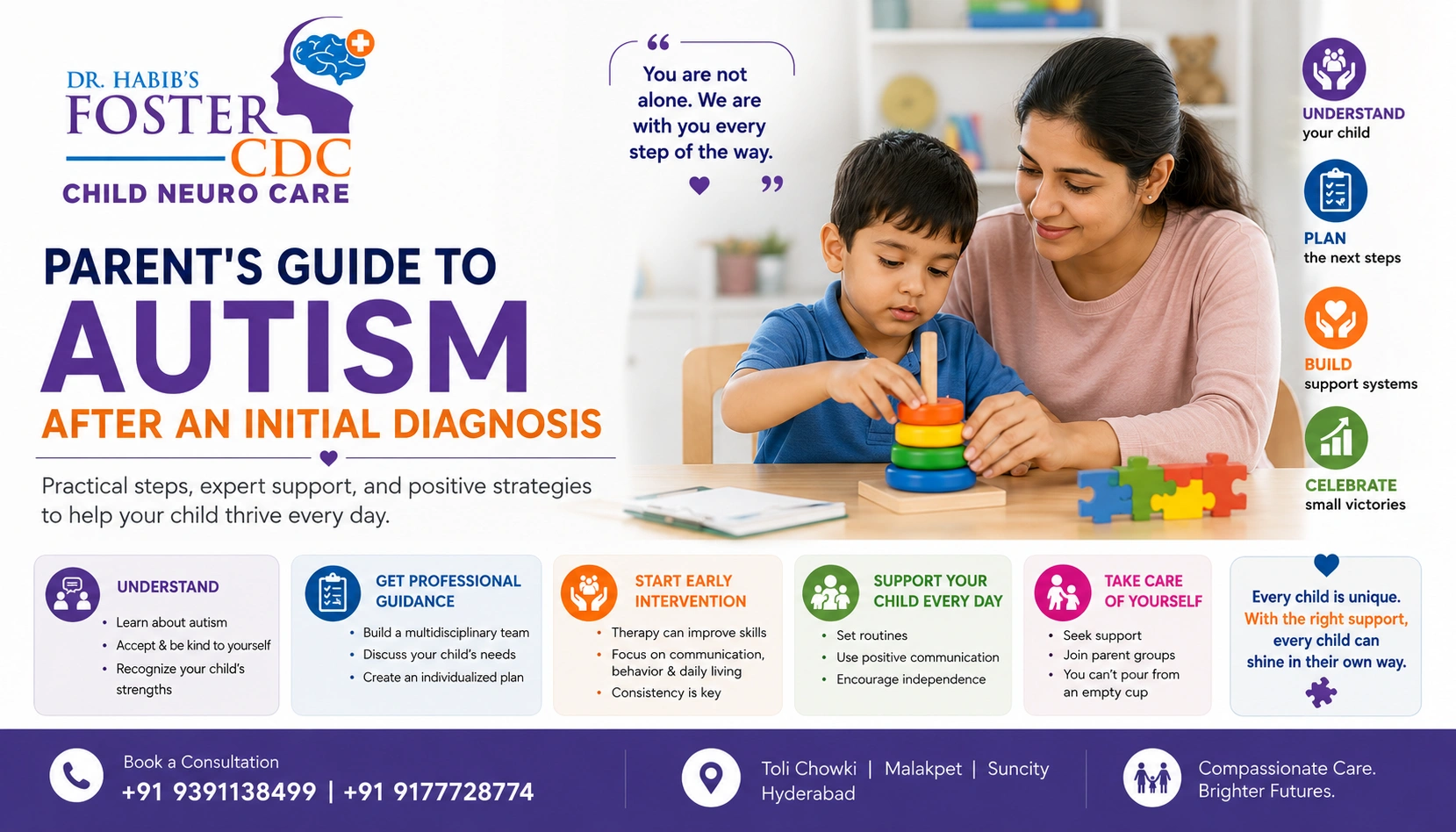
Parent's Guide to Autism After an Initial Diagnosis
Hearing that your child has autism can feel like the ground has shifted beneath you — even if you suspected it. Between processing your own emotions and figuring out what comes next, an autism diagnosis in Hyderabad can leave parents with more questions than answers. This guide is here to help you take a breath and understand exactly what the next steps look like, one at a time.
At Dr. Habib's Foster CDC, guided by Dr. Habib G Pathan, Developmental Pediatrician, we walk alongside families in these first difficult weeks. This guide reflects that experience — but it isn't a substitute for personalized medical guidance from your child's care team.
Quick Answers
What should I do right after my child is diagnosed with autism?
Start by giving yourself time to process the news, then request a referral for a comprehensive developmental evaluation if you haven't already had one, and begin researching therapy options like speech and occupational therapy.
Is it normal to feel overwhelmed after an autism diagnosis?
Yes. Most parents experience a mix of grief, relief, confusion, and worry — sometimes all at once. These feelings are a normal part of adjusting to new information about your child.
How soon should therapy start after diagnosis?
Ideally, therapy should begin as soon as possible. Early, consistent intervention during the toddler and preschool years is associated with stronger long-term communication and social outcomes.
Will my child need therapy forever?
Not necessarily. Therapy intensity often changes over time — some children need long-term, ongoing support, while others transition to lighter, maintenance-level care as skills develop.
How do I explain the diagnosis to family members?
Focus on simple, factual language: autism affects how your child communicates and processes the world, and with support, your child can continue to grow and thrive. You don't owe anyone a lengthy explanation before you're ready.
Can my child still live a full, happy life with autism?
Yes. With the right support, many autistic children build strong communication skills, meaningful relationships, and independence over time.
Your Emotional Response Is Valid
Before anything else — however you're feeling right now is okay. Some parents feel a sense of relief that finally explains behaviors they'd noticed for a while. Others feel grief, fear, or even guilt. Many feel all of these at different moments in the same week. None of these reactions mean you're not equipped to support your child. They mean you're human.
Give yourself permission to process this at your own pace, while still taking practical next steps alongside it.
What Happens After an Autism Diagnosis?
1. Understand the Diagnosis Details
Ask your developmental pediatrician to walk you through exactly what was assessed, what level of support your child may need, and what specific strengths and challenges were identified.
2. Build a Care Team
Autism support typically involves more than one specialist. A well-rounded care team often includes:
3. Start Therapy Early
Once you understand your child's specific needs, begin exploring autism therapy in Hyderabad options that match those needs — rather than choosing a generic program.
4. Learn What to Expect at First Sessions
It's normal for children to feel unsure during early therapy visits. Our guide on preparing your child for their first therapy session can help ease that transition for both of you.
5. Connect with Other Parents
Talking to other families who've been through a similar diagnosis can reduce feelings of isolation and offer practical, real-world insight you won't find in a pamphlet.
A Simple Roadmap: First 30, 60, and 90 Days
First 30 Days
Process the diagnosis at your own pace
Ask your pediatrician detailed questions about your child's specific profile
Begin researching therapy options and specialists in your area
Avoid major decisions made purely out of panic
Next 30 Days (Day 31–60)
Start therapy sessions based on your child's individualized plan
Set up a consistent daily routine at home to support therapy goals
Begin learning practical strategies from your therapy team to reinforce progress
Following 30 Days (Day 61–90)
Review early progress with your therapy team
Adjust routines or therapy focus areas based on what's working
Start building a support network — other parents, extended family, or support groups
Common Mistakes Parents Make Early On
Waiting too long to start therapy while researching the "perfect" option
Trying to manage everything alone instead of building a support team
Comparing their child's progress to another child's timeline
Making major decisions in the first few days while still processing emotions
Avoiding conversations with family out of fear of judgment
Do's and Don'ts After a Diagnosis
Do:
Ask your care team as many questions as you need to
Start therapy as early as realistically possible
Involve yourself actively in home-based reinforcement activities
Take care of your own emotional wellbeing too
Don't:
Blame yourself — autism is not caused by parenting
Wait for "certainty" before seeking support
Isolate yourself from family, friends, or parent communities
Expect immediate, dramatic changes in the first few weeks
Myths New Parents Often Believe
Key Takeaways
The first few weeks after an autism diagnosis in Hyderabad are emotionally significant — give yourself space to process while still taking practical steps.
Building a multidisciplinary care team early helps ensure your child gets well-rounded, individualized support.
Starting therapy sooner rather than later is linked to stronger long-term outcomes, but progress takes consistent time.
Connecting with other parents and support networks can make the journey feel far less isolating.
For more on daily life with a diagnosis, see our guide on parenting a child with special needs.
Frequently Asked Questions
1. What should be my very first step after my child is diagnosed with autism? Take time to understand your child's specific evaluation results, then begin researching developmental therapy options suited to their needs, starting with your developmental pediatrician's recommendations.
2. Is it normal to feel grief after an autism diagnosis? Yes, many parents experience grief for the expectations they had, alongside other emotions like relief or worry. These feelings are a normal part of adjusting, not a reflection of how well you'll support your child.
3. How do I choose the right therapy team in Hyderabad? Look for a multidisciplinary approach, individualized assessment-based planning, transparent progress tracking, and a team that actively involves parents in the process.
4. Should I tell my child about their diagnosis? This depends on your child's age and understanding level. Many families introduce age-appropriate language over time rather than a single conversation; your care team can guide this based on your child's needs.
5. How do I talk to grandparents or extended family about the diagnosis? Keep it simple and factual: explain that autism affects communication and social processing, and that with support, your child will continue to grow and develop. You can share more detail over time as needed.
6. Will my child need to attend a special school? Not necessarily. Many autistic children attend mainstream schools with additional support, while others benefit from specialized educational settings — this depends on individual needs.
7. How often should therapy sessions happen initially? This varies by child and severity, ranging from a few sessions a week to more intensive schedules. Your developmental pediatrician and therapy team will recommend an appropriate starting point.
8. What if I disagree with parts of the diagnosis or recommended plan? It's completely reasonable to ask for clarification, request a second opinion, or discuss your concerns directly with your care team — being an informed, involved parent is part of good care.
9. How do I balance therapy schedules with normal family life? Start with a realistic, sustainable routine rather than an overly ambitious one. Many families gradually build therapy into daily life rather than treating it as separate from everything else.
10. Where can I find support as a new autism parent in Hyderabad? Many child development centres, including Foster CDC, connect families with parent support networks, in addition to clinical therapy services — don't hesitate to ask your care team for these resources.
Conclusion
An autism diagnosis in Hyderabad is the beginning of a new chapter, not the end of the one you'd imagined — and it's normal for that to feel overwhelming at first. With a clear understanding of your child's needs, a strong care team, and steady, consistent support, most families find their footing over time, often faster than they expected.
If you've recently received a diagnosis and aren't sure where to start, book an assessment with Dr. Habib's Foster CDC in Hyderabad, and let an experienced team help you build a clear, personalized path forward.
This article is for informational purposes only and is not a substitute for professional medical evaluation. Please consult a qualified developmental pediatrician for concerns about your child's development. For further reading, see resources from the World Health Organization (WHO), the American Academy of Pediatrics (AAP), and the American Speech-Language-Hearing Association (ASHA).
Other Blogs

Services
- Behavioural Therapy
- Speech Therapy
- Special Education
- Parent Training
- Psychotherapy & Counselling
- Yoga Therapy
- Postural & Mobility Therapy
- Early Intervention Services
- Cognitive Behavioural Therapy
- Occupational Therapy
- Group Teaching
- Teachers' Training
- Certified Courses
- Developmental Therapy
- Autism Therapy