Speech Therapy for Kids: What Parents Need to Know
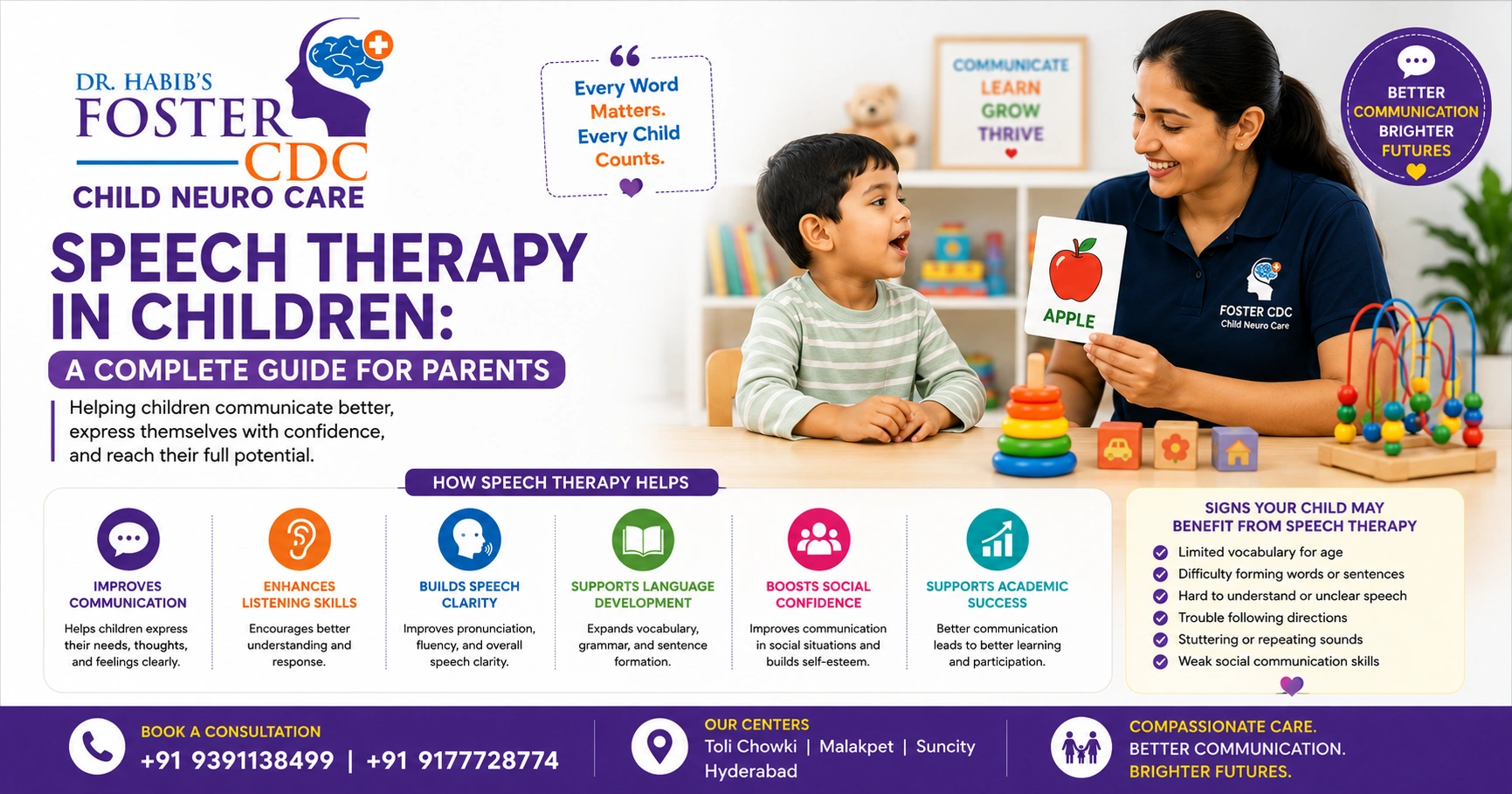
If you've already recognized signs of speech delay in toddlers and started researching options, you're likely past the "is this normal?" stage and into a more practical one: how does speech therapy actually work, and how do I choose the right centre for my child? This complete guide covers everything from therapy techniques to what to look for when comparing providers, so you can move forward with confidence.
At Dr. Habib's Foster CDC, guided by Dr. Habib G Pathan, Developmental Pediatrician, we work with families at exactly this stage — ready to act, but wanting to understand the process first. This guide reflects that clinical experience, but it isn't a substitute for a professional evaluation.
Quick Answers
What is speech therapy for children?
Speech therapy is a structured, individualized intervention delivered by a licensed speech-language pathologist to help children develop clearer speech, stronger language skills, and more effective communication.
How do I know if my child needs speech therapy?
Signs include limited vocabulary for their age, unclear speech that's hard to understand, difficulty forming sentences, and frustration when trying to communicate — a formal evaluation confirms the specific need.
What techniques are used in speech therapy?
Common techniques include articulation practice, language modeling, play-based communication activities, oral-motor exercises, and augmentative communication tools for children with more significant needs.
How long does speech therapy usually take?
This varies widely by child and severity — some children show meaningful progress within months, while others need longer-term, ongoing support through early school years.
How do I choose a speech therapist near me?
Look for a licensed speech-language pathologist, a centre that conducts a thorough initial evaluation, clear progress tracking, and an approach tailored to your child rather than a one-size-fits-all program.
Is speech therapy covered by insurance in India?
Coverage varies significantly by provider and policy. It's best to check directly with your insurance provider and the therapy centre about billing and coverage options.
What Is Speech Therapy?
Speech therapy addresses two connected but distinct areas: speech (how sounds and words are physically produced) and language (how words and grammar are used to communicate meaning). A speech-language pathologist assesses both, since a child might struggle with one, the other, or both.
Speech therapy isn't only about "talking more" — it also covers understanding language, social communication, and, for some children, alternative communication methods when spoken language is significantly delayed.
Common Techniques Used in Speech Therapy
Articulation Therapy
Focuses on correcting specific sound errors through targeted practice, often using games and repetition suited to the child's age.
Language Intervention
Builds vocabulary, sentence structure, and comprehension through modeling, storytelling, and structured conversation practice.
Oral-Motor Exercises
Strengthens the muscles used for speech production, particularly helpful for children with coordination-related speech difficulties.
Play-Based Therapy
Uses toys, games, and everyday activities to encourage natural communication in a low-pressure setting — especially effective for younger children.
Augmentative and Alternative Communication (AAC)
For children with more significant communication challenges, AAC tools like picture boards or communication devices support expression alongside or instead of spoken language.
Comparison Table: Speech Therapy Techniques
How a Speech Therapy Evaluation Works
Initial consultation — Discussing developmental history and specific concerns with the therapy team.
Formal assessment — Standardized tools evaluate vocabulary, sentence structure, clarity, and comprehension.
Hearing screening — Often included to rule out hearing-related causes of delay.
Individualized therapy plan — Goals and techniques are selected based on the child's specific profile.
Regular progress reviews — Plans are adjusted as the child develops new skills.
What Causes Speech Delay in Toddlers?
Speech delay rarely has a single cause. Common contributing factors include:
Hearing difficulties, even mild or undetected cases
Oral-motor coordination challenges
Developmental differences, sometimes alongside conditions like autism
Limited language exposure or interaction, though this is less common than assumed
Bilingual environments, which may temporarily affect vocabulary size per language without indicating a true delay
A formal evaluation is the most reliable way to identify what's contributing to your child's specific delay.
How to Choose a Speech Therapy Centre in Hyderabad
What to Look For
Licensed, experienced speech-language pathologists
A thorough initial evaluation rather than a quick screening
Clear, measurable progress goals shared with parents
Individualized therapy plans rather than fixed programs
Active parent involvement and take-home strategies
Questions to Ask Before Choosing
How do you evaluate a child before starting therapy?
How do you measure and communicate progress?
What does a typical session structure look like?
How are parents involved between sessions?
How do you adjust the plan if progress is slower than expected?
Myths vs Facts About Speech Therapy
Do's and Don'ts When Starting Speech Therapy
Do:
Ask for a detailed explanation of your child's evaluation results
Request clear, specific progress goals from the therapy team
Practice simple communication strategies at home between sessions
Stay patient — progress is often gradual, not immediate
Don't:
Choose a centre based on marketing claims alone
Expect dramatic changes within the first few sessions
Skip the formal evaluation step to save time
Compare your child's pace too strictly to other children's progress
What Progress Typically Looks Like
Progress in speech therapy is rarely linear. Early sessions often focus on building comfort and rapport before measurable language gains appear. Most families begin noticing small, specific improvements — like new words or clearer sounds — within the first few months, with broader communication gains building steadily over time with consistency.
Key Takeaways
Speech therapy addresses both speech production and language use, often through a combination of techniques suited to the child.
Speech delay in toddlers has multiple possible causes, which is why a formal evaluation matters more than guesswork.
Choosing the right centre means looking beyond marketing — ask about evaluation depth, individualization, and progress tracking.
Progress typically builds gradually, and consistency matters more than intensity alone.
For related guidance, see our comparison of speech therapy vs. occupational therapy and our overview of speech therapy in Hyderabad.
Frequently Asked Questions
1. What's the difference between speech delay and a speech disorder?
Speech delay generally means development is following the typical pattern but at a slower pace, while a speech disorder involves atypical patterns, such as specific sound errors or apraxia, that need targeted intervention.
2. Can speech therapy help children who are completely non-verbal?
Yes. Speech therapy for non-verbal children often incorporates augmentative and alternative communication (AAC) tools alongside efforts to build spoken language where possible.
3. How often should speech therapy sessions happen?
This depends on the child's needs and severity of delay, ranging from once a week to more frequent sessions — your speech-language pathologist will recommend an appropriate schedule.
4. Is early intervention really more effective than starting later?
Research generally supports starting speech therapy as early as possible, since foundational communication skills are easier to build during toddler and preschool years, though therapy can still help older children.
5. Can I do speech therapy exercises with my child at home?
Yes, many therapists provide take-home strategies to reinforce sessions, but these should complement, not replace, professional guidance from a licensed speech-language pathologist.
6. Does speech therapy help with stuttering too?
Yes. Speech-language pathologists are trained to address stuttering using specific strategies distinct from those used for articulation or language delays.
7. What should I expect at my child's first speech therapy evaluation?
Expect a discussion of developmental history, direct observation or play-based interaction with your child, and standardized assessments of speech and language skills.
8. How is progress measured in speech therapy?
Progress is typically tracked against specific, individualized goals — such as vocabulary growth, sentence complexity, or sound accuracy — reviewed regularly by the therapy team.
9. Can speech therapy be combined with other therapies like occupational therapy?
Yes, many children benefit from a combined approach, especially when communication difficulties overlap with sensory or motor challenges.
10. What if my child isn't making progress after a few months of therapy?
Other Blogs

Services

Special School for Kids with vocational courses & therapies coming soon...